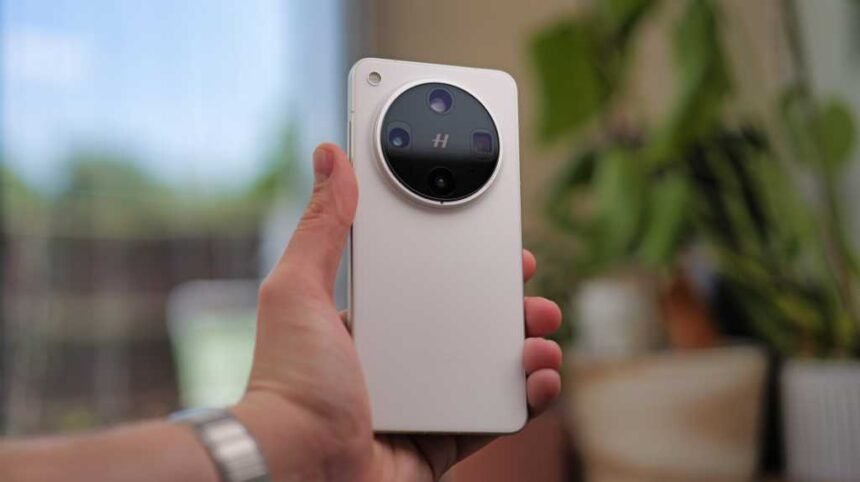
The phone’s camera hardware sets it apart, featuring a 1-inch type sensor – the largest sensor found in modern smartphones. Compared to popular flagship devices like the iPhone 16 Pro Max and Samsung Galaxy S25 Ultra, the X8 Ultra’s sensor offers approximately 30% more surface area. This larger sensor enables superior performance in low-light conditions and enhances background blur in close-up shots, akin to professional mirrorless cameras and DSLRs.
The camera hardware
Complementing the primary sensor, the Oppo Find X8 Ultra boasts an ultrawide lens equivalent to 15mm, a 70mm (3x) periscope telephoto, and a 135mm (6x) telephoto lens. Additionally, a dedicated colour spectrum sensor aids in achieving accurate white balance, particularly in challenging lighting scenarios. Each of these cameras features a 50MP resolution sensor, with most utilizing larger sensors than their mainstream counterparts. The device also includes a 32MP autofocus selfie camera.
Despite the array of lenses, the phone’s sleek design minimizes the camera bump, showcasing meticulous engineering by Oppo.
Furthermore, the collaboration with Hasselblad introduces a Hasselblad-tuned Master Mode, film simulations, and comprehensive manual control options, enhancing the device’s image processing capabilities.
The results
My experience using the X8 Ultra for photography was consistently impressive, producing detailed and vivid images in various lighting conditions. Whether capturing distant landscapes or intricate details up close, the cameras delivered exceptional results with an appealing color palette.
While the device tends to favor cooler tones, especially when utilizing Hasselblad film simulations, the overall image quality remains striking. The phone’s performance excelled in portraying the aesthetics of Swedish architecture, although some nuances in warmth may require manual adjustments to accurately reflect real-world scenarios.
The 3x telephoto excels in capturing close-up shots of food and nature, while the 6x zoom maintains quality up to 20x with minimal loss
The device’s 3x telephoto lens is particularly noteworthy for its close-up photography capabilities, while the 6x zoom impressively retains quality even at high magnifications. AI image enhancement further enhances zoomed images, although serious photographers may prefer manual adjustments in such scenarios.
Both the main camera and 3x telephoto lens perform admirably in low-light settings, making them suitable for indoor and nighttime photography. The selfie camera also delivers impressive results, capturing accurate skin tones and fine details even in challenging lighting conditions.
While the ultrawide lens performs adequately and complements the other cameras effectively, it may not stand out significantly compared to other lenses. Ultrawide photography remains a standard feature across most flagship devices.
Is the Oppo Find X8 Ultra the best camera phone?
While the Oppo Find X8 Ultra showcases remarkable photography capabilities, labeling it as the best camera phone requires consideration of various factors. Positioned alongside competitors like the Xiaomi 15 Ultra, Vivo X200 Ultra, and Huawei Pura 80 Ultra, the X8 Ultra holds its own in the realm of mobile photography.
Availability of these devices in Western markets poses a challenge, with limited access to these flagship models. However, Oppo’s resurgence in Europe signals a potential international launch for future Ultra models, maintaining the Hasselblad partnership for enhanced imaging capabilities.
In conclusion, while Apple and Samsung continue to dominate the smartphone market, China’s latest lineup of Ultra flagships presents a compelling option for photography enthusiasts seeking top-tier camera performance.