At a glance
Expert’s Rating
Pros
- Empties into base
- Anti-hair wrap
- Base has compact footprint
- On-board tools
Cons
- Bin doesn’t close after emptying
- Fine dust can clog
- Max power very noisy
Our Verdict
Attractive features abound on the Levoit Aero: self-emptying capabilities, varied tools with on-board storage for your favourites, plus a decent battery life on low power. However, while hair doesn’t clog, we found on test that fine dust did, while the self-emptying isn’t as slick as it should be. It’s also pretty heavy as a handheld and not comfortable to use for long periods. In short, there’s lots to love but room for improvement.
Price When Reviewed
This value will show the geolocated pricing text for product undefined
Best Pricing Today
Price When Reviewed
Best Prices Today: Levoit Aero
$499.99
You might know Levoit for its air purifiers, humidifiers and fans but a few years ago the company branched out into vacuums, the most recent of which is the Aero. While the vacuum itself bears a striking resemblance to previous models, such as the LVAC-200, there are notable differences.
These include self-emptying into a tall base fitted with a bag that will accommodate up to 60 days of dirt, a longer runtime and a greater emphasis on picking up hair, fur and dander without wrapping around the floor head brush bar or becoming tangled inside.
Design and Build
- Up to 70 mins of battery life
- Swappable battery
- Vacuum auto-empties into stand
It’s the base that sets the Aero vacuum apart from rivals. Looking remarkably like a tower fan at first glance, it’s home to what makes this model special: a tall bag for the cordless vac to empty into. Its 3.5-litre bag is so capacious that its makers estimate you may only have to empty it every two months – a real win for those who dislike coming into contact with mess.
Another plus for the base is its relatively compact footprint (around 31cm diameter), meaning that it can easily sit in a corner or below a staircase. It’s also freestanding, so there’s no need to screw in a wall mounting.
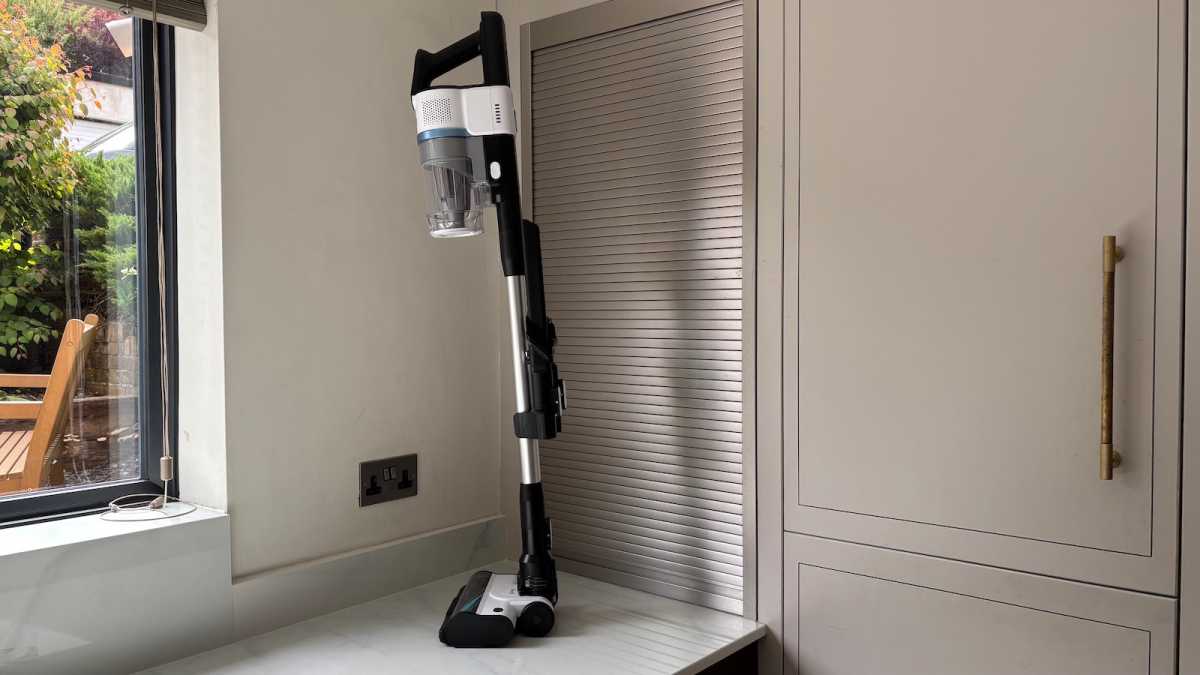
The vacuum itself is similar to Levoit’s previous models in basic dimensions and style: around 110cm tall (W25 x D19cm), it has a 3.5-litre dustbin, although the max fill level is low. It’s a little weightier than some at 3.5kg. As a handheld it’s 1.95kg, making overhead cleaning a challenge.
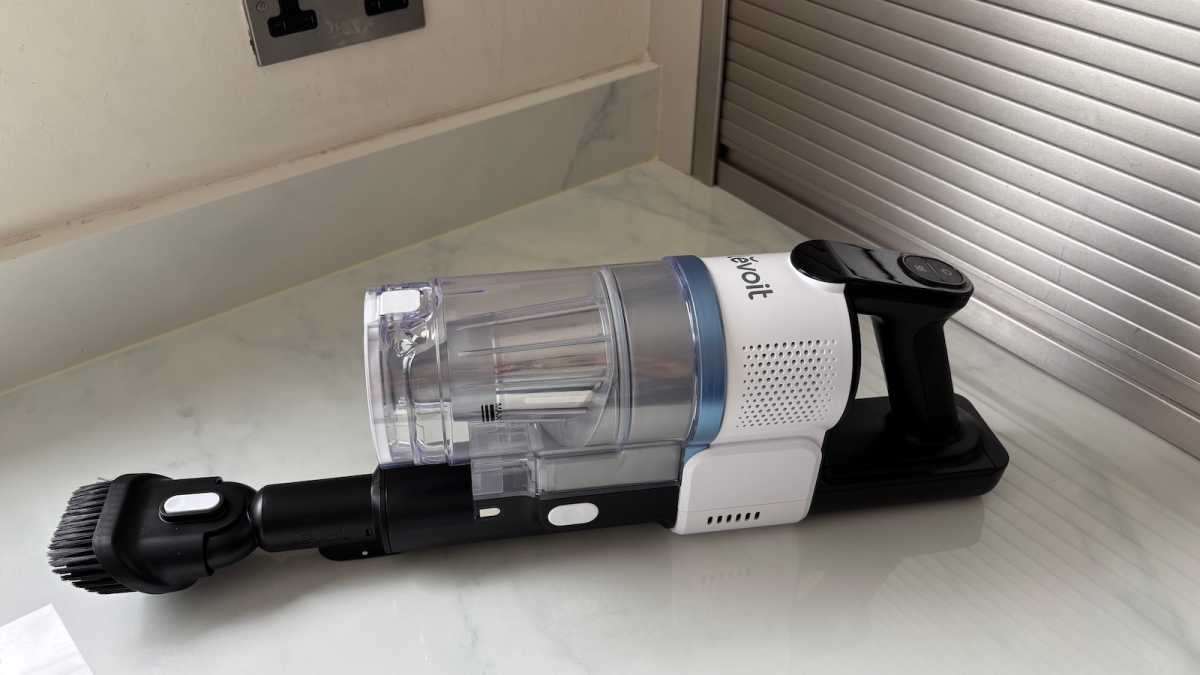
The controls are pleasingly simple though: one button for on/off, and one to toggle through three power levels from min to max, plus a turbo option when held down. There’s a countdown to show how much cleaning time is left, which alters when the power level is changed, and its battery provides up to 70 minutes if you stick to the min setting and a tool.
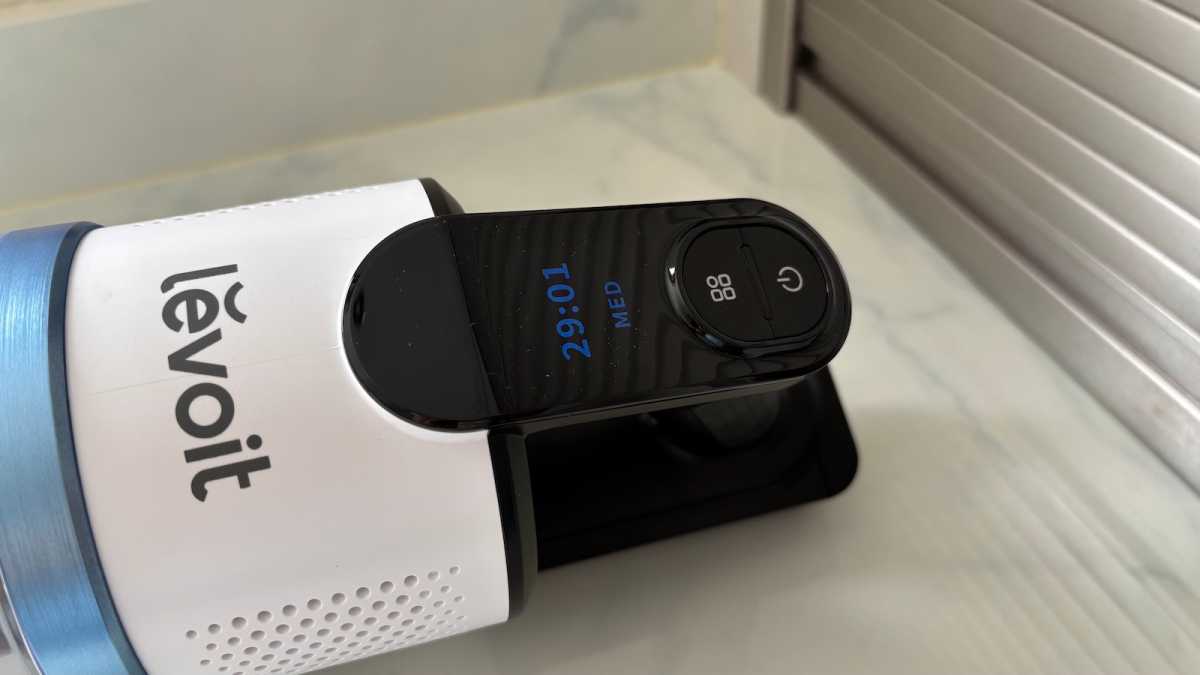
It’s worth noting that the floor head provides only 40 minutes on min while the floorhead with turbo will drain the battery in a skimpy six minutes. The fact that the battery can be removed is a big plus, though, allowing you to have a spare for deep cleaning sessions.
Performance and Features
- 180AW of suction
- Anti-tangle brush bar
- Noisy in use
One of the big pluses of the Aero is its anti-tangle floor head brush, designed to prevent hair and fur wrapping around it and clumping. Rather than only traditional brush fibres, it features two pairs of stiff but flexible plastic strips with fibres in between, much like a sandwich. These are complemented by hard plastic ridges. The result was that, in testing, no human or pet hair wrapped around the bar.
But should something become stuck, the brush bar twists out with the push of a button, making it easy to keep the floor head clean.
There’s plenty of suction power here too – 180AW – but that also means it’s noisy. In testing, med, max and turbo settings drowned out conversation, with only min able to be talked over. Annoyingly, the default setting when turning it on was med, rather than min, meaning that any early morning cleaning is sure to wake the household.
On the plus side, emptying the vacuum’s bin into the base doesn’t have to be an automatic action – it’s possible to set it to manual, so you can save the loud whooshing sound for later.
Emptying into the base does have a major flaw: the action opens the vacuum’s bin lid, but doesn’t close it again: this has to be done manually when lifting the vacuum off the base next time. During testing, I found that if the bin didn’t empty fully into the base, vacuumed-up dust and mess was deposited on the floor again before the bin lid was closed.
I also noted that the vacuum’s bin has a low max fill level, which is about a third of the actual capacity: it’s easy to reach this with deep cleaning, meaning that you’ll have to return to the base to empty before you can carry on.
Overall, cleaning was good: the floor head picked up pet hair well even on mid-pile carpet, with turbo being the most efficient, but med being suitable for everyday cleaning. However, the vacuum felt quite heavy to push around on the higher power levels and the handle wasn’t comfy for long periods. We felt it worked better for little and often cleaning or for mostly hard floors.
Manoeuvrability was good: the floor head fitted under the edges of most furniture, its lights provided extra visibility, and it swivelled easily around corners and curves.
We liked the attachment clip that fitted onto the main tube, as it allows your two most used tools to be stored on the stick so they’re to hand as you vacuum. However, there’s no storage for the other accessories, such as the bendy extension hose.
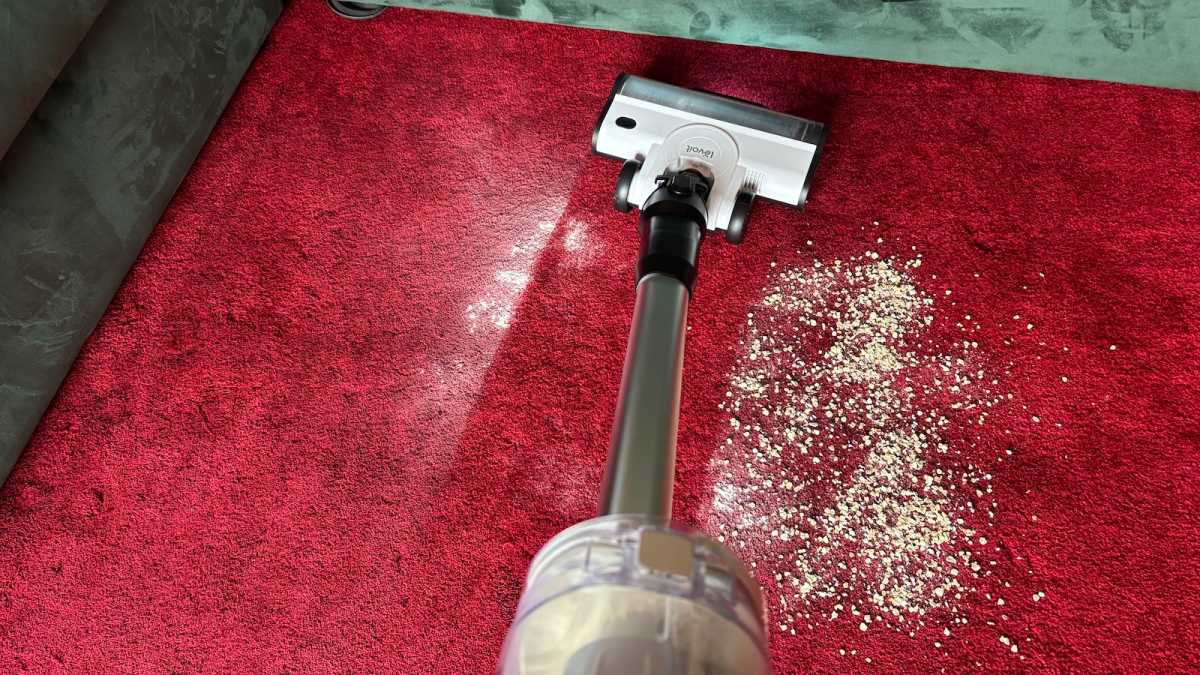
I tested the Aero vacuum on both hard and soft flooring, using flour to represent fine dust and oats as larger debris. On the hard floor, flour was easily picked up on min, while most oats were also sucked up min.
Still, the floor head had a tendency to push a few oats ahead of it, and leave a few at the rear. Several strokes were needed to pick them all up, and I felt that med delivered a better performance for both.
On the soft floor, most of the flour was picked up on min, but there were still patches deeper in the pile that it didn’t lift. Med was needed to pick these up, although max delivered a visible clean and we didn’t feel the need for turbo.
Most of the oats were picked up on min but a few were pushed ahead of the floorhead and med was required to pick the rest of them up, with no need to resort to max.