

Sunday, 3 May 2026
Subscribe
logo logo
  • Global
  • Technology
  • Business
  • AI
  • Cloud
  • Edge Computing
  • Security
  • Investment
  • More
    • Sustainability
    • Colocation
    • Quantum Computing
    • Regulation & Policy
    • Infrastructure
    • Power & Cooling
    • Design
    • Innovations
  • 🔥
  • data
  • revolutionizing
  • Stock
  • Investment
  • Future
  • Secures
  • Growth
  • Top
  • Funding
  • Power
  • Center
  • technology
Font ResizerAa
Silicon FlashSilicon Flash
Search
  • Global
  • Technology
  • Business
  • AI
  • Cloud
  • Edge Computing
  • Security
  • Investment
  • More
    • Sustainability
    • Colocation
    • Quantum Computing
    • Regulation & Policy
    • Infrastructure
    • Power & Cooling
    • Design
    • Innovations
Have an existing account? Sign In
Follow US
© 2022 Foxiz News Network. Ruby Design Company. All Rights Reserved.
Silicon Flash > Blog > Innovations > Machine Learning: Teaching Algorithms to Understand Physical Awareness
Innovations

Machine Learning: Teaching Algorithms to Understand Physical Awareness

Published July 27, 2025 By Juwan Chacko
Share
4 Min Read
Machine Learning: Teaching Algorithms to Understand Physical Awareness
SHARE
In a research facility at MIT’s Computer Science and Artificial Intelligence Laboratory (CSAIL), a unique soft robotic hand delicately maneuvers to grasp a small object. This hand operates solely based on visual data captured by a single camera, showcasing a groundbreaking approach to robotic control.

In an office at MIT’s Computer Science and Artificial Intelligence Laboratory (CSAIL), a soft robotic hand carefully curls its fingers to grasp a small object. The intriguing part isn’t the mechanical design or embedded sensors—in fact, the hand contains none. Instead, the entire system relies on a single camera that watches the robot’s movements and uses that visual data to control it.

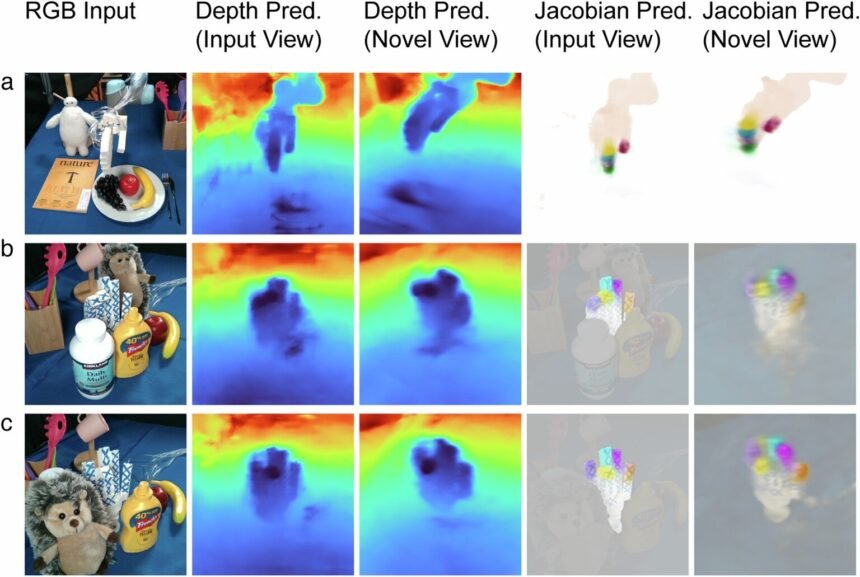
This capability comes from a new system CSAIL scientists developed, offering a different perspective on robotic control. Rather than using hand-designed models or complex sensor arrays, it allows robots to learn how their bodies respond to control commands, solely through vision. The approach, called Neural Jacobian Fields (NJF), gives robots a kind of bodily self-awareness.

A paper about the work was published in Nature.

“This work points to a shift from programming robots to teaching robots,” says Sizhe Lester Li, MIT Ph.D. student in electrical engineering and computer science, CSAIL affiliate, and lead researcher on the work.

“Today, many robotics tasks require extensive engineering and coding. In the future, we envision showing a robot what to do, and letting it learn how to achieve the goal autonomously.”

The motivation stems from a simple but powerful reframing: The main barrier to affordable, flexible robotics isn’t hardware—it’s control of capability, which could be achieved in multiple ways.

Traditional robots are built to be rigid and sensor-rich, making it easier to construct a digital twin, a precise mathematical replica used for control. But when a robot is soft, deformable, or irregularly shaped, those assumptions fall apart. Rather than forcing robots to match our models, NJF flips the script—giving robots the ability to learn their own internal model from observation.

See also  The Evolution of Data Centre Design: How AI is Revolutionizing the Physical Infrastructure

**Look and learn**

This decoupling of modeling and hardware design could significantly expand the design space for robotics. In soft and bio-inspired robots, designers often embed sensors or reinforce parts of the structure just to make modeling feasible.

NJF lifts that constraint. The system doesn’t need onboard sensors or design tweaks to make control possible. Designers are freer to explore unconventional, unconstrained morphologies without worrying about whether they’ll be able to model or control them later.

“Think about how you learn to control your fingers: you wiggle, you observe, you adapt,” says Li. “That’s what our system does. It experiments with random actions and figures out which controls move which parts of the robot.”

The system has proven robust across a range of robot types. The team tested NJF on a pneumatic soft robotic hand capable of pinching and grasping, a rigid Allegro hand, a 3D-printed robotic arm, and even a rotating platform with no embedded sensors.

In every case, the system learned both the robot’s shape and how it responded to control signals, just from vision and random motion.

The researchers see potential far beyond the lab. Robots equipped with NJF could one day perform agricultural tasks with centimeter-level localization accuracy, operate on construction sites without elaborate sensor arrays, or navigate dynamic environments where traditional methods break down.


TAGGED: Algorithms, Awareness, Learning, machine, physical, Teaching, understand
Share This Article
Facebook LinkedIn Email Copy Link Print
Previous Article Baxter Aerospace Secures M in Series A Funding to Propel Growth Baxter Aerospace Secures $6M in Series A Funding to Propel Growth
Next Article Maximizing Data Storage: Innovations in Capacity Devices from Leading Vendors Maximizing Data Storage: Innovations in Capacity Devices from Leading Vendors
Leave a comment

Leave a Reply Cancel reply

Your email address will not be published. Required fields are marked *

Your Trusted Source for Accurate and Timely Updates!

Our commitment to accuracy, impartiality, and delivering breaking news as it happens has earned us the trust of a vast audience. Stay ahead with real-time updates on the latest events, trends.
FacebookLike
LinkedInFollow

Popular Posts

Shiba Inu’s $1 Future: Prepare to be Amazed by the 2026 Outlook

Summary: Shiba Inu experienced a remarkable rise in 2021 but faced a significant decline in…

January 19, 2026

Mirador Capital’s Bold Move: Investing Heavily in Nike Stocks in Q3

Summary: Mirador Capital Partners LP purchased 59,998 shares of Nike worth $4.47 million on Oct.…

October 7, 2025

Navigating the Latest Advances in AI Technology: Insights for Investors from Meta Platforms

Meta Platforms, formerly known as Facebook, is making significant investments in artificial intelligence (AI) that…

September 5, 2025

Investors Rejoice: Strategy’s Stock Surges with Positive News

In a recent development, Strategy is set to remain in MSCI indexes for the time…

January 6, 2026

Navigating the Cloud: Understanding the Implications of AWS Fastnet Cable Expansion for CIOs

Cloud providers are expanding their reach in response to the growing demand for data and…

November 11, 2025

You Might Also Like

Empowering Innovation: The Role of Design Enablement Teams in the European Chips Act
Innovations

Empowering Innovation: The Role of Design Enablement Teams in the European Chips Act

Juwan Chacko
Secure Access: Biometric Passwordless Login and EU Digital Wallet Protection Platform
Innovations

Secure Access: Biometric Passwordless Login and EU Digital Wallet Protection Platform

Juwan Chacko
The Crucial Role of Intelligent Networks in Europe’s Digital Future
Innovations

The Crucial Role of Intelligent Networks in Europe’s Digital Future

Juwan Chacko
Innovating the Future: EPI’s Revolutionary Approach to High-Performance Computing
Innovations

Innovating the Future: EPI’s Revolutionary Approach to High-Performance Computing

Juwan Chacko
logo logo
Facebook Linkedin Rss

About US

Silicon Flash: Stay informed with the latest Tech News, Innovations, Gadgets, AI, Data Center, and Industry trends from around the world—all in one place.

Top Categories
  • Technology
  • Business
  • Innovations
  • Investments
Usefull Links
  • Home
  • Contact
  • Privacy Policy
  • Terms & Conditions

© 2025 – siliconflash.com – All rights reserved

Welcome Back!

Sign in to your account

Lost your password?