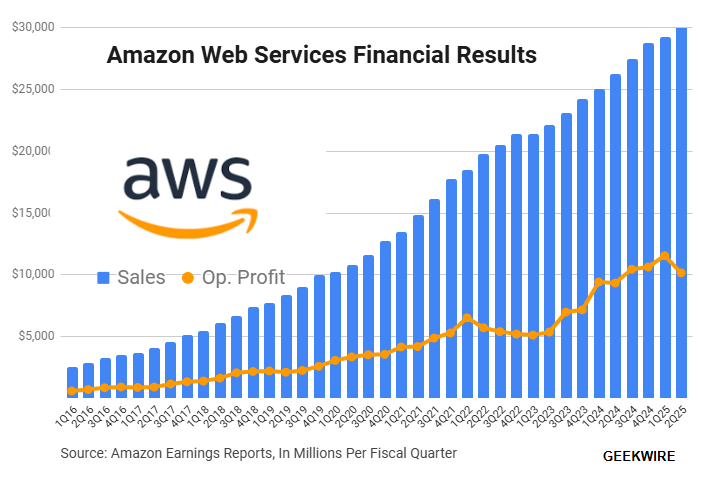
While Amazon exceeded revenue estimates, its profits were overshadowed by the surge in costs associated with the AI competition. AWS revenue grew by 17.5% year-over-year to reach $30.9 billion, meeting expectations. However, the expenses of staying competitive in the AI sector were evident in the cloud unit’s profits. AWS operating income increased by less than 9% to $10.2 billion, with operating expenses jumping to $20.7 billion from $16.9 billion the previous year.
This resulted in an operating margin of 32.9%, marking the cloud giant’s lowest profit-to-revenue ratio since late 2023, and significantly lower than the operating margin of nearly 40% in the first quarter.
During the earnings call with analysts, Amazon CFO Brian Olsavsky attributed the pressure on AWS’s profit margin to various factors, including a seasonal rise in stock-based compensation, unfavorable foreign exchange rates, and increased depreciation costs stemming from ongoing investments in AI infrastructure.
Later in the call, analysts questioned Amazon CEO Andy Jassy about the perception on Wall Street that the company is trailing behind Microsoft and Google in seizing the AI opportunity. Amazon’s results were unveiled a day after Microsoft revealed annual revenue exceeding $75 billion for its Azure cloud platform, with a quarterly growth rate of 39%, surpassing expectations.
Google Cloud’s annual revenue run rate surpassed $50 billion, with a 32% quarterly growth year-over-year, as per numbers disclosed by Google parent Alphabet recently.
Despite being a significantly larger entity with an annual revenue run rate exceeding $123 billion, making it challenging to achieve staggering growth rates, Morgan Stanley analyst Brian Nowak probed Jassy about the potential for AWS growth to accelerate in the remainder of 2025, considering the vast scope of the opportunity and the influx of generative AI workloads expected in the next 12 months.
Jassy refrained from providing specific guidance for the AWS segment but expressed optimism about the business’s potential to accelerate. He cited multiple factors contributing to this, such as more enterprises shifting from on-premises data centers to the cloud, the anticipated rise in companies deploying AI applications, and the forthcoming increase in AWS capacity.
Jassy highlighted long-term strategic advantages for AWS, emphasizing that AI inference would eventually become a fundamental component, similar to compute, storage, and database services. He noted that many customers would prefer running their AI applications in close proximity to their existing applications and data, giving Amazon a competitive edge due to the extensive presence of applications and data within AWS.
Jassy underscored AWS’s advantage in custom-built chips, offering superior price-performance for inference compared to other GPU providers. He also emphasized the significant disparity in security, without directly naming Microsoft, and highlighted AWS’s comprehensive range of AI services from the foundational level to the top.
Notable AI milestones for Amazon in the recent quarter included the introduction of Kiro, a new integrated development environment (IDE) that enables developers to code in natural language, with the system automatically generating documentation, scanning for security vulnerabilities, and creating specifications.
The company reported $31.4 billion in capital expenditures for the second quarter, primarily related to technology infrastructure, representing an increase from nearly $25 billion in the first quarter. Amazon’s capex figure differs from that of Microsoft and Google due to additional investments in fulfillment centers and the Project Kuiper satellite network.
Olsavsky stated that AWS would continue to invest capital in data centers and other resources to capitalize on the substantial opportunity in generative AI. Operating margins may fluctuate over time due to the level of investments being made.