

Wednesday, 1 Apr 2026
Subscribe
logo logo
  • Global
  • Technology
  • Business
  • AI
  • Cloud
  • Edge Computing
  • Security
  • Investment
  • More
    • Sustainability
    • Colocation
    • Quantum Computing
    • Regulation & Policy
    • Infrastructure
    • Power & Cooling
    • Design
    • Innovations
  • 🔥
  • data
  • revolutionizing
  • Stock
  • Investment
  • Future
  • Secures
  • Growth
  • Top
  • Funding
  • Power
  • Center
  • technology
Font ResizerAa
Silicon FlashSilicon Flash
Search
  • Global
  • Technology
  • Business
  • AI
  • Cloud
  • Edge Computing
  • Security
  • Investment
  • More
    • Sustainability
    • Colocation
    • Quantum Computing
    • Regulation & Policy
    • Infrastructure
    • Power & Cooling
    • Design
    • Innovations
Have an existing account? Sign In
Follow US
© 2022 Foxiz News Network. Ruby Design Company. All Rights Reserved.
Silicon Flash > Blog > Innovations > Enhancing Lithium-Metal Battery Performance with Nanoengineered Electrode Materials
Innovations

Enhancing Lithium-Metal Battery Performance with Nanoengineered Electrode Materials

Published August 15, 2025 By Juwan Chacko
Share
6 Min Read
Enhancing Lithium-Metal Battery Performance with Nanoengineered Electrode Materials
SHARE
Lithium metal batteries present a promising alternative to traditional lithium-ion batteries, offering higher energy storage capacity. However, challenges such as instability and lower efficiency have hindered their widespread adoption. Researchers have developed a nanoengineered electrode material that addresses these issues, paving the way for more efficient and durable Li-metal batteries. This article explores the innovative composite design and its potential impact on the future of battery technology.

Lithium metal (Li-metal) batteries are among the most promising alternatives to widely employed rechargeable lithium-ion (Li-ion) batteries, as they could store more energy and thus extend the battery life of many electronic devices. Despite their potential, existing Li-metal batteries have been found to be less stable than Li-ion batteries, while also exhibiting lower coulombic efficiencies (CE) and degrading faster over time.

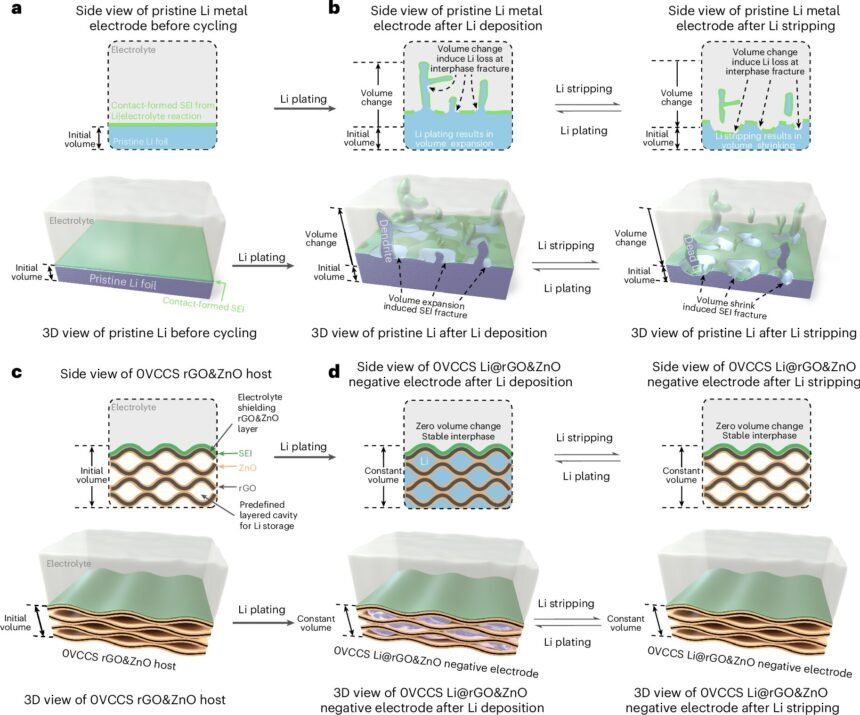
In addition, the Li-metal electrodes integrated in these batteries tend to expand and contract when a battery is charging and discharging. These changes in volume can result in cracks and a loss of electrical contact, further hindering the batteries’ performance.

Researchers at Shandong University, Zhejiang University and other institutes recently introduced a new nanoengineered material that could be used as an electrode in Li-metal batteries, which does not expand or shrink during charging and discharging. The new material, presented in a paper published in Nature Nanotechnology, is comprised of reduced graphene oxide (rGO), a thin material that conducts electricity, and zinc oxide, a stable and electrochemically active ceramic.

“Our recent work stemmed from decades of frustration in the lithium metal battery field, namely that the highest capacity anode material consistently failed due to its infinite volume changes during cycling,” Hao Chen, co-senior author of the paper, told Tech Xplore. “These volume fluctuations rupture solid electrolyte interfaces and trigger irreversible corrosion, preventing the >99.9% coulombic efficiency (CE) essential for practical batteries.”

See also  Exploring the Effects of 5G Radiation on Human Health: Insights from EU-Funded Research

The main goal of this recent study by Chen and his colleagues was thus to realize an electrode material that does not change in volume and that entirely isolates lithium from the corrosive electrolytes inside a battery. The composite material they realized, based on rGO and ZnO, was found to prompt the formation of a durable solid-electrolyte interphase (SEI), the protective layer separating electrodes from electrolytes in battery cells.

“We designed a two-dimensional, continuous layered-cavity zero-volume-change complete-sealing rGO&ZnO host,” explained Chen. “Its architecture has two key features. First, Li plating/stripping occurs entirely within rigid cavities, eliminating destructive volume expansion. Second, a continuous host structure acts like corrosion-proof armor, entirely preventing electrolyte penetration and contact with Li.”

The material nanoengineered by Chen and his colleagues was found to successfully overcome the limitations of electrodes that are widely employed in Li-metal batteries. In initial tests, it was found to exhibit no changes in volume during charging and discharging, which is highly desirable and proved difficult to achieve so far.

“Our host enabled unprecedented Li cycling,” said Chen. “We attained a record efficiency of 99.99–99.9999% and a coulombic efficiency of almost 2,000 cycles—surpassing the critical >99.9% threshold for viable Li-metal batteries. We solved the core challenge of volume-change-driven Li degradation, demonstrating for the first time that near-perfect Li reversibility is achievable.”

The composite electrode material engineered by this team of researchers could soon be deployed in Li-metal batteries with varying compositions to further assess its potential and performance. In the future, it could contribute to the development of Li-metal batteries with high energy densities and ultra-long lifespans.

See also  Using E-beam lithography to produce semiconductors

“Looking ahead, we are scaling this host design for commercial pouch cells while refining manufacturing processes,” added Chen. “We’re also adapting its zero-volume-change sealing concept to other battery chemistries (e.g., sodium-metal anodes) and exploring integrations with solid-state electrolytes to further enhance safety and energy density—aiming to accelerate real-world deployment through industry partnerships in the next 3–5 years.”

Written for you by our author Ingrid Fadelli, edited by Lisa Lock, and fact-checked and reviewed by Robert Egan—this article is the result of careful human work. We rely on readers like you to keep independent science journalism alive. If this reporting matters to you, please consider a donation (especially monthly). You’ll get an ad-free account as a thank-you.

More information:
Lequan Deng et al, A nanoengineered lithium-hosting carbon/zinc oxide composite electrode material for efficient non-aqueous lithium metal batteries, Nature Nanotechnology (2025). DOI: 10.1038/s41565-025-01983-4

© 2025 Science X Network

This document is subject to copyright. Apart from any fair dealing for the purpose of private study or research, no part may be reproduced without the written permission. The content is provided for information purposes only.


TAGGED: Battery, Electrode, Enhancing, LithiumMetal, Materials, Nanoengineered, Performance
Share This Article
Facebook LinkedIn Email Copy Link Print
Previous Article The Winners of Trump’s Plan to Streamline the Space Industry: Cutting Through the Red Tape The Winners of Trump’s Plan to Streamline the Space Industry: Cutting Through the Red Tape
Next Article Seroda Ventures Invests in Evonence and Cloudnyx.ai Merger Seroda Ventures Invests in Evonence and Cloudnyx.ai Merger
Leave a comment

Leave a Reply Cancel reply

Your email address will not be published. Required fields are marked *

Your Trusted Source for Accurate and Timely Updates!

Our commitment to accuracy, impartiality, and delivering breaking news as it happens has earned us the trust of a vast audience. Stay ahead with real-time updates on the latest events, trends.
FacebookLike
LinkedInFollow

Popular Posts

Embracing Change: How Microsoft Teams Seizes Opportunities Post-Android 10 EOL

Discover the impact of Android 10's End of Life (EOL) on Microsoft Teams Rooms and…

September 25, 2025

Volteras Secures $11.1M in Series A Investment Round

Summary: Volteras, a London-based data streaming platform for the energy ecosystem, secured $11.1M in Series…

May 31, 2025

Microsoft rolls out Recall and other AI features to all Copilot+ PCs, nearly a year after unveiling

Microsoft Expands AI-Powered Features for Copilot+ PCs A Copilot+ PC display at the Microsoft Store…

April 28, 2025

Tech Startup CNaught Secures $4.5M Investment

CNaught Raises $4.5M in Funding for Carbon Credit Platform CNaught founders CNaught, a San Francisco-based…

May 7, 2025

The Impact of Nike Stock Performance: A Closer Look

Summary: 1. Nike, the largest athletic wear company in the world, has faced stock market…

November 26, 2025

You Might Also Like

Empowering Innovation: The Role of Design Enablement Teams in the European Chips Act
Innovations

Empowering Innovation: The Role of Design Enablement Teams in the European Chips Act

Juwan Chacko
Secure Access: Biometric Passwordless Login and EU Digital Wallet Protection Platform
Innovations

Secure Access: Biometric Passwordless Login and EU Digital Wallet Protection Platform

Juwan Chacko
Powering Ahead: FirstEnergy’s Strong Performance in Q4 2025
Investments

Powering Ahead: FirstEnergy’s Strong Performance in Q4 2025

Juwan Chacko
The Crucial Role of Intelligent Networks in Europe’s Digital Future
Innovations

The Crucial Role of Intelligent Networks in Europe’s Digital Future

Juwan Chacko
logo logo
Facebook Linkedin Rss

About US

Silicon Flash: Stay informed with the latest Tech News, Innovations, Gadgets, AI, Data Center, and Industry trends from around the world—all in one place.

Top Categories
  • Technology
  • Business
  • Innovations
  • Investments
Usefull Links
  • Home
  • Contact
  • Privacy Policy
  • Terms & Conditions

© 2025 – siliconflash.com – All rights reserved

Welcome Back!

Sign in to your account

Lost your password?