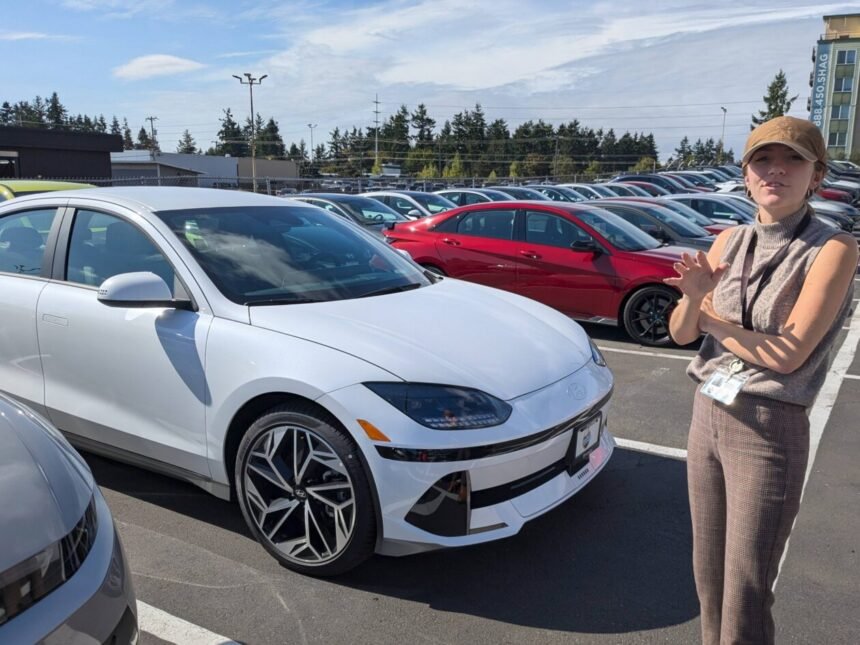
Seattle Hyundai’s sales manager, Rachel Walen, is gearing up for a hectic weekend at the dealership as the deadline for the federal tax credit on electric vehicles draws near.
As of Tuesday, shoppers in the U.S. have until the end of the month to take advantage of tax credits of up to $7,500 for new EVs and $4,000 for used ones. This tax incentive, which was originally planned to span a decade, was eliminated by the Republican-led Congress as part of the comprehensive budget legislation passed earlier this year.
With just a few days left to benefit from the tax break, Walen is seeing a surge in demand. She mentioned that customers have been advised to act quickly if they have specific preferences in terms of color or trim level, as the dealership’s EV inventory is dwindling rapidly.
In August, new EV sales in the U.S. rose by nearly 18% compared to the previous year, while used EV purchases saw a 59% increase. Electric vehicles accounted for 10% of all new vehicle sales in August, setting a record for the country. Analysts at Cox Automotive anticipate this momentum to continue through September.
Scott Case, the CEO of Recurrent, a startup based in Seattle that provides battery data for used EVs, finds it ironic that the attempt by the Trump administration to hinder EV adoption actually led to a surge in demand. He believes that this spike in interest will accelerate the transition to full EV penetration in the long run.
Although the federal tax credit is set to expire on September 30, Washington state is stepping in to support the shift towards zero-emission vehicles. The state recently launched an initiative called ZEVergreen to promote the adoption of EVs and plug-in hybrid EVs. Last year, one out of every five cars purchased in Washington was zero-emission.
The transportation sector is the largest contributor to carbon emissions in Washington, prompting local leaders to advocate for greater EV adoption to meet state climate goals. They argue that EVs can save drivers up to $8,000 over seven years due to lower electricity rates and reduced maintenance costs compared to gas or diesel vehicles.
To encourage EV sales, Washington previously offered a sales tax exemption for new or used EVs, which ended on July 31, 2025. The state also ran a successful program that provided instant rebates for low-income consumers purchasing or leasing an EV, demonstrating the high demand for such initiatives.
Looking ahead, Case predicts a rise in the availability of used EVs as more leases expire next year. He believes that these 3-year-old used EVs will be attractive options for many buyers, contributing to the growth of the used EV market.
While BloombergNEF forecasts lower passenger EV sales in the U.S. over the next few years due to recent policy changes, global sales of EVs and plug-in hybrids are expected to increase by 24% this year, driven primarily by the Chinese market.
Despite the challenges in the U.S. market, Case remains optimistic, citing research that shows a majority of EV owners are likely to stick with electric vehicles for their next purchase. He believes that every EV sold before September 30 represents another driver committed to staying electric, ultimately contributing to the long-term growth of the EV market.
Are you looking to boost your website’s visibility and attract more visitors? In today’s digital age, mastering the art of SEO is essential for success online. While it may seem complex, implementing SEO strategies doesn’t have to be daunting. By following some key tips and tricks, you can optimize your website in a way that feels natural and engaging for your audience. Let’s dive into some effective strategies for improving your website’s search engine rankings.