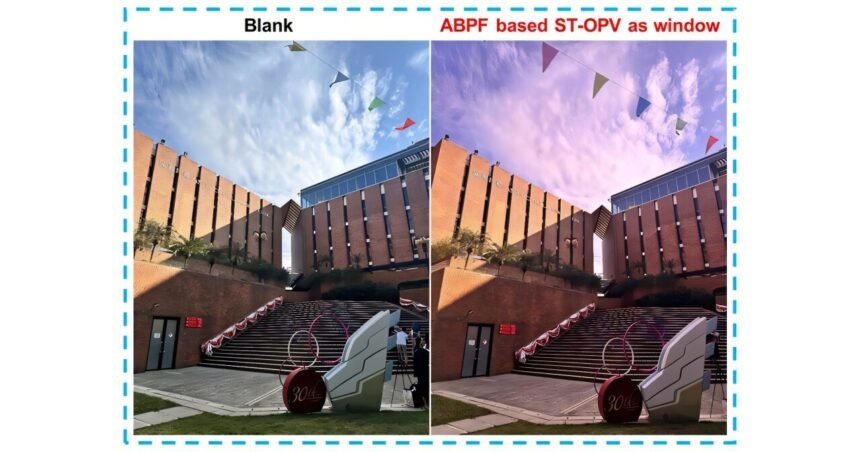
Transparent solar cells have the potential to revolutionize the renewable energy sector by being seamlessly integrated into windows, screens, and other surfaces. However, the challenge lies in balancing transparency with power conversion efficiency. This has led to a growing interest in semi-transparent organic photovoltaics (ST-OPVs), which offer both efficient energy generation and visually appealing design. These ST-OPVs have significant development potential in building-integrated photovoltaics (BIPV) due to their unique properties such as discrete absorption, low-cost production, and environmental sustainability.
Prof. Li Gang and his team, along with Research Fellow Dr. Yu Jiangsheng, have introduced a dimensionless parameter, FoMLUE, to evaluate classic photoactive materials for ST-OPVs. By considering factors like average visual transmittance, bandgap, and current density, this parameter helps screen materials for their normalized absorbance. The researchers discovered that ST-OPVs based on ternary materials with the highest FoMLUE values exhibited enhanced thermal insulation and operational stability, achieving a record light utilization efficiency of 6.05%.
Their study also explored the impact of geographical factors on ST-OPV performance, using a transient model to simulate power output and assess its effect on building space cooling and heating loads in various cities across China. The results showed significant energy savings in regions with hot summers and warm winters, making them ideal for the installation of ST-OPV glazed windows. These findings highlight the multifunctionality and geographical adaptability of high-performance ST-OPVs in creating sustainable and energy-saving smart windows that maintain architectural integrity.
As the research progresses, the team aims to enhance the long-term stability of ST-OPVs and scale up development to large-area solar modules for commercialization. The study published in Nature Communications provides valuable insights into the potential of ST-OPVs as sustainable smart windows, offering new opportunities for practical applications in BIPV, renewable energy vehicles, and agricultural greenhouses.