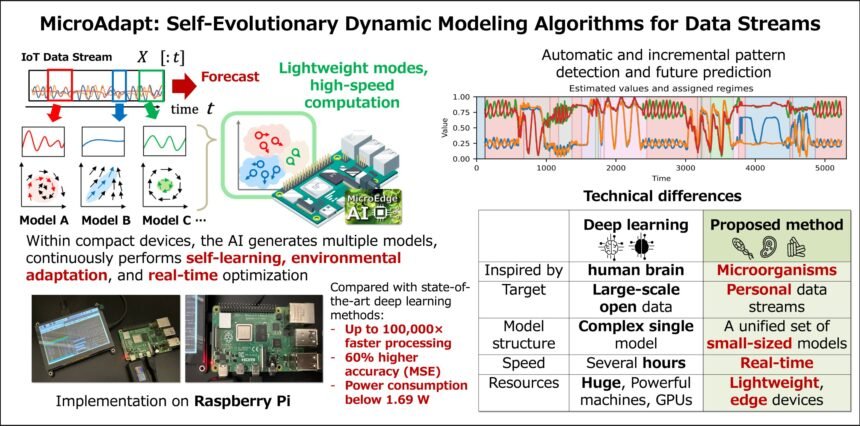
The advancement of MicroAdapt by Professor Yasuko Matsubara’s research group marks a significant breakthrough in the realm of real-time AI applications. This technology caters to the increasing need for high-speed AI processing in resource-constrained edge devices across various industries such as manufacturing, automotive IoT, and medical wearables.
Unlike conventional cloud-dependent AI models, MicroAdapt operates uniquely by decomposing incoming data streams, integrating lightweight models, and continuously evolving through self-learning mechanisms inspired by microorganisms. This approach allows for real-time model learning and future prediction directly within small devices.
The results of implementing MicroAdapt are outstanding, showcasing up to 100,000 times faster processing speeds and 60% higher accuracy than existing deep learning prediction techniques. Moreover, the practical implementation on a Raspberry Pi 4 demonstrates the technology’s efficiency, requiring minimal memory and power consumption.
This breakthrough in self-evolving edge AI opens up a world of possibilities for real-time applications in manufacturing, mobility, healthcare, and beyond. Collaborations with industry partners are underway to leverage the potential of this technology for widespread industrial impact.
More information:
Yasuko Matsubara et al, MicroAdapt: Self-Evolutionary Dynamic Modeling Algorithms for Time-evolving Data Streams, Proceedings of the 31st ACM SIGKDD Conference on Knowledge Discovery and Data Mining V.2 (2025). DOI: 10.1145/3711896.3737048