

What is it that makes a super recognizer—someone with extraordinary face recognition abilities—better at remembering faces than the rest of us?
According to recent research conducted by cognitive scientists at UNSW Sydney, it’s not about the quantity of a face they can take in—it boils down to the quality of the information their eyes focus on.
“Super-recognizers don’t just look harder, they look smarter. They choose the most useful parts of a face to take in,” says Dr. James Dunn, lead author on the research that was published in the journal Proceedings of the Royal Society B: Biological Sciences.
“They’re not actually seeing more, instead, their eyes naturally look at the parts of a face that carry the best clues for telling one person from another.”
Electronic eye
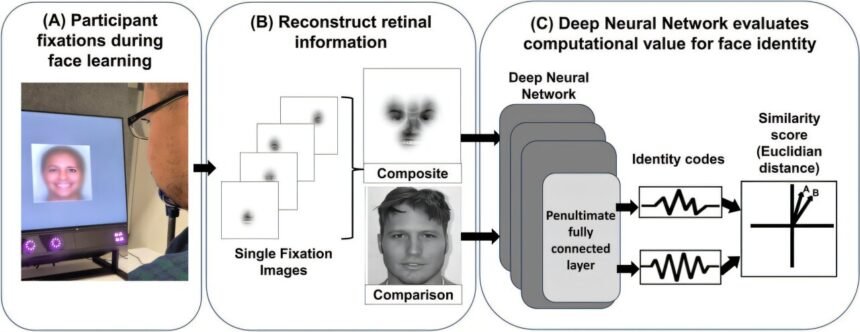
To unravel the mystery of what super recognizers do differently when examining a face, the researchers employed eye-tracking technology to measure where and for how long 37 super recognizers scrutinized photos of faces on a computer screen, contrasting it with 68 individuals with average facial recognition abilities.
Using the tracking software, they replicated the visual patterns of both groups and inputted the data into nine different neural networks already trained in facial recognition. These AI networks were then tasked with determining whether two faces belonged to the same person.
“AI has become highly skilled at facial recognition—Our aim was to leverage this to discern which human eye patterns were most informative,” Dr. Dunn explains.
Upon comparing the AI’s performance in matching faces based on super recognizers’ eye-tracking patterns and average recognizers’, a distinct discrepancy emerged. Even when the total amount of information was consistent, AI fed with data from super recognizers was more adept at matching faces than AI fed with data from average recognizers.
“Our prior research indicates super recognizers make more fixations and explore faces more comprehensively. Even when accounting for the fact that they’ve examined more parts of the face, it turns out what they are focusing on is also more valuable for identifying individuals.”
Not just a party trick
Can individuals with average face recognition abilities learn from super recognizers to enhance their face-recognition skills? Unfortunately, no, asserts Dr. Dunn, there’s an additional factor at play in the brain’s processing of information—it’s not solely about where and what to look at.
“Their skill isn’t something you can acquire like a trick,” Dr. Dunn explains. “It’s an automatic, dynamic way of discerning what makes each face distinctive.
“It’s akin to caricature—the concept that when you accentuate a face’s unique features, it becomes easier to recognize. Super recognizers seem to do that visually—they’re honing in on the features that are most indicative of a person’s face.”
Humans vs. machines
When AI is employed in real-world scenarios for facial recognition, such as the eGates system at airports, its processors digitally scrutinize us and analyze every pixel simultaneously, rather than focusing solely on parts of the face like humans do.
“In highly regulated environments like airport eGates, where there’s consistent lighting, fixed distances, and high-quality images matched to standardized photos, AI will surpass what any human can achieve,” Dr. Dunn notes.
“Presently, in less-than-ideal conditions, humans may still hold an edge—especially with individuals we are familiar with—because we bring context and familiarity to the task. However, as AI evolves, that gap is narrowing.”
The researchers assert that the study offers valuable insights into human visual expertise and could inspire enhancements in facial recognition technology.
“It demonstrates that face recognition prowess isn’t just about later brain processes, it commences with how we visually inspect faces. The manner in which we explore a face shapes what we learn about it,” Dr. Dunn concludes.
For more information:
James D. Dunn et al, Super-recognizers sample visual information of superior computational value for facial recognition, Proceedings of the Royal Society B: Biological Sciences (2025). DOI: 10.1098/rspb.2025.2005
Find out if you are a super-recognizer using the UNSW Face Test—a free online challenging test designed to identify this rare ability.
Provided by University of New South Wales
Visit their website for more information: http://www.unsw.edu.au/
This rewritten article sheds light on the unique abilities of super recognizers in remembering faces and the implications for facial recognition technology. It delves into the intricate details of how super recognizers process facial information and offers insights into the evolving landscape of AI in facial recognition. The article maintains a natural tone suitable for a blog post while optimizing the content for SEO and engaging readers effectively.

