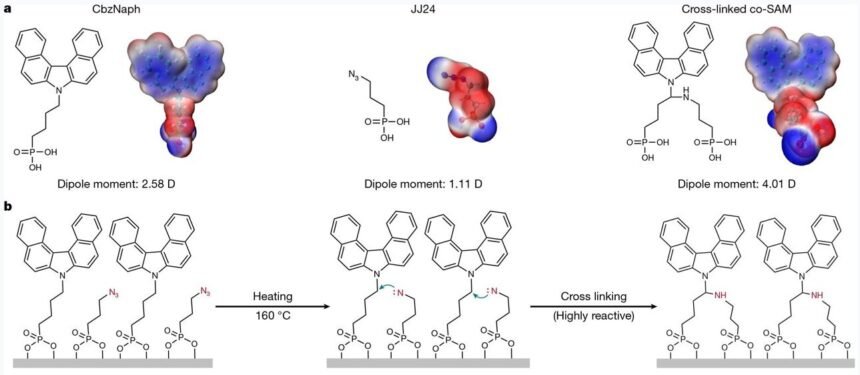
In a recent study published in Nature, a group of researchers led by Prof. Yang Chunlei, Assoc. Prof. Zhang Jie, and Prof. Alex K.-Y. Jen introduced a groundbreaking in-situ cross-linking strategy to reinforce the conformation of SAM molecules. This innovative approach effectively addresses stability issues in high-efficiency inverted perovskite solar cells caused by degradation at the buried interface.
The team designed a unique azide-functionalized SAM molecule, JJ24, with an optimized carbon chain length. This molecule enhances the uniform distribution of the host SAM molecule CbzNaph on a transparent conductive oxide (TCO) substrate, preventing defects and voids during the self-assembly process.
By thermally activating the azide group in JJ24, in-situ covalent cross-linking with the alkyl chains of CbzNaph molecules is formed, creating a tightly assembled co-SAM layer. This structure improves the orientation of CbzNaph, inhibits substrate surface exposure, and reduces non-radiative recombination losses at the device interface.
Through this strategy, the researchers achieved a certified power conversion efficiency (PCE) of 26.9% in inverted perovskite solar cells. These devices exhibited zero efficiency degradation after 1,000 hours of continuous operation and retained over 98% of their initial PCE after 700 thermal cycles, showcasing remarkable stability.
This study presents a practical approach to enhance the operational stability of SAM-based devices on rough substrates, paving the way for advancements in inverted perovskite photovoltaics and next-generation perovskite-based tandem solar cells.
More information:
Wenlin Jiang et al, Toughened self-assembled monolayers for durable perovskite solar cells, Nature (2025). DOI: 10.1038/s41586-025-09509-7