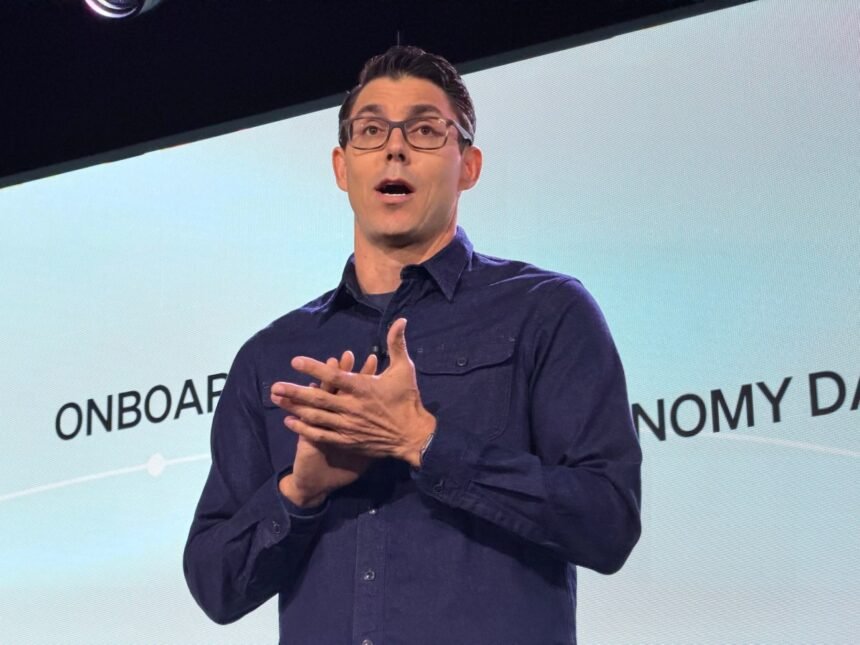
The bustling cafeteria of Rivian’s Palo Alto office was the scene of a comical mishap as a robot attempted to navigate its way through the shelves stocked with chilled canned coffees, only to find itself stuck moments later. A kind man came to its rescue, pushing it out of the way as the words “I’m stuck” flashed yellow on the robot’s screen. This incident set the tone for Rivian’s “Autonomy & AI Day,” a showcase of the company’s ambitious plans for self-driving vehicles.
As I embarked on a demo ride in a 2025 R1S SUV, I couldn’t help but recall the earlier mishap with the cafeteria robot. The vehicle, equipped with Rivian’s new “Large Driving Model,” smoothly maneuvered along a switchback route near the campus. However, a moment of tension arose when a Tesla Model S in front of us made a sudden turn, prompting the R1S to brake abruptly to avoid a collision. This incident highlighted the challenges and complexities of autonomous driving technology.
During the demo drive, there was a minor disengagement when the driver took control to navigate a narrow road section. Despite this hiccup, the software performed admirably, showcasing Rivian’s transition to an AI-centric approach to self-driving technology. The company abandoned its old rules-based system in favor of a more adaptive, end-to-end solution similar to Tesla’s Full Self-Driving system.
CEO RJ Scaringe revealed a pivotal moment in 2021 when Rivian embraced transformer-based AI, prompting a complete overhaul of its self-driving platform. The company launched its new driving software in 2024, powered by Nvidia’s Orin processors, marking a significant leap forward in autonomous technology.
Rivian aims to introduce “Universal Hands-Free” driving by early 2026, allowing owners to experience autonomous driving on designated roads in the U.S. and Canada. The company plans to expand this capability to enable “point-to-point” driving later in 2026, offering a glimpse of the future of autonomous transportation.
Looking ahead, Rivian faces the challenge of integrating its new autonomy computer and lidar sensor into its upcoming R2 SUVs, which are crucial for the company’s growth. Customers may have to wait for the full autonomy features, but Rivian remains committed to transparency and customer choice.
As Rivian navigates the evolving landscape of autonomous driving technology, the company remains dedicated to innovation and progress. The journey towards fully autonomous vehicles may be fraught with challenges, but Rivian’s determination and vision for the future of transportation are unwavering.
The founder of Rivian envisioned a future where their vehicles could autonomously navigate to the end of a hiking trail to pick up their owners, embodying the brand’s spirit of adventure. While this idea may have seemed far-fetched in the past, the company still believes it’s achievable in the coming years.
According to Scaringe, Rivian is working towards enabling such a use case with their R2 vehicles, set to be tested and built in the near future. The focus on achieving level 4 autonomy is crucial for this goal, as the vehicles will need to navigate challenging terrains without traditional road markings.
While the concept of self-driving vehicles meeting owners at the end of a trail is exciting, Rivian is realistic about its limitations. The company is not investing resources in autonomous rock crawling but is more focused on reaching trailheads autonomously, showcasing a balance between innovation and practicality.