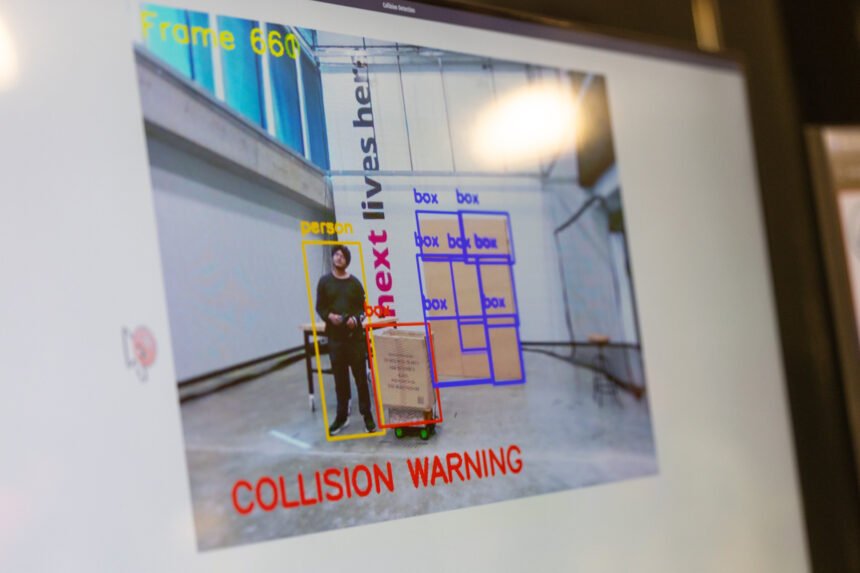
The University of Cincinnati, in partnership with Ohio’s Bureau of Workers’ Compensation, is pioneering the use of digital-twin technology to create safer work environments. This advanced system can detect objects and individuals within a workspace and send instant alerts to workers’ smartwatches or phones to warn them of potential collisions. Developed by UC College of Engineering and Applied Science professors Manish Kumar and Sam Anand, these tools are designed to prevent common workplace injuries caused by accidents and repetitive stress.
During a demonstration at UC’s Digital Futures, Kumar and Anand showcased the capabilities of the digital-twin technology. By utilizing cameras to create a live virtual representation of a worker in their actual workspace, such as a warehouse or factory floor, the system can provide real-time feedback on risky movements and issue warnings to avoid collisions with moving equipment. This proof of concept has garnered interest from industrial collaborators like Siemens, Innovative Numerics, Worthington Steel, and thyssenkrupp Bilstein.
With over 76,800 nonfatal workplace injuries recorded in Ohio in 2023, the need for innovative safety measures is evident. More than half of these injuries were severe, resulting in days away from work or job restrictions. The digital-twin system aims to address these issues by proactively identifying potential hazards and providing timely alerts to prevent accidents.
Using cameras to capture workers’ movements in real-time, the digital-twin system creates a virtual representation that can warn employees about dangers like approaching forklifts or repetitive stress injuries. In addition to real-time alerts, the system compiles data on workers’ activities throughout the day, offering valuable insights into ergonomic risks and injury prevention strategies.
The collaboration between UC researchers and industry partners has led to the development of an AI-powered digital-twin system that can monitor workers’ movements to prevent injuries and collisions in the workplace. This system, supported by UC Professor Kelly Cohen and his aerospace engineering students, ensures the reliability and trustworthiness of the AI deployed in the technology.
By generating daily ergonomic assessments based on workers’ posture and movements, the digital-twin system can help employees understand and mitigate injury risks effectively. With the support of the Ohio Bureau of Workers’ Compensation, researchers are working on practical applications of the technology, aiming to create a functional prototype to enhance workplace safety.
As the team continues to explore the potential applications of the digital-twin system, they emphasize the importance of responsible use and ethical considerations. With a commitment to being the “guardian of the good,” the researchers at the University of Cincinnati are dedicated to leveraging technology to create safer and healthier work environments for all.