Neural Radiance Fields (NeRF) have emerged as a game-changing technique in the realm of computer vision, enabling the creation of intricate three-dimensional (3D) representations from two-dimensional (2D) images. This innovative approach involves training a sophisticated neural network to anticipate color and density at any given point within a 3D space. The fundamental premise of NeRF revolves around casting virtual light rays from the camera through each pixel across various input images, thereby capturing points along these rays with their respective 3D coordinates and viewing directions. Leveraging this wealth of data, NeRF reconstructs the scene in a 3D format, enabling the rendering of images from entirely new vantage points, a process commonly referred to as novel view synthesis (NVS).
Additionally, the article delves into the challenges associated with utilizing videos in NeRF applications, particularly focusing on the limitations posed by motion blur. Videos captured through a single camera, such as those from smartphones or drones, often suffer from motion blur induced by rapid object movements or camera shake. This blurriness presents a significant obstacle in creating sharp and dynamic novel view synthesis. The existing deblurring-based NVS methodologies are primarily tailored for static multi-view images, failing to adequately address global camera and local object motion. Consequently, the inaccuracy in camera pose estimations and loss of geometric precision are commonplace issues encountered when dealing with blurry videos.
To combat these obstacles, a team of researchers led by Assistant Professor Jihyong Oh from the Graduate School of Advanced Imaging Science (GSIAM) at Chung-Ang University (CAU) in Korea, in collaboration with Professor Munchurl Kim from the Korea Advanced Institute of Science and Technology (KAIST), Korea, alongside Mr. Minh-Quan Viet Bui and Mr. Jongmin Park, developed MoBluRF. This two-stage motion deblurring technique for NeRFs aims to address the challenges posed by blurry monocular videos, offering a novel approach to reconstruction without the need for mask supervision. Dr. Oh emphasizes the significance of their framework in enhancing the NeRF landscape, enabling the reconstruction of sharp 4D scenes and facilitating NVS from blurry monocular videos.
The core components of MoBluRF consist of two key stages: Base Ray Initialization (BRI) and Motion Decomposition-based Deblurring (MDD). Unlike existing deblurring-based NVS methods that struggle with accurately predicting latent sharp rays from blurry images, MoBluRF’s BRI phase focuses on refining the initialization of base rays by roughly reconstructing dynamic 3D scenes from blurry videos. Subsequently, the MDD stage employs these base rays to predict latent sharp rays using an Incremental Latent Sharp-rays Prediction (ILSP) technique. This incremental motion decomposition significantly enhances the deblurring accuracy by separating global camera motion from local object motion components. Moreover, MoBluRF introduces novel loss functions that effectively differentiate static and dynamic regions without relying on motion masks, thereby improving the geometric accuracy of dynamic objects.
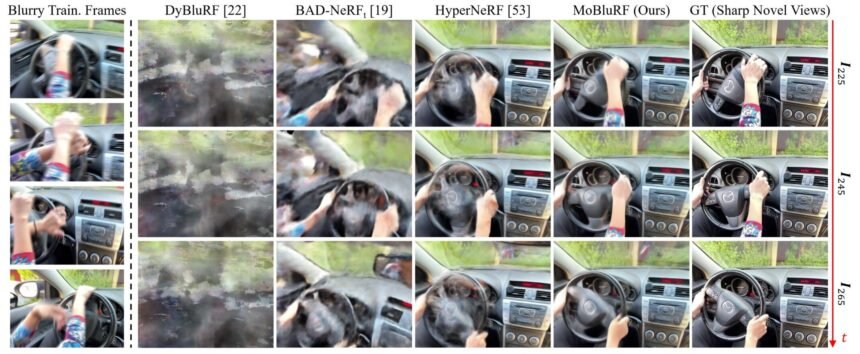
The innovative design of MoBluRF has positioned it as a standout performer among existing methods, showcasing superior performance across various datasets both quantitatively and qualitatively. Its robustness against varying degrees of blur underscores its potential to revolutionize the landscape of 3D reconstruction and novel view synthesis. Dr. Oh envisions a myriad of applications for MoBluRF, from enhancing content creation on smartphones and consumer devices to improving scene understanding for robots and drones. The framework’s ability to generate crisp 3D models from shaky footage and eliminate the need for specialized capture setups underscores its versatility and potential impact across diverse domains.
In conclusion, MoBluRF represents a significant leap forward for NeRFs, offering a groundbreaking solution for generating high-quality 3D reconstructions from everyday blurry videos. The research team’s innovative approach has the potential to reshape the future of computer vision and pave the way for new possibilities in content creation and immersive experiences.