


With the rise of mobile applications transforming various aspects of our lives, including communication, shopping, work, and healthcare, the healthcare industry is also embracing innovative mobile app development trends. The evolution from in-person visits and paper-based systems to a tech-driven ecosystem with telemedicine, AI diagnostics, remote monitoring, and IoT medical devices has been significant.
The healthcare sector is experiencing rapid changes, with advancements like AI, IoMT, big data, and cloud technologies driving real-time insights, scalability, and personalized care. User experience is also evolving with voice interfaces, gamification, AR/VR, and immersive interactions in the metaverse. Personalization is a key focus, enabled by genomics, digital therapeutics, mental health solutions, and women-focused wellness platforms. Security, compliance, and interoperability are foundational aspects, supported by blockchain technology and seamless EHR and EMR integrations.
Looking ahead to 2026, healthcare app development trends are set to revolutionize the delivery of care, data utilization, and patient-provider interactions. In this blog, we delve into the top trends shaping the future of digital health and how they will impact the healthcare industry.
The article discusses the rapid evolution of healthcare apps, driven by mobile technology and innovative trends. It explores the shift towards personalized, tech-driven care experiences in the healthcare industry, highlighting key advancements and future predictions.
Key Takeaways
- Healthcare apps in 2026 will evolve into intelligent ecosystems that deliver connected, predictive, and patient-centric digital care.
- AI, IoMT, big data, and cloud technologies will power real-time insights, scalability, and smarter clinical decision-making.
- User experience will drive adoption through voice interfaces, gamification, AR/VR, and immersive metaverse-based interactions.
- Personalization will dominate healthcare apps, enabled by genomics, digital therapeutics, mental health solutions, and women-focused wellness platforms.
- Security, compliance, and interoperability will become foundational, supported by blockchain and seamless EHR and EMR integrations.
Healthcare App Development Market Analysis
- According to Precedence Research, the global mHealth app market is valued at USD 43.13 billion in 2025 and is projected to surpass USD 154.12 billion by 2034, expanding at a robust CAGR of 15.20% during the forecast period.
- The U.S. mHealth apps market is valued at USD 14.44 billion in 2025 and is expected to reach approximately USD 51.83 billion by 2034, registering a CAGR of 15.40% over the forecast period.
- Deloitte’s survey reveals that in 2025, health tech startups captured 14% of total venture capital investments, highlighting strong investor confidence in the sector.
- Roots Analysis says that based on geographic distribution, the global patient-centric healthcare app market spans North America, Europe, Asia-Pacific, the Middle East, and Latin America.
- Hospitals represent the largest share of end-users, reflecting their strong reliance on digital tools to streamline patient care and improve operational efficiency.
- The disease and treatment management segment remains the most dominant, largely because patient-centric healthcare apps are extensively used to track key health metrics such as blood pressure, glucose levels, and heart rate.
However, the peak of the COVID-19 pandemic has affected the healthcare industry extensively, which led to the rapid adoption of healthcare software development solutions.
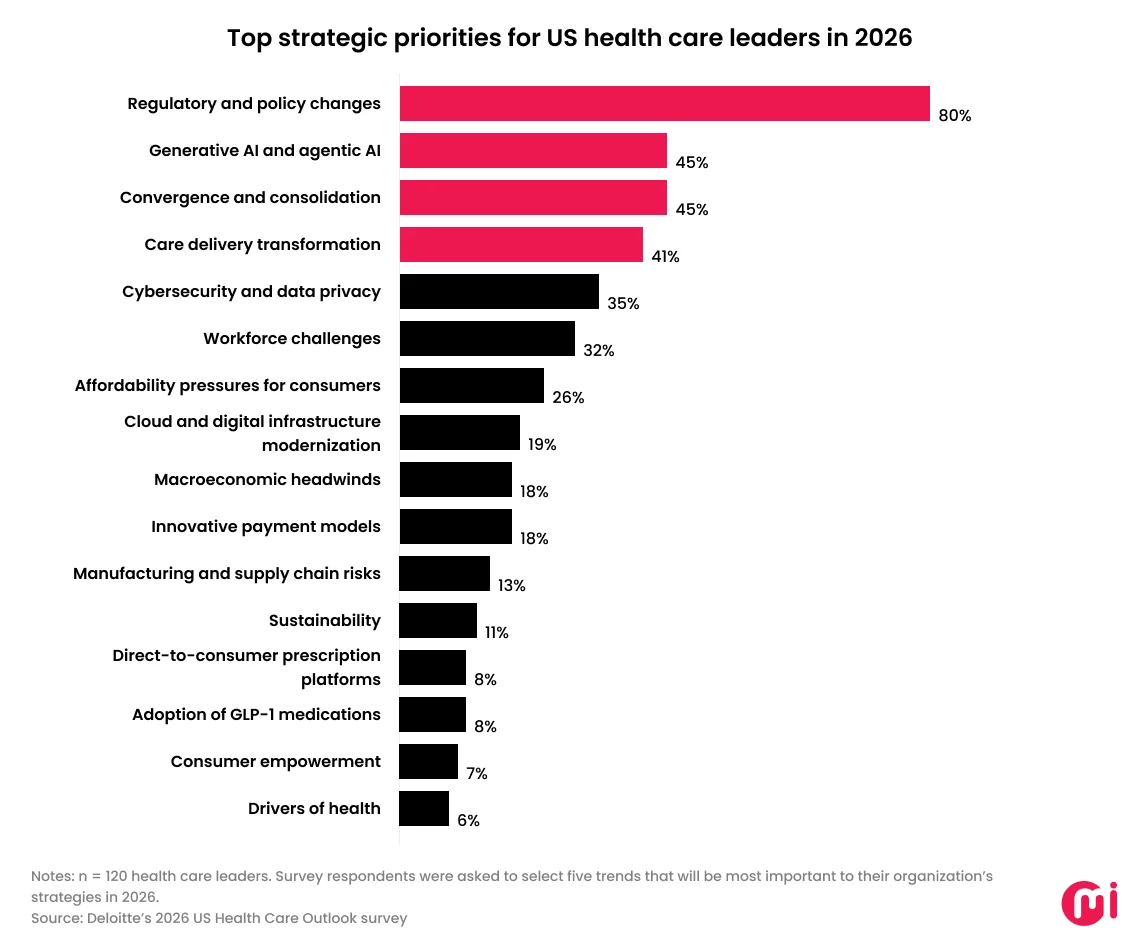
Knowing healthcare app adoption market statistics is just a first step, but you do want to know healthcare app development trends for 2026 to move forward.
Top Healthcare App Development Trends to Rule in 2026
In 2026, emerging trends like AI-led personalization, next-generation telemedicine, and remote patient monitoring will ensure continuous care beyond traditional settings. Moreover, personalized medicine, big data, and cloud computing will help provide care and build scalable healthcare ecosystems.
AR/VR, the metaverse, and gamification will enhance engagement and training experiences. Interoperability, blockchain, EHR/EMR integrations, voice interfaces, digital therapeutics, and women’s wellness apps will ensure secure, inclusive, and patient-centric healthcare delivery. Below is a detailed exploration of these trends and their impact on the healthcare industry.
1. Artificial Intelligence for Smarter Healthcare Apps
The growing adoption of AI in healthcare has enabled the industry to lead innovation, efficiency, and data-driven decision-making. Deloitte’s recent survey reveals that more than 80% of healthcare executives expect generative AI and agentic AI to drive meaningful value across core operations in 2026.
With its proposals for pharmaceutical & biotechnology startups, NLP, RPA, and clinical trial participant identifiers, the use of AI and ML in healthcare will revolutionize the industry.
- Artificial intelligence can help to examine patients more accurately and can be considered a huge blessing where immediate medical treatment is required.
- The advanced AI solutions will allow the computer systems to make self-decisions even in the absence of the medical staff.
- The patients will not be required to visit the clinics and hospitals regularly, which will definitely make medical bills more cost-effective.
- The Artificial Intelligence (AI) technique will also reduce the number of human errors. Yes, even doctors, at times, may make a mistake while diagnosing a patient or during treatment.
- AI will make complex and life-risking surgeries easier and will help in the faster recovery of patients.
- An AI solution like Robotic Process Automation (RPA) can help to streamline healthcare body processes, including health payments, early diagnostics, patient data analytics, data entry, etc.
- AI-powered chatbots for initial health-related data gathering and analyzing symptoms to schedule an appointment with a doctor.
With its ability to enhance clinical accuracy, automate operations, and support remote care, AI will help the industry provide intelligent, scalable, and patient-centric healthcare solutions in 2026.
2. Telemedicine and Virtual Healthcare Services
Telemedicine has rapidly emerged as a cornerstone trend in healthcare app development because it fundamentally transforms how care is delivered, accessed, and managed. At its core, telemedicine removes traditional barriers such as distance and limited clinical capacity, allowing patients to consult healthcare providers from anywhere via digital platforms.
This trend is a response to convenience driven by massive market growth and shifting healthcare dynamics worldwide. According to Precedence Research, the global telemedicine market is projected to reach USD 160.13 billion in 2025 and expand to nearly USD 710 billion by 2034, growing at an impressive CAGR of 17.99% over that period.
The telehospital segment is anticipated to experience a significant growth rate as the adoption of remote patient monitoring devices increases. This growth can be attributed to government initiatives, rising patient awareness of health concerns, and widespread access to internet-based solutions.
Several key factors are fueling this trend:
- Patients increasingly seek convenient access to healthcare services without needing to travel, especially in rural or underserved regions where clinics and specialists are scarce.
- Advances in mobile connectivity, video conferencing, and secure data sharing make virtual consultations more reliable and user-friendly than ever.
- Rising chronic disease prevalence, physician shortages, and overloaded healthcare systems are pushing providers to adopt digital alternatives that improve reach and efficiency.
- Telemedicine reduces travel costs, shortens wait times, and expands access to specialist care, making it a compelling solution for both patients and providers.
Telemedicine will push healthcare apps beyond support tools into always-available care channels that meet modern patient demands.
3. Internet of Medical Things for Connected Care
The Internet of Medical Things (IoMT) is one of the rapidly emerging healthcare app development trends. It enables seamless connectivity between medical devices, apps, and healthcare systems, bringing real-time health data directly into the hands of clinicians and patients.
This connected ecosystem supports remote monitoring, continuous diagnostics, personalized care, and enhanced patient engagement, which are all urgently needed in today’s healthcare environment.
According to the Fortune Business Insights, the global IoMT market is expected to expand from USD 60.03 billion in 2024 to USD 814.28 billion by 2032, growing at a CAGR of 38.5% during the forecast period.
Multiple underlying drivers are contributing to this trend:
- IoMT devices, such as wearable sensors, smart monitors, and connected implants, collect continuous health data that can be integrated with healthcare apps for real-time insights into vital signs, disease progression, and treatment effectiveness.
- IoMT enables remote monitoring and telehealth services, allowing healthcare providers to support patients outside hospital walls, reducing travel, lowering costs, and improving access for underserved populations.
- Connected devices generate large datasets using analytics and generative AI in healthcare, providing help in predicting health risks, personalizing interventions, and supporting preventive care.
In 2026, by syncing with mobile apps, IoMT will empower patients to monitor their own health metrics, adhere to treatment plans, and communicate with providers more effectively, driving better long-term health outcomes.
4. Personalized Medicine and Genomics in Apps
Personalized medicine and genomics are approaches that tailor healthcare delivery and treatment plans to each individual’s unique genetic profile, lifestyle, and biological data. Rather than relying on one-size-fits-all solutions, this trend uses genomic insights and advanced analytics to make care more predictive, precise, and effective.
Moreover, advances in genome sequencing and related technologies are driving down costs and making genetic data more accessible than ever before. Modern genomic sequencing can be performed faster and at a fraction of the historical cost, enabling applications to incorporate individualized genetic information into clinical decision-making and patient engagement.
Healthcare apps are increasingly integrating genetic and clinical data to personalize treatments and risk predictions. This includes features like
- Predictive analytics to assess disease risk or treatment response
- Pharmacogenomic insights that suggest the most effective medications with fewer side effects
- Tailored preventive care recommendations based on genetic markers
These capabilities not only support better outcomes but also enhance the relevance of app-based health guidance for individual users.
Personalized medicine is increasingly embedded in digital health ecosystems. Many healthcare apps now incorporate capabilities such as:
- Genetic test result interpretation
- Real-time tracking of health metrics alongside genomic context
- AI-based recommendations that adjust over time based on user data
Hence, personalized medicine and genomics will become central to healthcare app development because they empower apps to deliver context-aware, high-precision health interventions tailored to each individual.
5. Augmented & Virtual Reality and Metaverse in Healthcare
Augmented Reality (AR) & Virtual Reality (VR) and metaverse technologies are transforming how healthcare apps provide training, treatment, and patient engagement.
The global AR and VR healthcare market was valued at USD 3.05 billion in 2025 and is expected to reach USD 3.81 billion in 2026. By 2035, the market is projected to grow to USD 27.98 billion, expanding at a CAGR of 24.81% between 2026 and 2035.
This growth is driven by several practical use cases:
- AR/VR apps allow students and surgeons to rehearse procedures in immersive environments that mimic real-world anatomy and cases, improving skills without risk to patients.
- Virtual environments, overlays, and metaverse experiences help clinicians explain conditions or visualize treatment plans during telemedicine sessions.
- VR and metaverse-based therapies can reduce anxiety, assist in
