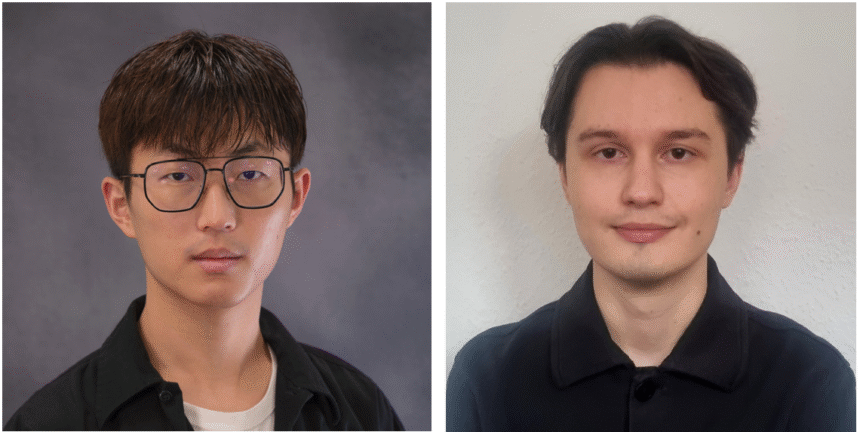
Xhuliano Brace quickly discovered that traditional venture capital wasn’t flowing towards two young founders pursuing an unconventional approach to utilizing AI for drug design.
Instead of waiting for external investment, Brace took a bold step and decided to fund his ambitious project independently. Departing from his role at Amazon, where he had spent four years working on AI initiatives, Brace poured his personal savings and earnings from online trading into establishing Rhizome Research. This Seattle-based startup is dedicated to developing tailored small drug-like molecules.
After its recent emergence from stealth mode, Rhizome Research, which currently consists of five team members, is led by CEO Brace, a multi-disciplinary graduate from the University at Albany with degrees in math, computer science, and economics. The startup’s leadership also includes:
- Yiwen Wang, co-founder and chief scientist, holds a PhD in chemistry from Carnegie Mellon University.
- Gregory Sinenka, chief technologist, is a physics PhD with prior experience at a European research center and Johnson & Johnson.
- John Proudfoot, a former U.S.-based director in the Medicinal Chemistry Department at Boehringer Ingelheim, serves as a scientific advisor.
Revolutionizing Drug Discovery
Distinct from conventional molecule design tools, Rhizome has developed its proprietary advanced model called r1. This technology, known as a “graph neural network,” was trained using a database of over 800 million small drug-like molecules.
Unlike the popular RoseTTAFold model from the University of Washington’s Institute for Protein Design, which focuses on amino acids in protein building, Rhizome’s r1 model is centered on the atomic and bonding structure of molecules. The graph concept visualizes atoms as nodes and bonds as edges, emphasizing the molecule’s topology.
The team’s primary goal is to facilitate fragment-based drug discovery by crafting optimized small molecules tailored to bind with specific targets specified by customers. Each drug candidate is meticulously designed for efficient lab synthesis and patent protection.
Recently, Rhizome unveiled ADAMS, an open-source AI tool that utilizes natural language commands to simulate biological molecule binding. Additionally, the team plans to introduce MolSim, a physics-based simulation incorporating advanced free-energy calculations to predict molecular binding strength. MolSim will not be open source.
Seattle’s Innovative Drug Discovery Hub
Establishing collaborations with wet labs for validating drug performance and exploring client engagements, Rhizome is actively expanding its network. While Brace operates from Foundations, the Seattle startup community founded by entrepreneur Aviel Ginzburg, the rest of the team works remotely, with plans to relocate to Washington.
Expressing his vision to transform Seattle into a central hub for small molecule drug discovery, Brace highlights the prominent institutions in the region, such as the Allen Institute and the Institute for Protein Design, along with other drug design startups like Pauling.AI, Synthesize Bio, and Xaira Therapeutics. Brace is enthusiastic about the meaningful impact AI-driven molecule design can have across various industries, emphasizing its potential in healthcare, materials science, and advanced manufacturing.
Brace’s unwavering commitment to a project with significant societal implications, coupled with his belief in the power of AI for molecule design, reflects his optimism and dedication to pioneering innovation in the field.