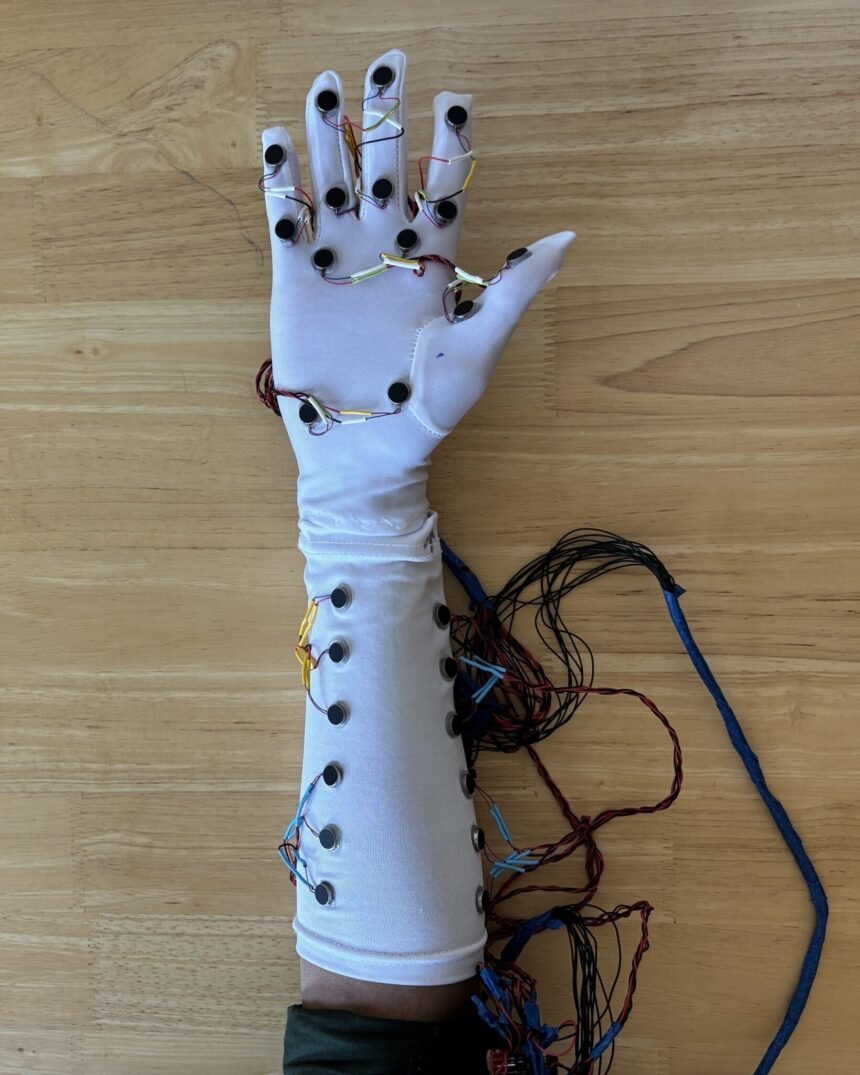
Touch is a fundamental aspect of human communication and bonding, playing a crucial role in fostering emotional connections, building trust, and reducing stress. However, in today’s digital era, where many of our interactions occur through screens, the element of touch is often missing. To address this gap, a team of experts at the USC Viterbi School of Engineering has developed a wearable haptic system that enables users to perform and feel physical gestures in virtual reality, enhancing the overall engagement and realism of virtual interactions.
The system consists of gloves and sleeves equipped with small vibration motors that replicate sensations like pressure and movement. This technology allows users to engage in gestures such as handshakes, pats, and squeezes within a shared virtual space, as well as interact with virtual objects while receiving realistic vibration feedback. A user study conducted to test the technology, in conjunction with the IEEE World Haptics Conference, revealed that participants found virtual interactions more engaging, pleasant, and lifelike when they could feel gestures.
Heather Culbertson, an associate professor at USC Viterbi and the study’s corresponding author, noted the importance of incorporating the sense of touch into online interactions, especially in light of the increasing levels of depression, anxiety, and “touch starvation” observed in individuals who spend significant amounts of time socializing online. The goal is to enhance virtual interactions to reflect the social benefits derived from in-person experiences, ultimately improving the overall quality of digital communication.
How the Technology Works
The haptic system supports up to 16 users simultaneously, each represented by a full-body 3D avatar that mirrors their real-world movements in a shared virtual environment. Unlike traditional video calls, users have the freedom to move around and interact with each other and virtual objects, fostering a more dynamic and immersive virtual experience. Premankur Banerjee, a doctoral student involved in the research, emphasized the personal significance of the project, highlighting the importance of technology in restoring a sense of physical closeness that is often lost in long-distance communication.
To enable the sense of touch, users wear gloves and armbands embedded with vibration motors that provide tactile feedback, simulating various sensations such as pressure and motion. Lab tests demonstrated that participants experienced a greater sense of presence and social connection when tactile feedback was integrated into their virtual interactions. The research also explored how different factors like gesture speed and vibration type influenced emotional and sensory experiences, providing valuable insights for designing more engaging virtual touch interactions.
Heather Culbertson emphasized the interdisciplinary nature of developing such technology, highlighting the collaboration between experts in computer science, engineering, neuroscience, psychology, and social sciences to create hardware and software that not only functions technically but also supports natural and emotionally meaningful social interactions.
Enhancing Social Connections through Virtual Touch
The ongoing shift towards online communication, accelerated by the COVID-19 pandemic, has undeniably improved connectivity but has also led to unintended consequences such as increased feelings of loneliness, anxiety, and depression. While platforms like Zoom and FaceTime have facilitated visual and verbal communication, they often lack the physicality that humans naturally crave in their interactions.
Heather Culbertson emphasized that while the technology cannot fully replicate the experience of in-person contact, it can serve as a powerful tool to enhance social interaction, particularly in situations where physical presence is not feasible. The researchers envision a variety of applications for their system, including enabling patients and family members in hospitals or long-term care facilities to share comforting touch across distances, providing immersive collaboration and engagement in remote or hybrid workplaces and classrooms, and fostering a deeper sense of closeness between loved ones separated by various circumstances.
The integration of touch into virtual spaces is seen as a crucial step towards facilitating more meaningful connections in today’s digital world, recognizing the fundamental role of human touch in overall well-being. The USC researchers’ groundbreaking technology offers a glimpse into a future where virtual interactions can be as emotionally engaging and socially fulfilling as face-to-face encounters.
More information:
Premankur Banerjee et al, Virtual Encounters of the Haptic Kind: Towards a Multi-User VR System for Real-Time Social Touch, arXiv (2025). DOI: 10.48550/arxiv.2502.13421