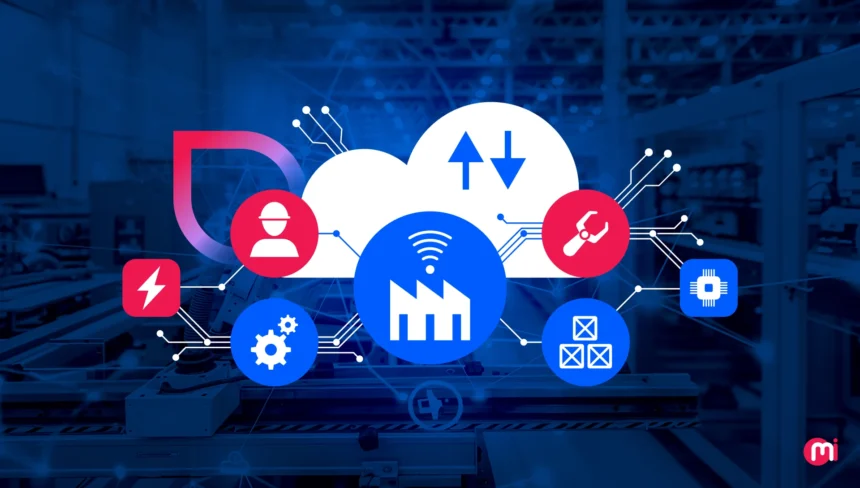
If you operate in the manufacturing sector, you understand the importance of gaining real insights. Missing out on these insights can result in disjointed systems, slower decision-making, and manual errors.
Fortunately, cloud computing has emerged as a game-changer for the manufacturing industry. It not only enhances efficiency and cuts costs but also fosters better collaboration, covering all bases effectively.
The global cloud computing market size is on the rise, projected to reach USD 3,349.61 billion by 2033 with a CAGR of 16.1% from 2026 to 2033 (source: Source).
These numbers clearly indicate that cloud computing is becoming the backbone of modern businesses. Organizations that delay or ignore cloud adoption risk falling behind in a market growing at over 16% annually.
It’s essential for the manufacturing sector to view cloud not merely as a cost line but as a facilitator of tangible business outcomes like reduced downtime, lower maintenance costs, quick changeovers, improved quality analytics, and enhanced collaboration with partners.
Cloud technology is revolutionizing the manufacturing industry, enabling businesses to adapt, progress, and lead in a rapidly evolving market. As products become more software-driven and interconnected, manufacturers are turning to cloud-based solutions for increased efficiency compared to traditional internal data centers.
Let’s delve into the role of cloud computing in manufacturing and explore more on this topic.

Key Takeaways
- Cloud computing boosts efficiency and decision-making in manufacturing by enabling real-time data collection, processing, and sharing across production lines.
- Manufacturers use cloud computing to integrate machines, sensors, MES, ERP, and supply chain for real-time planning, remote monitoring, and scalable predictive maintenance.
- Benefits of cloud computing in manufacturing include scalability, flexibility, cost reduction, real-time data access, monitoring, data security, supply chain management, and enhanced collaboration.
- Real-life applications of cloud computing in manufacturing encompass supply chain management, inventory management, predictive maintenance, production planning and execution, quality management, and smart factory operations.
- The future of cloud computing in manufacturing focuses on AI-native platforms, edge cloud hybrids, and verticalized solutions for autonomous factories, generative AI, and sustainability.
Summary: The manufacturing sector is embracing cloud computing to enhance efficiency, reduce costs, and foster innovation. Cloud technology offers numerous benefits, including scalability, real-time data access, and enhanced collaboration, positioning businesses for success in a dynamic market.