OpenAI has announced significant advancements in its deep learning systems, showcasing faster problem-solving capabilities. CEO Sam Altman revealed during a livestream that the company is on track to achieve an intern-level research assistant by September 2026 and a fully automated “legitimate AI researcher” by 2028.
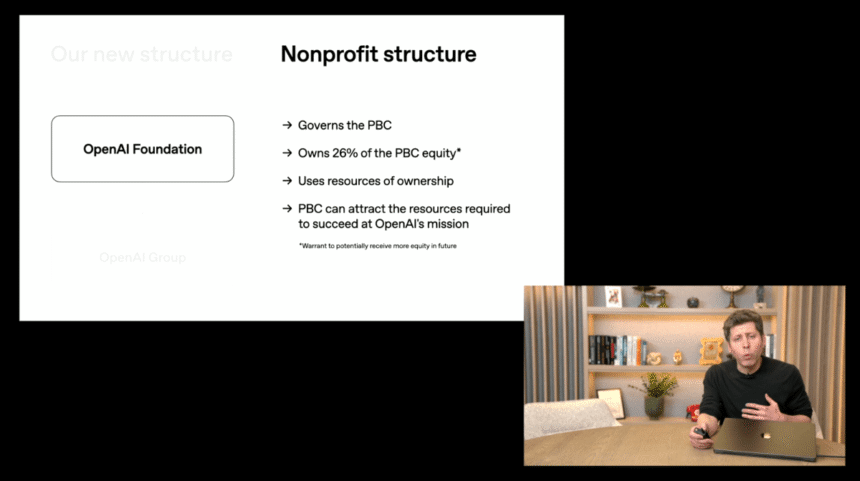
On the same day, OpenAI completed its transition to a public benefit corporation structure, departing from its non-profit origins. This move provides the company with more flexibility by freeing it from the constraints of its non-profit status, while also enabling opportunities for fundraising.
Chief Scientist Jakub Pachocki joined Altman on the livestream to discuss the development of an AI researcher capable of autonomously managing extensive research projects. Pachocki also expressed the belief that superintelligent systems, surpassing human intelligence in various critical tasks, could be less than a decade away.
To realize these objectives, OpenAI is focusing on advancing algorithms and significantly increasing “test time compute,” which involves enhancing the time models spend deliberating on complex issues. The company aims to extend the horizons of its models rapidly by allocating more computational resources for problem-solving, potentially dedicating entire data centers to solve major scientific challenges.
OpenAI’s overarching mission is to drive scientific progress, empower AI to outperform human researchers, tackle intricate problems beyond human capabilities, and accelerate technological innovation in fields like medicine, physics, and technology development.
Altman emphasized that the restructuring enables OpenAI to pursue its ambitious AI research assistant timeline while upholding a commitment to responsible AI advancement. The non-profit OpenAI Foundation, focused on scientific progress, will hold a 26% stake in the for-profit arm, shaping research direction and overseeing AI research and safety initiatives.
Techcrunch event
San Francisco
|
October 27-29, 2025
Altman highlighted that the for-profit division’s enhanced fundraising capacity will facilitate the expansion of necessary infrastructure to drive scientific breakthroughs. OpenAI has committed to developing 30 gigawatts of infrastructure, equating to a $1.4 trillion financial investment over the coming years.