

Metal-air batteries have the potential to revolutionize the energy sector by providing a cleaner and more efficient alternative to fossil fuels. By converting oxygen from the air into power, these batteries offer significantly higher energy densities compared to lithium-ion cells, making them ideal for various applications.
Despite their theoretical advantages, metal-air batteries face challenges in achieving widespread commercial viability. The high-performance catalysts required for these batteries often rely on expensive precious metals, hindering mass production and deployment. Additionally, existing catalyst materials are typically monofunctional, limiting their effectiveness in driving essential electrochemical processes.
To address these challenges, a team of researchers led by Professor Takahiro Ishizaki from Shibaura Institute of Technology, Japan, and Assistant Professor Sangwoo Chae from Nagoya University, Japan, have developed a groundbreaking single-step method for creating highly efficient bifunctional catalysts using affordable materials.
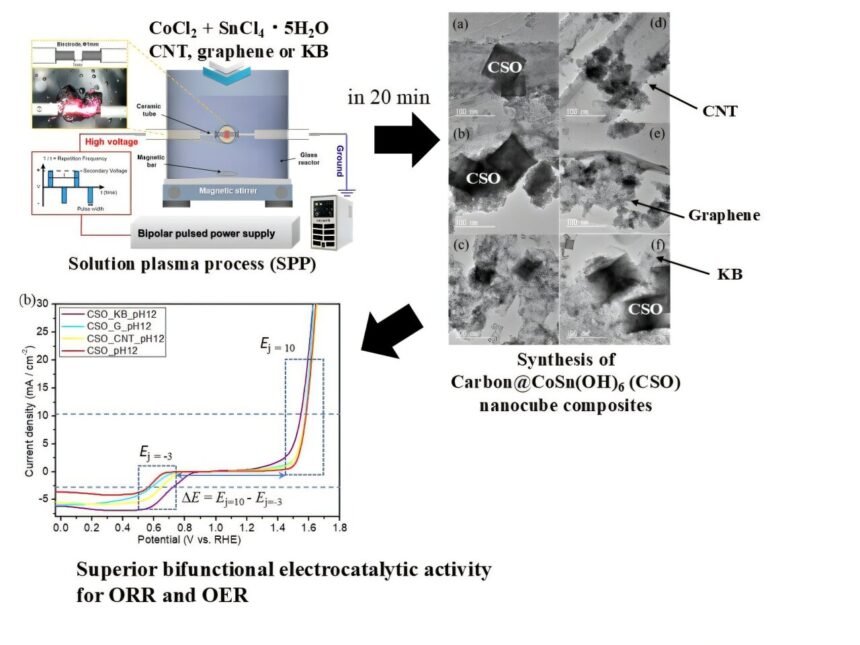
In their recent study published in Sustainable Energy & Fuels, the researchers utilized a solution plasma process (SPP) to synthesize cobalt-tin hydroxide (CoSn(OH)6) composites anchored to various carbon supports. Unlike traditional synthesis methods, SPP allows for rapid and cost-effective production of catalysts with superior catalytic activity.
The innovative catalysts demonstrated exceptional performance in both the oxygen reduction and oxygen evolution reactions, essential for overall battery efficiency. The CoSn(OH)6-Ketjen Black composite, in particular, outperformed industry-standard catalysts in terms of efficiency and durability, offering a sustainable alternative to precious metal-based catalysts.
The research findings hold significant implications for energy storage in electric vehicles and grid-scale applications, promising longer ranges, faster charging capabilities, and reduced costs. The single-step synthesis method also presents industrial advantages by simplifying production processes and reducing environmental impact.
Overall, the study represents a crucial step towards achieving economically viable clean energy storage solutions on a global scale, accelerating the transition away from fossil fuels in the transportation and energy sectors.

