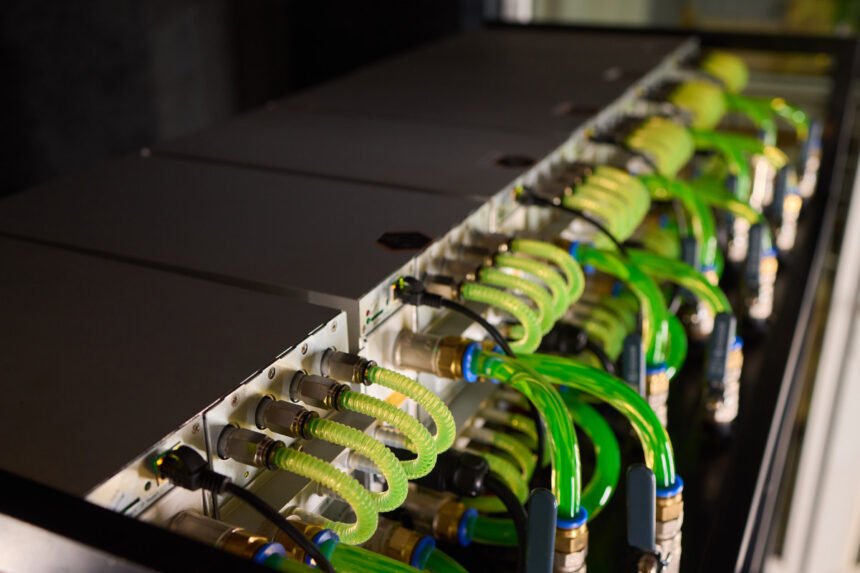
In this article, Stephanie Buschmann, Corporate Account Manager at Ecolab, discusses the importance of water-centric, instrumented liquid cooling in data centres. With the increasing power density of modern GPU-dense racks, the challenge of effectively and efficiently cooling data centres has become a central focus for operators.
Water is highlighted as an excellent heat-transfer medium that can enable thermal density without the energy penalty of traditional air-cooling methods. However, the use of water in cooling systems also introduces operational risks such as fluid concentration, contamination, corrosion, and microbiological growth near high-value AI chips.
To address these challenges, Buschmann emphasizes the importance of treating the coolant loop like a process plant from the beginning, implementing real-time instrumentation for monitoring fluid health, and ensuring materials compatibility and addressing the biology problem. Integrating cooling with energy and operational planning is also crucial for maximizing efficiency and reducing both energy and water footprints.
Overall, well-designed liquid cooling systems can unlock higher rack density, extend equipment life, improve PUE and WUE metrics, and provide a competitive advantage for data centre operators. By working with experienced vendor partners, implementing best practices in commissioning and monitoring, and measuring water usage accurately, cooling systems can become a value-adding component of data centre operations.