The team led by Professor Chiara Neto developed a porous polymer coating that reflects nearly all sunlight and emits heat into the atmosphere, keeping surfaces up to 6 degrees cooler than the ambient air even in direct sunlight. This cooling effect creates optimal conditions for water vapor in the air to condense into droplets on the cooler surface, similar to how steam forms on a bathroom mirror.
Professor Neto, from the University of Sydney Nano Institute and School of Chemistry, emphasized the far-reaching implications of this technology. She stated, “This breakthrough not only advances the field of cool roof coatings but also introduces a sustainable, cost-effective, and decentralized method of obtaining fresh water—a crucial necessity in the face of climate change and escalating water scarcity.”
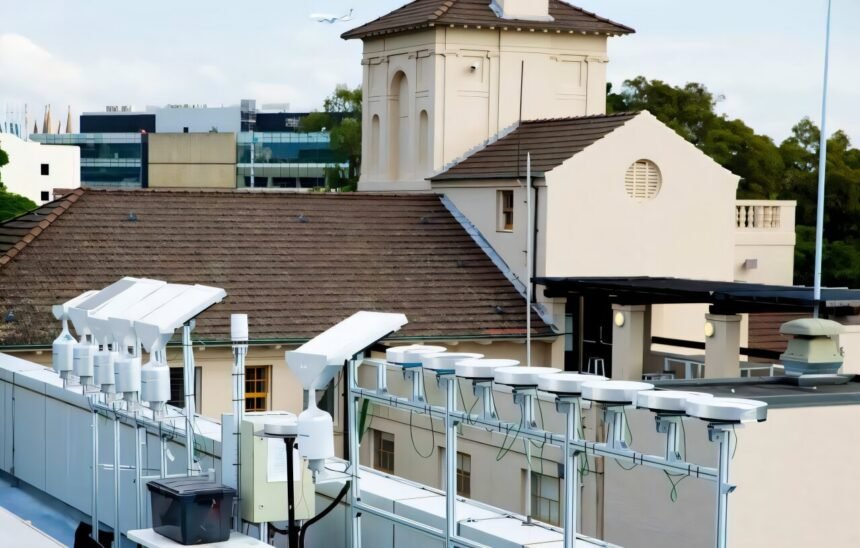
The findings from a six-month outdoor study conducted on the roof of the Sydney Nanoscience Hub revealed that dew could be collected for over 32% of the year, providing a consistent and predictable water supply even during dry periods. Under optimal conditions, the coatings have the capacity to harvest up to 390 mL of water per square meter daily, sufficient to meet the daily drinking requirements of an individual on a 12-square-meter surface.
The study, published in Advanced Functional Materials, demonstrates the integration of passive cooling and atmospheric water collection into a paint-like material suitable for widespread use.
These innovative coatings, made of polyvinylidene fluoride-co-hexafluoropropene (PVDF-HFP), do not rely on traditional white pigments like titanium dioxide. Dr. Ming Chiu, the lead author of the study and Chief Technology Officer of Dewpoint Innovations, explained, “Our design achieves high reflectivity through its internal porous structure, ensuring durability without the environmental downsides of pigment-based coatings. By eliminating UV-absorbing materials, we surpass the conventional limits of solar reflectivity while preventing glare through diffused reflection, making it more practical and visually appealing for real-world applications.”
Throughout the extensive outdoor trial, the research team meticulously recorded data on cooling and water collection minute by minute, confirming the robust performance of the coatings without any degradation under the harsh Australian sun. This durability sets these coatings apart from similar technologies that degrade rapidly.
Besides water harvesting, these coatings have the potential to mitigate urban heat island effects, reduce the energy demands for air conditioning, and offer climate-resilient water sources in regions facing escalating heat and water stress.
Professor Neto also highlighted that dew collection is not limited to humid climates, challenging the common belief. She stated, “While humid conditions are ideal, dew can form even in arid and semi-arid regions where nighttime humidity levels rise. This technology is not about replacing rainfall but supplementing it by providing water where and when other sources are limited.”
To transition this groundbreaking discovery from the laboratory to practical applications on rooftops, Dewpoint Innovations is currently developing a water-based paint formulation that can be easily applied using standard rollers or sprayers. Perzaan Mehta, CEO of Dewpoint Innovations, expressed pride in collaborating with the University of Sydney to bring this passive atmospheric water harvesting innovation to life through advanced paint coatings, offering a scalable, energy-efficient solution to transform rooftops and remote structures into reliable sources of clean water.
With over 2 million Australian households already collecting rainwater, the concept of dew-collecting roofs could complement existing water harvesting systems. Professor Neto envisioned a future where roofs not only stay cooler but also generate their own fresh water, underscoring the potential of this technology.
Licensed from the University of Sydney to start-up Dewpoint Innovations in 2022, this pioneering technology represents a significant advancement towards scalable, eco-friendly solutions for water harvesting and passive cooling, with diverse applications in the construction sector, agriculture, remote communities, and urban infrastructure.
More information:
Ming Chiu et al, Passively Cooled Paint‐Like Coatings for Atmospheric Water Capture, Advanced Functional Materials (2025). DOI: 10.1002/adfm.202519108