The world of fashion is constantly evolving, with trends coming and going at a rapid pace. This ever-changing landscape can make it challenging to keep up, leading many to constantly refresh their wardrobes to stay current. However, this cycle of consumption can be both wasteful and expensive, contributing to the staggering amount of textile waste generated each year.
According to studies, approximately 92 million tons of textile waste are produced annually, much of which comes from discarded clothing that is no longer in style or no longer fits. In an effort to combat this issue and promote sustainability in the fashion industry, a team of researchers from MIT’s Computer Science and Artificial Intelligence Laboratory (CSAIL) and Adobe have developed a groundbreaking software system called “Refashion.”
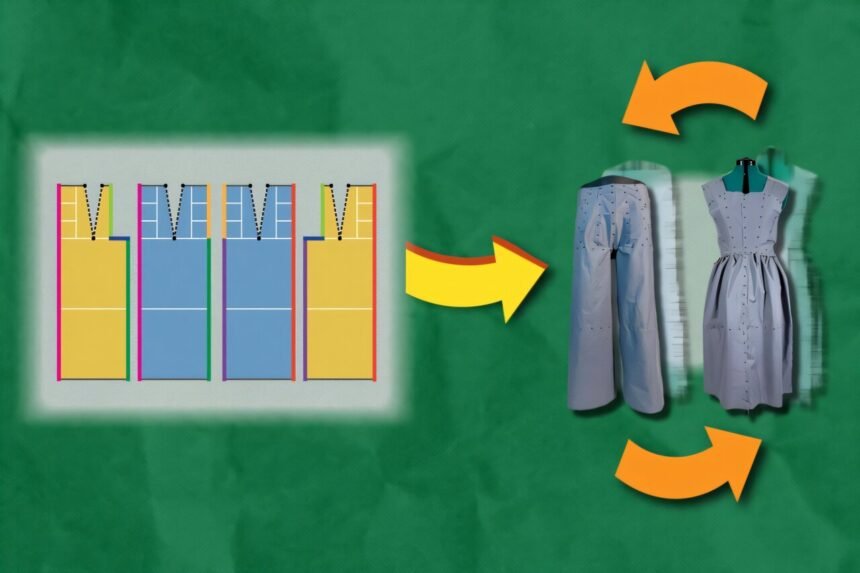
Refashion revolutionizes the way we approach fashion design by breaking it down into modular components, allowing users to draw, plan, and visualize each element of a clothing item. This innovative approach transforms fashion ideas into blueprints that outline how to assemble each component into versatile, reconfigurable garments. For example, users can create a pair of pants that can be easily transformed into a dress, or a shirt with an attachable hood for rainy days.
The software provides a user-friendly interface where individuals can simply draw shapes and piece them together to create adaptable fashion pieces. This visual diagram not only demonstrates how to cut garments but also provides a straightforward way to design items that can be repurposed for different occasions or body types. From maternity wear that adjusts to the various stages of pregnancy to a skirt that can be reconfigured into a dress for a formal event, Refashion empowers users to create personalized, sustainable clothing solutions.
“We wanted to create garments that consider reuse from the start,” says Rebecca Lin, a Ph.D. student in MIT’s Department of Electrical Engineering and Computer Science (EECS) and lead author of the paper. “Most clothes you buy today are static and are discarded when you no longer want them. With Refashion, we aim to shift this paradigm by enabling individuals to design garments that can evolve and adapt to their changing needs and preferences.”
By embracing the principles of circular fashion and promoting a more sustainable approach to clothing design, Refashion represents a significant step towards reducing waste and promoting a more environmentally conscious fashion industry. With its intuitive design tools and focus on adaptability, this innovative software system has the potential to revolutionize the way we think about fashion and inspire a new wave of eco-friendly, versatile clothing solutions. Refashion is a revolutionary tool that revolutionizes the way we approach our garments, allowing us to design items that can easily be resized, repaired, or restyled into different outfits. This innovative system has the potential to make prototyping garments more accessible and efficient, as demonstrated by a preliminary user study.
In this study, both designers and novices were able to create garment prototypes using Refashion. Participants were able to assemble pieces such as an asymmetric top that could be extended into a jumpsuit or remade into a formal dress in just 30 minutes. This showcases the ease of use and versatility of Refashion in creating unique and customizable clothing designs.
One of the key features of Refashion is its intuitive interface, which presents a simple grid in its “Pattern Editor” mode. Users can easily connect dots to outline the boundaries of a clothing item, essentially drawing rectangular panels and specifying how different modules will connect to each other. This allows for easy customization of the shape of each component, whether creating a straight design for garments or tinkering with one of Refashion’s templates.
Users can also get creative with individual modules, such as using the “pleat” feature to fold a garment over itself or the “gather” option to create puffy skirts or sleeves. The “dart” module allows for shaping the garment at the waist or tailoring it to the upper body. These features enable users to design a wide range of clothing styles and silhouettes.
Refashion also offers flexible and efficient means of connecting garments, allowing users to seam edges together using double-sided connectors like metal snaps or Velcro dots. This makes it easy to reconfigure modules if needed, whether due to damage or a desire for a new look.
As users design their clothing piece, Refashion automatically creates a simplified diagram of how it can be assembled. The pattern is divided into numbered blocks, which can be dragged onto different parts of a 2D mannequin to specify the position of each component. Users can then simulate how their sustainable clothing will look on 3D models of various body types.
Overall, Refashion presents a new way of approaching fashion, emphasizing sustainability and creativity. Instead of constantly buying new clothes, users can simply reconfigure and restyle existing pieces to create fresh and unique outfits. This shift in mindset has the potential to revolutionize the fashion industry and promote a more sustainable approach to clothing design.