

Tuesday, 24 Mar 2026
Subscribe
logo logo
  • Global
  • Technology
  • Business
  • AI
  • Cloud
  • Edge Computing
  • Security
  • Investment
  • More
    • Sustainability
    • Colocation
    • Quantum Computing
    • Regulation & Policy
    • Infrastructure
    • Power & Cooling
    • Design
    • Innovations
  • 🔥
  • data
  • revolutionizing
  • Stock
  • Investment
  • Future
  • Secures
  • Growth
  • Top
  • Funding
  • Power
  • Center
  • technology
Font ResizerAa
Silicon FlashSilicon Flash
Search
  • Global
  • Technology
  • Business
  • AI
  • Cloud
  • Edge Computing
  • Security
  • Investment
  • More
    • Sustainability
    • Colocation
    • Quantum Computing
    • Regulation & Policy
    • Infrastructure
    • Power & Cooling
    • Design
    • Innovations
Have an existing account? Sign In
Follow US
© 2022 Foxiz News Network. Ruby Design Company. All Rights Reserved.
Silicon Flash > Blog > Innovations > Revolutionizing Data Applications with DNA Technology
Innovations

Revolutionizing Data Applications with DNA Technology

Published February 7, 2026 By Juwan Chacko
Share
4 Min Read
Revolutionizing Data Applications with DNA Technology
SHARE

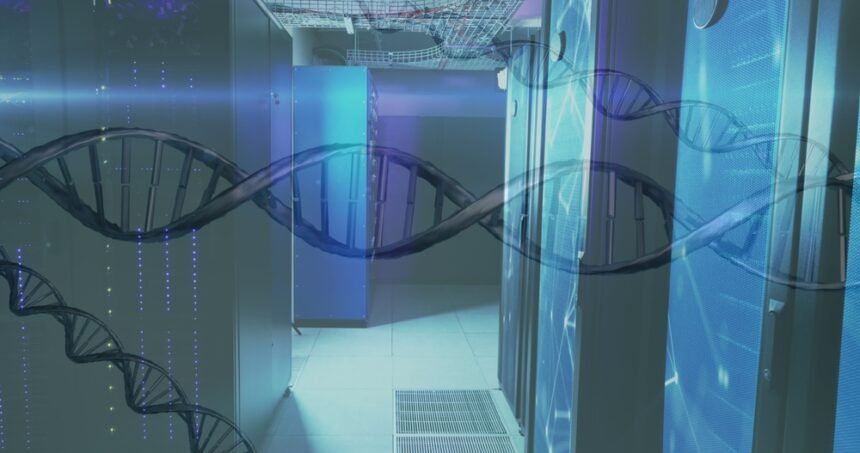
The DiDAX consortium, supported by EU EIC funding, consists of eight research groups from academia and industry collaborating to revolutionize DNA-based data applications. Their innovative work focuses on developing advanced algorithms, cost-effective synthesis methods, novel chemistries, and cutting-edge protection technologies to harness the potential of DNA as a versatile and secure medium for long-term data storage and applications.

DiDAX is a consortium of eight research groups, coming from both academia and industry and working together, under EU EIC funding, to innovate DNA-based data applications. Our work is based on novel encoding and decoding algorithms, reduced cost flexible synthesis, novel chemistries and new protection and embedding technologies and material science innovations.

Innovating in these disciplines, DiDAX expands the applicability of long-term archival DNA-based data storage and develops new applications to protect, verify and object authenticity.

DNA, as an information storage medium, has many advantages. First, DNA’s density – it can store extraordinary amounts of data in an extremely small volume. To illustrate the scale, if all the information currently hosted on YouTube were encoded in DNA, it would, in theory, fit in a single shoe box. Second, DNA is inherently stable, and we understand how to preserve it for extremely long periods. Third, DNA is environmentally friendly in having little associated energy cost, compared to magnetic media in data centers and in reducing electronic waste. And finally, its longevity and universality – DNA is the fundamental building block of life. As long as humans (and biology) exist, we will possess the tools and knowledge to read, write, and interpret DNA, unlike legacy storage technologies such as magnetic tapes, VCRs, or obsolete disk formats that became unreadable.

See also  Ink engineering approach boosts efficiency and cuts cost of quantum dot-based photovoltaics

Together, these and more make DNA an attractive medium for long-term, archival data storage.

Here is how we can (and indeed do so, in DiDAX) store data in DNA.

A DNA strand is a sequence built from four nucleotides, which together form a four-letter alphabet (A, C, G, T). Since modern synthesis technologies allow us to chemically create almost any DNA sequence we choose, we can treat DNA as a programmable storage medium. The process begins by taking a digital file and converting it into a binary representation (e.g., 00110010101). We then encode the binary string into DNA letters using a predefined mapping such as 00 → A, 01 → C, 10 → G, 11 11->T.  After encoding, the DNA sequences are chemically synthesized and stored in a physical container. For better sustainability encapsulation, chemistry may also be applied. Error correction codes are also used to address corruption that can occur in the process.

To retrieve the information, the stored DNA is sequenced using DNA sequencing technology (such as Illumina or Oxford Nanopore). Sequencing reveals the nucleotide order of the strands, which is then decoded by applying the same mapping in reverse, including algorithmic error correction, to reconstruct the original binary data and the original file.

TAGGED: applications, data, DNA, revolutionizing, technology
Share This Article
Facebook LinkedIn Email Copy Link Print
Previous Article The Importance of Data Governance for Small and Medium Businesses The Importance of Data Governance for Small and Medium Businesses
Next Article CoreWeave’s AI Readiness Lab: Testing the Boundaries of Technology CoreWeave’s AI Readiness Lab: Testing the Boundaries of Technology
Leave a comment

Leave a Reply Cancel reply

Your email address will not be published. Required fields are marked *

Your Trusted Source for Accurate and Timely Updates!

Our commitment to accuracy, impartiality, and delivering breaking news as it happens has earned us the trust of a vast audience. Stay ahead with real-time updates on the latest events, trends.
FacebookLike
LinkedInFollow

Popular Posts

Grabbing the Wheel: Vay’s Remote Driving Startup Secures $410M Investment from Singapore’s Grab

The rise of autonomous vehicles is creating opportunities for smaller companies to secure funding. Vay,…

November 10, 2025

How to Stream NFL Games in the UK: Sky Sports, NFL Game Pass & Free on Channel 5

NFL fans in the UK have an exciting season ahead with a variety of options…

November 30, 2025

Enhancing Edge Inference: Breaking AI’s Storage Barrier

Summary: 1. Innovations in storage technology enable enterprise AI use cases in healthcare. 2. The…

July 7, 2025

Webinar: The Future of Edge Computing: Trends, Innovations, and Predictions with Scale Computing

In collaboration, they will delve into the primary trends propelling the adoption of edge computing…

April 25, 2025

Unbound Secures $4 Million in Funding

Summary: Unbound, a San Francisco-based company, secured $4 million in funding for its generative AI…

May 31, 2025

You Might Also Like

Revolutionizing Entertainment: OpenAI and Reliance Collaborate to Enhance JioHotstar with AI-Powered Search
Business

Revolutionizing Entertainment: OpenAI and Reliance Collaborate to Enhance JioHotstar with AI-Powered Search

Juwan Chacko
Empowering Innovation: The Role of Design Enablement Teams in the European Chips Act
Innovations

Empowering Innovation: The Role of Design Enablement Teams in the European Chips Act

Juwan Chacko
Revolutionizing Enterprise Treasury Management with AI Advancements
AI

Revolutionizing Enterprise Treasury Management with AI Advancements

Juwan Chacko
Revolutionizing Network Testing with Spirent Luma’s Agentic AI: A Game-Changer in Triage Time Reduction
Global Market

Revolutionizing Network Testing with Spirent Luma’s Agentic AI: A Game-Changer in Triage Time Reduction

Juwan Chacko
logo logo
Facebook Linkedin Rss

About US

Silicon Flash: Stay informed with the latest Tech News, Innovations, Gadgets, AI, Data Center, and Industry trends from around the world—all in one place.

Top Categories
  • Technology
  • Business
  • Innovations
  • Investments
Usefull Links
  • Home
  • Contact
  • Privacy Policy
  • Terms & Conditions

© 2025 – siliconflash.com – All rights reserved

Welcome Back!

Sign in to your account

Lost your password?