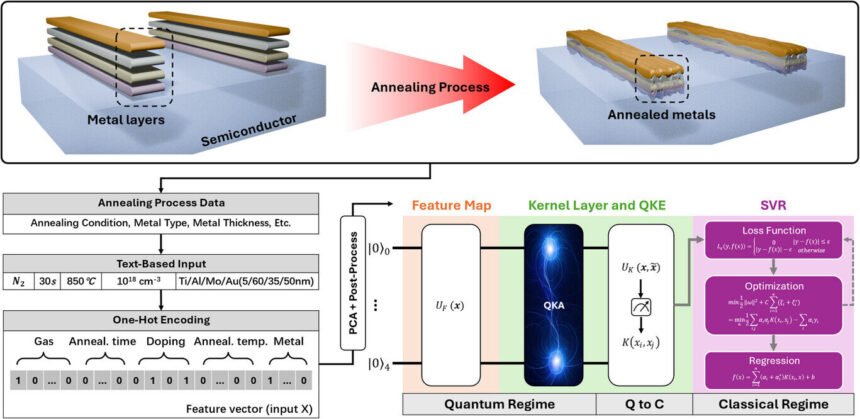
Semiconductor processing has long been known for its complexity, requiring meticulous attention to detail and numerous steps to create the tiny chips that power our modern devices. However, a groundbreaking achievement in the field has emerged, thanks to the innovative use of quantum machine learning by researchers at the Commonwealth Scientific and Industrial Research Organization (CSIRO), Australia’s national research agency.
The team’s groundbreaking research, recently published in the prestigious journal Advanced Science, showcases the application of quantum methodologies to enhance semiconductor fabrication, potentially revolutionizing the way chips are produced. This pioneering study marks the first instance where quantum machine learning has been successfully employed to optimize semiconductor manufacturing processes using real experimental data.
The focus of the study centered on a crucial aspect of semiconductor design—the modeling of Ohmic contact resistance in semiconductor materials. This resistance, which occurs when a semiconductor interfaces with metal, plays a critical role in determining the ease with which current can flow through the material.
Traditionally, modeling Ohmic contact resistance has presented a significant challenge due to its intricate nature. Conventional approaches rely on classical machine learning algorithms, which often struggle with small-sample, nonlinear settings. In contrast, the Australian researchers, led by the esteemed Professor Muhammad Usman, leveraged quantum machine learning techniques to tackle this complex problem.
By utilizing data from 159 experimental samples of GaN HEMT semiconductors (gallium nitride high-electron-mobility transistors), the researchers implemented a novel Quantum Kernel-Aligned Regressor (QKAR) architecture. This innovative approach involved translating classical data into quantum states to initiate the machine learning process, ultimately outperforming seven different classical machine learning algorithms developed for the same task.
The findings of this study not only hold promise for enhancing semiconductor manufacturing processes and improving device performance but also shed light on the potential of quantum technologies to address intricate problems beyond the capabilities of traditional computing systems. As quantum hardware continues to advance, the application of quantum machine learning in real-world scenarios may pave the way for transformative technological breakthroughs.
In conclusion, the fusion of quantum methodologies with semiconductor fabrication represents a significant leap forward in the field of advanced technology. The successful integration of quantum machine learning in semiconductor manufacturing not only underscores the potential for groundbreaking advancements in the industry but also highlights the broader implications of quantum technologies in solving complex challenges across various domains.