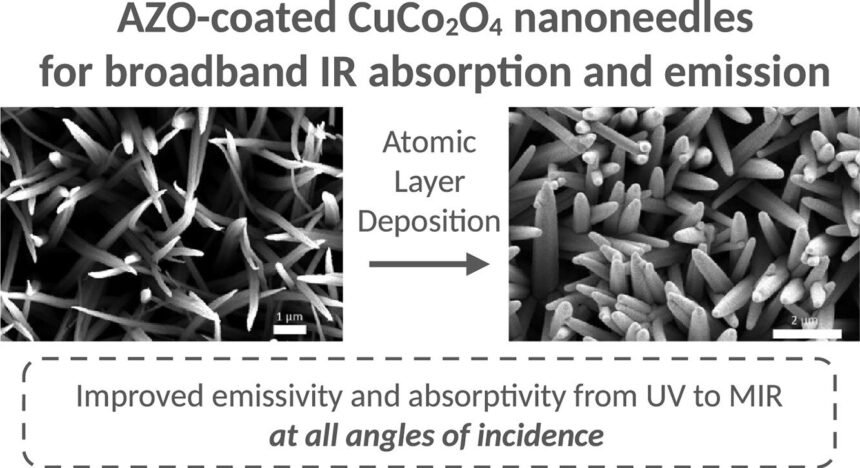
Using cutting-edge equipment, the Thermophysical Properties of Materials group at the University of the Basque Country (EHU) has evaluated the effectiveness of ultra-black copper cobaltate nanoneedles in absorbing solar energy. These nanoneedles have shown remarkable thermal and optical properties, making them well-suited for energy absorption. This discovery marks a significant step towards the development of concentrated solar power systems within the realm of renewable energy.
The experiments were conducted in a specialized laboratory equipped for high-temperature research. The results of the study were published in the journal Solar Energy Materials and Solar Cells, highlighting the potential of the new materials in revolutionizing solar energy absorption technologies.
Aiming for 100% light absorption
The research aims to enhance the efficiency of solar towers by maximizing light absorption. The ultra-black properties of the copper cobaltate nanoneedles offer a significant advantage over existing materials, such as carbon nanotubes. While carbon nanotubes have high light absorption capabilities, they lack stability at high temperatures and in humid conditions, limiting their application in solar towers.
By utilizing copper cobaltate nanoneedles, researchers have achieved a light absorption rate of up to 99.5%, surpassing the performance of carbon nanotubes. Coating the nanoneedles with zinc oxide further enhances their absorption capabilities, making them a promising candidate for future solar tower technologies.
Collaborative efforts between researchers at the University of the Basque Country and the University of California San Diego have paved the way for advancements in solar tower technology. The potential integration of copper cobaltate nanoneedles coated with doped zinc oxide in solar towers represents a significant leap forward in renewable energy innovation.
As the research continues to evolve, the focus remains on developing coatings with improved optical properties for solar tower applications. The exploration of new materials and enhanced conductivity options holds the key to further optimizing solar energy absorption and storage capabilities.
More information:
I. González de Arrieta et al, AZO-coated refractory nanoneedles as ultra-black wide-angle solar absorbers, Solar Energy Materials and Solar Cells (2025). DOI: 10.1016/j.solmat.2025.113840