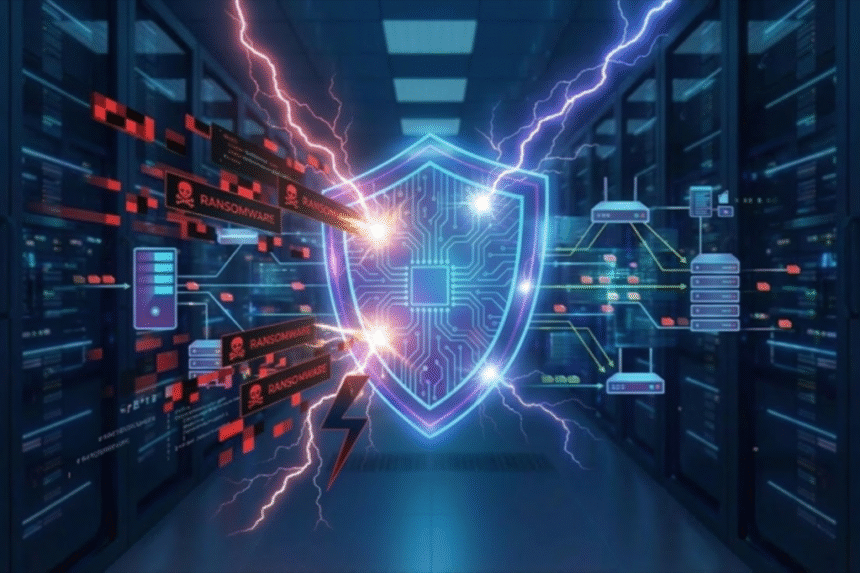
Summary:
1. Ransomware attacks in 2025 have caused widespread disruptions in various sectors, leading to significant financial losses.
2. The evolving threat landscape, driven by AI-powered attacks, requires a strategic shift in enterprise defense strategies.
3. Implementing distributed security controls, segmentation, and network detection and response are crucial in breaking the ransomware kill chain.
Article:
Ransomware attacks have become a prevalent threat in 2025, disrupting business operations across industries like retail, manufacturing, and healthcare. These attacks have resulted in substantial financial losses for organizations globally, highlighting the urgency for a reevaluation of enterprise defense strategies.
The emergence of AI-powered autonomous attacks has transformed the threat landscape, enabling attackers to exploit vulnerabilities at an unprecedented pace. With minimal human intervention, these attacks can probe enterprise networks and identify numerous entry points, emphasizing the need for enhanced security measures.
Traditional perimeter-based security models are no longer sufficient in protecting modern enterprises with distributed workloads and dynamic infrastructure. Once attackers breach the perimeter, they can freely navigate through unsegmented networks, underscoring the importance of adopting a different approach to security.
To combat ransomware effectively, organizations must implement distributed security controls at various stages of the attack chain. Intrusion prevention capabilities should be deployed across different environments to prevent initial infiltration, while macro- and micro segmentation can restrict lateral movement post-compromise.
Network detection and response (NDR) play a crucial role in identifying malicious activity and preventing data exfiltration. By leveraging AI-powered integrated threat defense, organizations can detect behavioral anomalies and respond proactively to potential threats.
The key to successful defense against ransomware lies in integrated software-defined security solutions like VMware vDefend. This unified stack offers distributed firewall capabilities for segmentation, automated deployment workflows, and advanced threat detection and prevention, ensuring comprehensive protection across evolving environments.
In conclusion, modern ransomware threats necessitate a shift towards smarter security architectures rather than relying on disparate tools. By implementing robust security measures and breaking the ransomware kill chain, organizations can safeguard their assets and mitigate the risk of devastating cyberattacks.