Summary:
1. Researchers at Tencent AI Lab and Washington University in St. Louis have developed a training framework called R-Zero that enables large language models to improve themselves without human-labeled data.
2. R-Zero uses reinforcement learning to generate its own training data, addressing the bottleneck of creating self-evolving AI systems.
3. The framework has shown significant improvements in reasoning capabilities across different models, potentially reducing the complexity and costs of training advanced AI.
Rewritten Article:
Are you ready to witness the future of AI evolution without the need for human-labeled data? A groundbreaking training framework called R-Zero, developed by researchers at Tencent AI Lab and Washington University in St. Louis, is paving the way for large language models to enhance themselves autonomously. This innovative technique utilizes reinforcement learning to create its own training data, revolutionizing the process of developing self-evolving AI systems.
The traditional approach of relying on human annotators to provide high-quality tasks and labels for AI training is not only costly and slow but also limits the potential capabilities of AI models. With R-Zero, the need for explicit labels is eliminated as the framework generates reward signals directly from the model’s own outputs, enabling a truly self-evolving scenario.
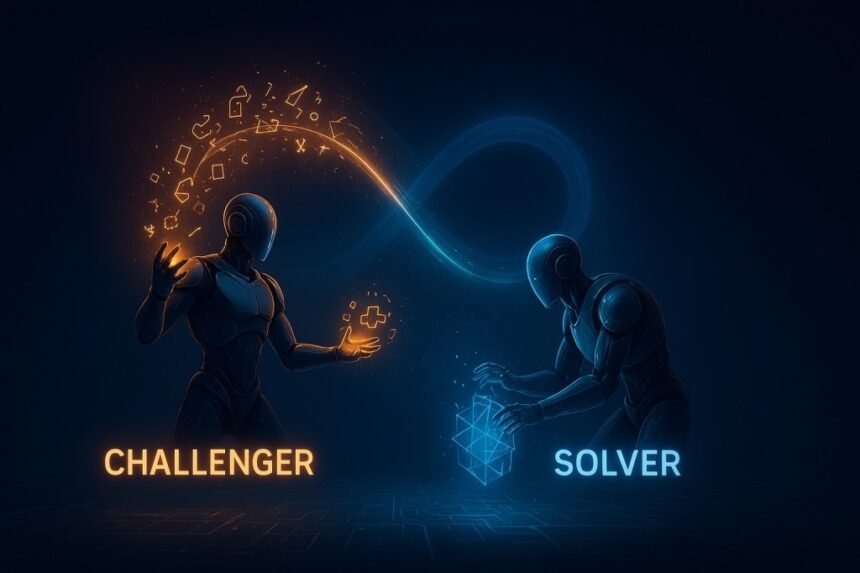
One of the key challenges in developing self-evolving AI systems is ensuring the quality of self-generated data, especially in domains like open-ended reasoning where correctness is not easily verifiable. R-Zero addresses this hurdle by introducing a dynamic co-evolutionary process between two independent models – a “Challenger” and a “Solver” – that continuously interact and challenge each other to push the boundaries of reasoning capabilities.
Through a series of experiments, R-Zero has demonstrated remarkable results in enhancing reasoning skills across various large language models. The framework not only accelerates the development of specialized models for complex tasks but also opens up new possibilities for AI advancement without the need for extensive data curation.
The success of R-Zero lies in its ability to generate a high-quality learning curriculum that propels AI models to new heights with each iteration. By fine-tuning on challenging questions generated by the Challenger, the Solver model continuously improves its performance without human intervention, creating a self-improving loop that drives progress in AI evolution.
While R-Zero has shown promising results in math reasoning tasks, the framework’s true potential lies in its ability to be a game-changer for enterprises operating in niche domains where high-quality data is scarce. By bypassing the laborious process of data curation, R-Zero offers a pathway to creating AI systems that can surpass human capabilities, ushering in a new era of autonomous intelligence.
As researchers continue to explore the capabilities of R-Zero, the framework’s limitations are also being addressed. By introducing a third AI agent, a “Verifier” or “Critic,” the paradigm can be extended to subjective enterprise tasks, paving the way for fully autonomous AI systems that excel in both objective logic and subjective reasoning.
In conclusion, R-Zero represents a significant advancement in the field of AI evolution, offering a glimpse into a future where AI systems can evolve and learn independently, driving innovation and progress in the realm of artificial intelligence.