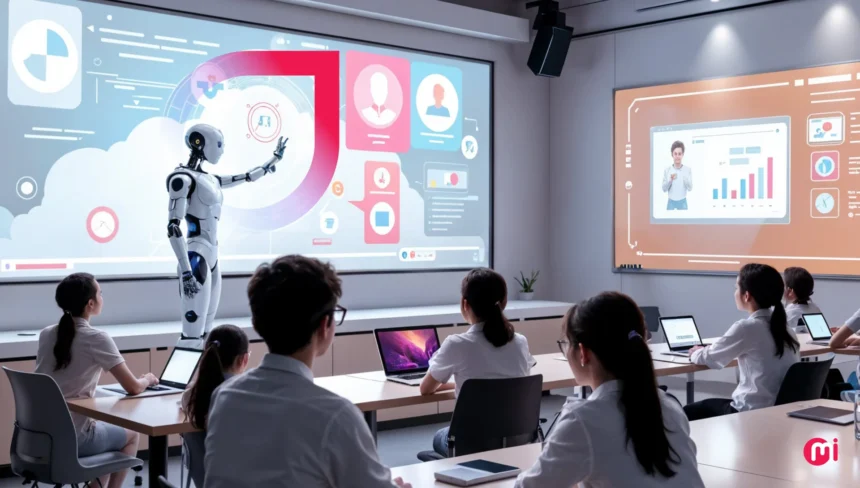
As technology continues to advance, the education industry is evolving alongside it, incorporating AI to create more intelligent classrooms that enhance the learning experience for both educators and students. With its wide range of applications, including streamlined workflow management, personalized content delivery, automated assessment, grading, and ongoing student support, AI has become essential for modern education.
Leading platforms like Coursera, Duolingo, and AltSchool serve as prime examples of how AI is transforming the traditional methods of teaching, learning, and school operations. By simplifying education and making it more accessible and convenient, these platforms cater to the evolving needs of educators and learners in today’s digital age.
Numerous schools, universities, and educational institutions are adopting AI-driven solutions such as intelligent tutoring systems, chatbots, and learning analytics to enhance teaching methods and student engagement. In this article, we will delve into the top 8 use cases of AI in education to help you identify the most suitable applications for your institution.
**Why AI in Education is Important**
The emergence of AI in education can be traced back to early systems like Stanford’s PLATO in 1965. However, its widespread adoption in eLearning gained momentum in the late 2000s and accelerated significantly post-2020, especially in the aftermath of the COVID-19 pandemic. With advancements in Natural Language Processing (NLP) and computer vision, AI applications have expanded to include adaptive learning, personalized content delivery, and automated assessments.
From data-driven decision-making for tailored education to remote learning and continuous assistance, AI has become an indispensable element in education. Educational institutions are leveraging AI to align themselves with the current needs and challenges faced by learners in today’s dynamic world.
**Differences Between Traditional And AI-Powered Classrooms**
Before delving into the specific use cases of AI in education, it is essential to understand the distinctions between traditional education and AI-enabled learning. The table below highlights these differences, showcasing how AI is revolutionizing the educational landscape:
**8 Top Use Cases of AI in Education**
AI in education offers a myriad of benefits, including streamlined administrative workflows, automated assessment and grading, personalized learning, predictive analytics, assistance for students with special needs, resource planning software, curriculum design solutions, and ongoing support during learning. Let’s explore each of these use cases in detail to understand their impact on modern education.
**Real-Life Examples of AI in Education**
Platforms like Duolingo, IBM Watson Education, Coursera, AltSchool, and Quizlet exemplify the practical applications of AI in education. These platforms leverage AI algorithms to personalize learning experiences, provide tailored resources, and enhance student outcomes. By analyzing user data and tracking learner progress, these platforms offer personalized guidance and support, leading to improved engagement and retention rates.
**Benefits of AI in Education**
AI in education brings a host of benefits, including efficient administrative task management, personalized learning at scale, reduced teacher workload, 24/7 learning support, data-driven insights, greater accessibility and inclusion, enhanced student engagement, optimized resource allocation, and continuous curriculum improvement. These advantages underscore the transformative impact of AI on the educational landscape.
**Bring AI to Your Classrooms with MindInventory**
As a leading AI development company, MindInventory offers tailored education software development services to meet the unique needs of educators. Whether you require custom EdTech solutions, integration with existing digital ecosystems, or modernization of obsolete software, MindInventory’s team of experienced AI/ML engineers can bring your educational software ideas to life. By partnering with MindInventory, educational institutions can benefit from cutting-edge AI solutions that enhance teaching and learning experiences.
**FAQs:**
1. **How is AI transforming traditional classroom learning?**
AI is revolutionizing traditional classroom learning by automating administrative tasks, tailoring education, and enhancing student engagement. By analyzing student data and providing personalized feedback and resources, AI improves understanding and retention.
2. **Can AI replace teachers in the future?**
While AI can enhance the learning experience by automating routine tasks and providing data-driven insights, it cannot fully replace the human element of teaching. The essential role of empathy, emotional support, and critical thinking provided by teachers cannot be replicated by AI.
3. **How can educational institutions integrate AI into their curriculum?**
Educational institutions can start by introducing AI topics in lessons, utilizing AI-powered tools like chatbots, and providing training for teachers. Clear goals, good data management, and staff training are crucial for successful integration. For tailored AI-enabled education software solutions, institutions can collaborate with AI ML development companies for comprehensive support.
4. **What are the challenges of AI in education?**
AI in education presents challenges such as security and data privacy concerns, potential algorithm biases, over-reliance on technology, training requirements, accessibility issues, ethical considerations, and the risk of dehumanizing the learning experience. Addressing these challenges is essential for successful AI integration in education.