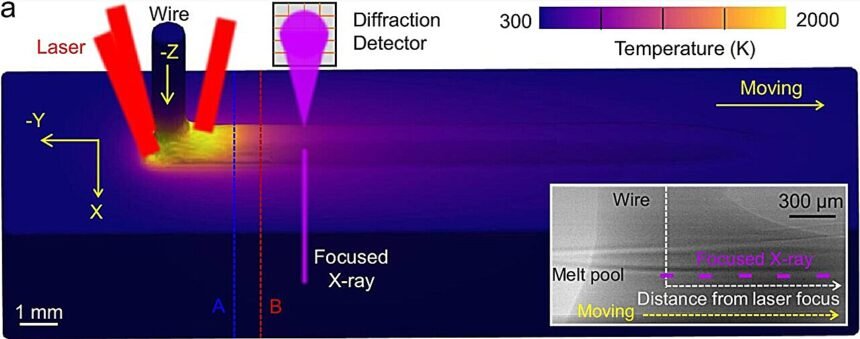
In a groundbreaking development for additive manufacturing, scientists have successfully observed the dynamic changes in metal microstructures as they occur during the 3D printing process. This innovative approach, made possible by the state-of-the-art facilities at the U.S. Department of Energy’s Argonne National Laboratory and Oak Ridge National Laboratory, has significant implications for the production of complex components essential for various sectors.
Additive manufacturing involves the layer-by-layer construction of intricate metal parts, offering a level of precision and complexity that traditional manufacturing methods cannot match. The ability to create 3D parts that were previously challenging or impossible to produce opens up new possibilities for supply chain management and domestic manufacturing efficiency.
While additive manufacturing is already utilized in critical industries like aerospace, healthcare, and defense, ensuring consistent quality and repeatability across different parts remains a key challenge. The recent breakthrough in real-time monitoring of metal microstructure evolution during 3D printing offers a promising solution to this challenge.
By leveraging the capabilities of the Advanced Photon Source at Argonne, researchers were able to track the 3D printing process of 316L stainless steel in unprecedented detail. The use of real-time X-ray diffraction allowed them to observe the formation and propagation of dislocations in the metal microstructure, providing valuable insights into the underlying mechanisms at play.
The discovery that dislocations form early in the printing process, rather than later as previously believed, represents a significant advancement in our understanding of additive manufacturing. This newfound knowledge can empower engineers to optimize printing parameters and control the formation of dislocations at a microscopic level, thereby enhancing the strength and reliability of 3D-printed components.
Furthermore, the insights gained from this research have the potential to drive the development of new alloys with tailored properties. By adjusting the chemical composition of metals like stainless steel, engineers can influence the formation of dislocations and the distribution of stress within the material, leading to the creation of customized parts with enhanced durability and performance.
Overall, this groundbreaking research not only enhances our understanding of additive manufacturing processes but also paves the way for the production of advanced metal components capable of withstanding extreme conditions. The implications of this study extend beyond current applications to future innovations in industries such as nuclear energy, where customized and reliable metal parts are essential for next-generation technologies.