Summary:
- Interview with Jerry R. Geisler III, Walmart’s Chief Information Security Officer, discussing cybersecurity challenges in the age of autonomous AI.
- Insights on securing agentic AI systems, modernizing identity management, and lessons learned from building Element AI.
- Walmart’s approach to implementing Zero Trust architectures and centralized AI technologies across hybrid multi-cloud infrastructure.
Article:
In a recent virtual interview with Jerry R. Geisler III, Executive Vice President and Chief Information Security Officer at Walmart Inc., VentureBeat delved into the cybersecurity challenges faced by the retail giant as AI continues to evolve autonomously. Geisler shared valuable insights on securing agentic AI systems, modernizing identity management, and the lessons learned from developing Element AI, Walmart’s centralized AI platform.
Geisler emphasized the importance of proactive security controls through advanced AI Security Posture Management (AI-SPM) to address new security threats posed by agentic AI. Walmart’s strategy focuses on continuous risk monitoring, data protection, regulatory compliance, and operational trust to mitigate risks such as data exfiltration and autonomous misuse of APIs.
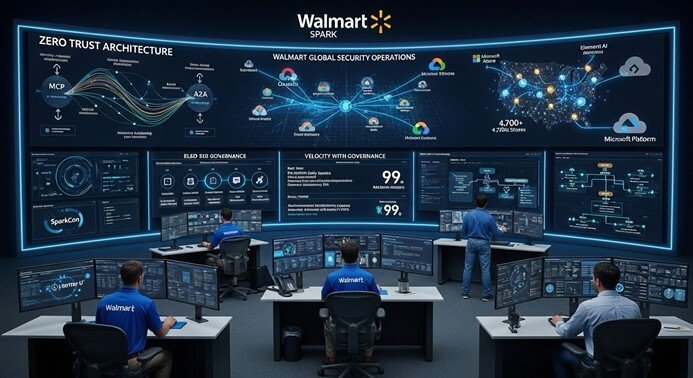
With Walmart’s vast hybrid multi-cloud infrastructure spanning Google Cloud, Azure, and private cloud environments, Geisler highlighted the importance of implementing Zero Trust architectures based on identity rather than network location. Access policies are consistently applied across cloud and on-premises environments to ensure uniform application of zero trust principles.
Moreover, Walmart’s commitment to staying ahead of evolving cybersecurity threats involves leveraging advanced automation in incident response programs, orchestrating rapid response workflows using SOAR platforms, and prioritizing response actions based on risk assessment. By combining talented associates with rapid automation, Walmart aims to deliver security at speed and scale across its global operations.
In terms of attracting and retaining cybersecurity talent, Walmart’s Live Better U (LBU) program offers education opportunities for associates to upskill in cybersecurity and related IT fields. Additionally, initiatives like SparkCon provide a platform for sharing knowledge, exploring cybersecurity trends, and building valuable relationships within the industry.
Reflecting on the development of Element AI, Geisler highlighted the critical lessons learned that guide Walmart’s strategy in centralizing emerging AI technologies. Centralization enables ‘velocity with governance’ by streamlining AI development and embedding security from the start, ensuring consistency in data handling and monitoring. It also allows for ‘concentrated defense and expertise,’ focusing AI security talent on critical projects to implement sophisticated defenses effectively.
Overall, Walmart’s approach to cybersecurity in the age of autonomous AI showcases a proactive stance towards addressing emerging threats, modernizing security frameworks, and leveraging advanced technologies to protect its operations at scale.