A research group led by Professor Sung-Yeon Jang from UNIST’s School of Energy and Chemical Engineering has successfully created the world’s first high-performance n-type solid-state thermogalvanic cell capable of powering real electronic devices. The study, published in the journal Energy & Environmental Science, showcases the potential of this new technology.
Thermogalvanic cells are compact generators that convert temperature differentials, such as the contrast between human body temperature (~36°C) and the surrounding air (20–25°C), into electrical energy. Previous iterations of these cells struggled to generate enough power to operate practical electronics due to minimal temperature gradients.
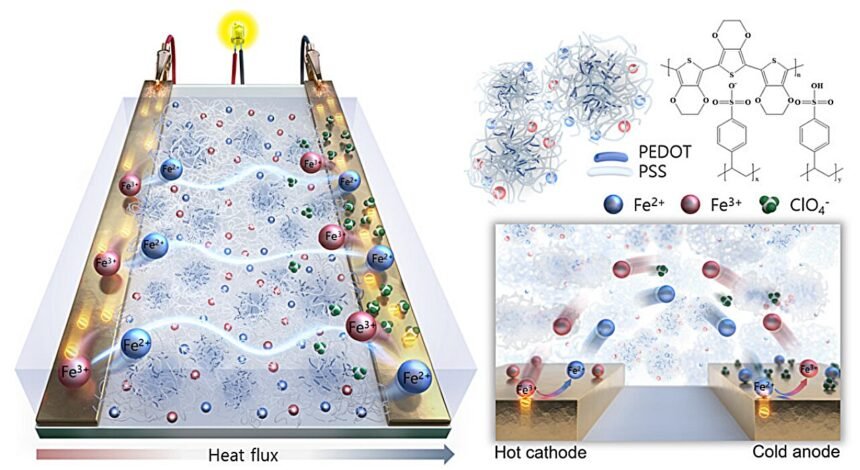
The newly developed solid-state device overcomes this limitation by providing sufficient voltage and current to power real-world devices effectively. While traditional solid-state designs offer safety benefits, issues with ion mobility within the electrolyte have hindered their current output. The research team addressed this challenge by engineering an electrolyte that facilitates efficient ion transport, enhancing overall output voltage through thermally driven ion diffusion.
By connecting 100 of these cells in series, approximately 1.5V can be generated from body heat, comparable to standard AA batteries. Combining 16 series-connected modules can activate devices like LED lights, electronic clocks, and temperature/humidity sensors, showcasing the practical applications of this technology.
The solid-state cell’s Seebeck coefficient, which represents the voltage change per temperature difference, stands at -40.05 mV/K, marking a significant improvement over conventional n-type cells. Additionally, the device demonstrates exceptional durability, maintaining consistent performance even after 50 charge-discharge cycles.
The core components of this solid-state cell include a conductive polymer, PEDOT:PSS, and a redox couple of Fe(ClO₄)₂/3. The stable structure is established through electrostatic interactions between the polymer’s negatively charged sulfonate groups and the Fe²⁺/Fe³⁺ ions, while the ClO₄⁻ ions facilitate ion diffusion and thermodiffusion effects, boosting power output significantly.
Professor Jang emphasized the significance of this research, stating that it represents a significant milestone in low-temperature waste heat energy harvesting and flexible energy conversion devices. The technology has the potential to serve as a self-powered system for wearable electronics and autonomous IoT devices powered solely by body heat.
More information:
Jeong-Ye Baek et al, Solid-state n-type thermodiffusion-assisted thermogalvanic cells with unprecedented thermal energy conversion, Energy & Environmental Science (2025). DOI: 10.1039/D5EE01216C