

Wednesday, 6 May 2026
Subscribe
logo logo
  • Global
  • Technology
  • Business
  • AI
  • Cloud
  • Edge Computing
  • Security
  • Investment
  • More
    • Sustainability
    • Colocation
    • Quantum Computing
    • Regulation & Policy
    • Infrastructure
    • Power & Cooling
    • Design
    • Innovations
  • 🔥
  • data
  • revolutionizing
  • Stock
  • Investment
  • Future
  • Secures
  • Growth
  • Top
  • Funding
  • Power
  • Center
  • technology
Font ResizerAa
Silicon FlashSilicon Flash
Search
  • Global
  • Technology
  • Business
  • AI
  • Cloud
  • Edge Computing
  • Security
  • Investment
  • More
    • Sustainability
    • Colocation
    • Quantum Computing
    • Regulation & Policy
    • Infrastructure
    • Power & Cooling
    • Design
    • Innovations
Have an existing account? Sign In
Follow US
© 2022 Foxiz News Network. Ruby Design Company. All Rights Reserved.
Silicon Flash > Blog > Innovations > Thermoelectric Wearables: Harnessing Body Heat for Sustainable Power Generation
Innovations

Thermoelectric Wearables: Harnessing Body Heat for Sustainable Power Generation

Published September 9, 2025 By Juwan Chacko
Share
3 Min Read
Thermoelectric Wearables: Harnessing Body Heat for Sustainable Power Generation
SHARE
A groundbreaking achievement by a team at UNIST has introduced a remarkable technological breakthrough allowing the generation of electricity from body heat to power electronic devices. This innovation opens the door for the development of battery-free wearable devices and IoT sensors that run solely on the heat produced by the human body.

A research group led by Professor Sung-Yeon Jang from UNIST’s School of Energy and Chemical Engineering has successfully created the world’s first high-performance n-type solid-state thermogalvanic cell capable of powering real electronic devices. The study, published in the journal Energy & Environmental Science, showcases the potential of this new technology.

Thermogalvanic cells are compact generators that convert temperature differentials, such as the contrast between human body temperature (~36°C) and the surrounding air (20–25°C), into electrical energy. Previous iterations of these cells struggled to generate enough power to operate practical electronics due to minimal temperature gradients.

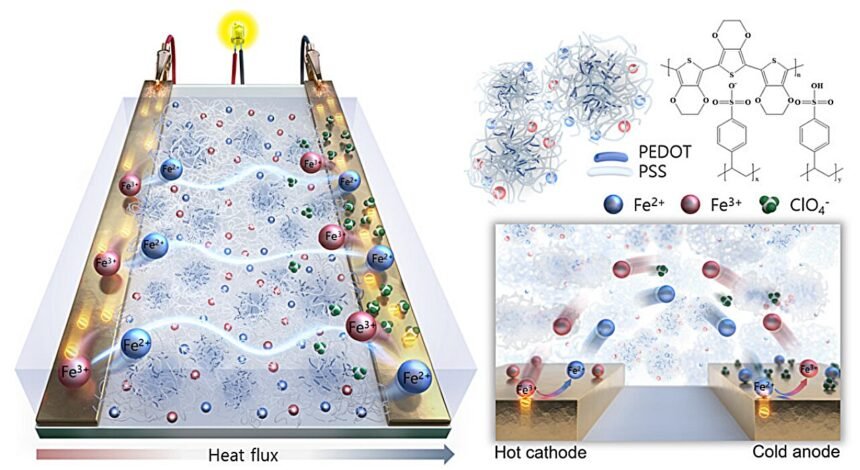
The newly developed solid-state device overcomes this limitation by providing sufficient voltage and current to power real-world devices effectively. While traditional solid-state designs offer safety benefits, issues with ion mobility within the electrolyte have hindered their current output. The research team addressed this challenge by engineering an electrolyte that facilitates efficient ion transport, enhancing overall output voltage through thermally driven ion diffusion.

By connecting 100 of these cells in series, approximately 1.5V can be generated from body heat, comparable to standard AA batteries. Combining 16 series-connected modules can activate devices like LED lights, electronic clocks, and temperature/humidity sensors, showcasing the practical applications of this technology.

The solid-state cell’s Seebeck coefficient, which represents the voltage change per temperature difference, stands at -40.05 mV/K, marking a significant improvement over conventional n-type cells. Additionally, the device demonstrates exceptional durability, maintaining consistent performance even after 50 charge-discharge cycles.

See also  Unleashing the Power of ChatGPT Go: A Marketing Strategy Analysis for the Indian Market

The core components of this solid-state cell include a conductive polymer, PEDOT:PSS, and a redox couple of Fe(ClO₄)₂/3. The stable structure is established through electrostatic interactions between the polymer’s negatively charged sulfonate groups and the Fe²⁺/Fe³⁺ ions, while the ClO₄⁻ ions facilitate ion diffusion and thermodiffusion effects, boosting power output significantly.

Professor Jang emphasized the significance of this research, stating that it represents a significant milestone in low-temperature waste heat energy harvesting and flexible energy conversion devices. The technology has the potential to serve as a self-powered system for wearable electronics and autonomous IoT devices powered solely by body heat.

More information:
Jeong-Ye Baek et al, Solid-state n-type thermodiffusion-assisted thermogalvanic cells with unprecedented thermal energy conversion, Energy & Environmental Science (2025). DOI: 10.1039/D5EE01216C


Provided by Ulsan National Institute of Science and Technology


TAGGED: Body, generation, harnessing, Heat, Power, sustainable, thermoelectric, Wearables
Share This Article
Facebook LinkedIn Email Copy Link Print
Previous Article Introducing the Revolutionary RTX Pro Server: A Breakthrough in Giga Computing Technology Introducing the Revolutionary RTX Pro Server: A Breakthrough in Giga Computing Technology
Next Article The Future Titans: 2 Stocks Set to Surpass Berkshire Hathaway in 5 Years The Future Titans: 2 Stocks Set to Surpass Berkshire Hathaway in 5 Years
Leave a comment

Leave a Reply Cancel reply

Your email address will not be published. Required fields are marked *

Your Trusted Source for Accurate and Timely Updates!

Our commitment to accuracy, impartiality, and delivering breaking news as it happens has earned us the trust of a vast audience. Stay ahead with real-time updates on the latest events, trends.
FacebookLike
LinkedInFollow

Popular Posts

Immersive Sensory Technology: Experience the Virtual World with a Haptic Patch

In the rapidly evolving world of virtual reality (VR) and augmented reality (AR), the desire…

May 9, 2025

Silver Investing: A Look Back at First Majestic’s 10-Year Growth

Summary: First Majestic Silver has established itself as a leading silver mining company in the…

February 9, 2026

Breaking News: Argan Stock Surges on Wednesday

Summary: 1. Argan (AGX) announced a substantial dividend raise of 33%, leading to a 4%…

September 10, 2025

OVHcloud and Crayon Join Forces to Deliver Compliant and Sustainable Cloud Solutions

In a significant move, OVHcloud and Crayon have formed a strategic partnership to provide businesses…

July 1, 2025

The Future of Nvidia: Can the AI Stock Maintain its Dominance in the GPU Market?

Summary: The AI hardware market is becoming increasingly competitive. Nvidia currently holds 85% market share…

January 25, 2026

You Might Also Like

Empowering Innovation: The Role of Design Enablement Teams in the European Chips Act
Innovations

Empowering Innovation: The Role of Design Enablement Teams in the European Chips Act

Juwan Chacko
Secure Access: Biometric Passwordless Login and EU Digital Wallet Protection Platform
Innovations

Secure Access: Biometric Passwordless Login and EU Digital Wallet Protection Platform

Juwan Chacko
The Crucial Role of Intelligent Networks in Europe’s Digital Future
Innovations

The Crucial Role of Intelligent Networks in Europe’s Digital Future

Juwan Chacko
Revolutionizing Data Centers: The Shift to 800VDC Power Architectures
Power & Cooling

Revolutionizing Data Centers: The Shift to 800VDC Power Architectures

Juwan Chacko
logo logo
Facebook Linkedin Rss

About US

Silicon Flash: Stay informed with the latest Tech News, Innovations, Gadgets, AI, Data Center, and Industry trends from around the world—all in one place.

Top Categories
  • Technology
  • Business
  • Innovations
  • Investments
Usefull Links
  • Home
  • Contact
  • Privacy Policy
  • Terms & Conditions

© 2025 – siliconflash.com – All rights reserved

Welcome Back!

Sign in to your account

Lost your password?