Written by Darren Watkins, the chief revenue officer at VIRTUS Data Centres.
The integration of artificial intelligence (AI) into everyday business operations has necessitated a significant overhaul of physical data center design. No longer confined to research labs, AI is now a standard component of various sectors, from healthcare to customer service. However, the expansion of AI workloads presents a practical challenge that requires more than just advanced algorithms – it demands a fundamental upgrade in the infrastructure.
Most enterprise IT infrastructures were originally designed to handle predictable workloads. However, the emergence of AI has completely altered this landscape. AI projects involving large models can put immense pressure on data centers, with racks consuming significantly higher amounts of power than traditional servers. This shift in workload dynamics often leads to project stalls as existing facilities struggle to cope with the demands of AI. Purpose-built data centers are now being recognized as the essential foundation for scaling AI operations.
One of the key distinctions between AI-ready data centers and legacy environments is the increase in density. Modern AI racks can require up to 80 kilowatts of power, compared to the 2-4 kilowatts consumed by traditional enterprise racks. This shift necessitates a complete redesign of the data center, affecting everything from electrical systems to cooling mechanisms.
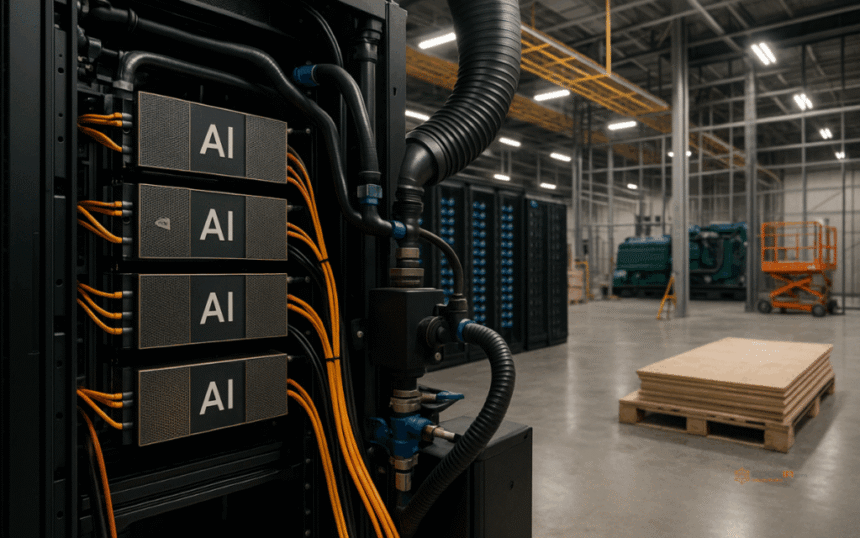
Moreover, cooling systems need to evolve to meet the demands of AI hardware. Traditional air cooling methods are insufficient for AI workloads, leading to the adoption of advanced cooling technologies such as direct-to-chip liquid cooling and immersion systems. Retrofitting these systems into existing structures can be complex and costly, emphasizing the importance of designing them into the facility from the outset.
In addition to cooling, power distribution also needs to adapt to support high-density loads reliably. This includes implementing redundant distribution paths, intelligent UPS systems, and the ability to allocate power at the rack level. Without these design considerations, data centers risk facing performance bottlenecks that can hinder operations.
The location of data centers is also crucial for optimizing AI performance, particularly in latency-sensitive applications. Proximity to major datasets and user bases is increasingly being viewed as a strategic advantage in the AI value chain, influencing both speed and quality of operations.
Flexibility for evolving workloads
AI initiatives are dynamic, with models requiring retraining, datasets expanding, and regulatory landscapes shifting. As a result, data center infrastructure must be designed with flexibility in mind to accommodate evolving workloads. This includes scalable rack options, modular capacity additions without downtime, and workload portability across different sites.
The sustainability challenge
The energy-intensive nature of AI operations has raised concerns around sustainability, with the energy consumption of training advanced models being equivalent to hundreds of homes annually. With a growing focus on sustainability from regulators and investors, addressing these challenges is imperative for the industry.
From aspiration to physical reality
Enterprises aiming to leverage AI must prioritize the development of robust physical foundations within their data centers. While algorithms, talent, and data are essential components of AI strategies, infrastructure designed to support density, proximity, flexibility, and sustainability is crucial for translating vision into reality. As AI technology becomes increasingly pervasive across industries, data center design plays a central role in driving competitiveness.
About the author
Darren Watkins brings over 20 years of experience in telecommunications and managed services to his role as the chief revenue officer at VIRTUS Data Centres. His background includes working with leading organizations in the industry, such as BT, Level3 Communications, and COLT. Darren’s expertise in market-changing deals and innovative solutions positions him as a key player in the data center sector.
Additionally, Darren serves on the board of Odyssey Mobile Interaction, a prominent Mobile Media Advertising company, reflecting his interest in emerging technologies and industry developments.
Related
Article Topics
AI data centers | AI/ML | edge data center | GPU infrastructure | liquid cooling | VIRTUS Data Centres