Unlocking the Potential of New Electrolytes for High-Energy Batteries
Traditional batteries rely on liquid electrolytes that can operate up to 4.5 V, but their stability diminishes beyond this threshold. In contrast, solid electrolytes offer stability at higher voltages, enabling batteries to store more energy efficiently.
A recent breakthrough by researchers from Yonsei University, Dongguk University, KAIST, and other institutions introduces a new fluoride-based solid electrolyte capable of maintaining stability at unprecedented voltages exceeding 5 V.
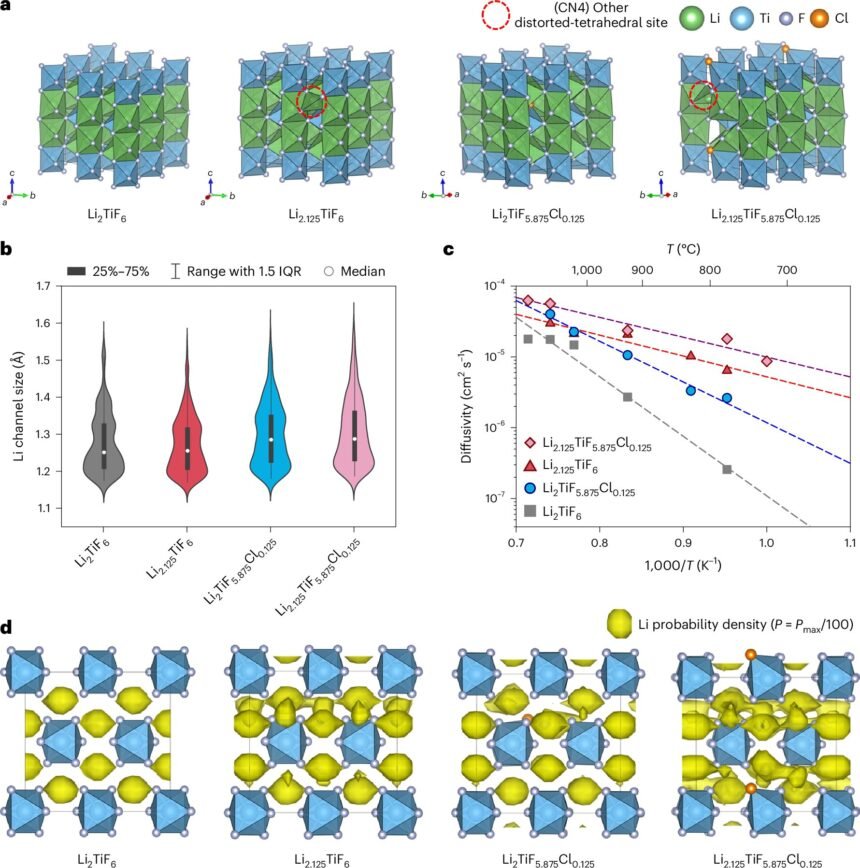
Published in Nature Energy, the innovative electrolyte combines lithium chloride (LiCl) with lithium titanium fluoride Li2TiF6, pushing the boundaries of battery chemistry to enhance energy density.
Enhancing Stability with Fluoride-Based Solid Electrolytes
Past studies have shown the potential of chloride-based solid electrolytes in improving battery cycling stability, especially when paired with nickel, cobalt, and manganese-based cathode materials operating at 4 V. However, challenges arise when integrating these electrolytes with high-voltage spinel cathodes.
Recognizing the resistance of fluoride-based materials to oxidation, the research team explored their application as solid-state electrolytes, resulting in remarkable outcomes that surpassed expectations. By replacing flammable liquid electrolytes with inorganic solid alternatives, the team achieved enhanced safety and energy density in batteries.
The introduction of a fluoride-based protective layer on a spinel cathode composed of LiNi0.5Mn1.5O4 paved the way for stable operation at voltages exceeding 5.5 V, ensuring high ionic conductivity and smooth ion transport under extreme conditions.
Unveiling Extraordinary Stability
The newly designed fluoride-based electrolyte demonstrated exceptional performance in conducting lithium ions and operating at high voltages in combination with spinel cathodes. This achievement marks a significant milestone, as no other electrolyte has achieved successful operation at such high voltages, unlocking new possibilities for high-energy all-solid-state batteries.
The team’s initial tests showcased significantly higher capacity in batteries utilizing the new electrolyte with a spinel system, retaining 75.2% of capacity after 500 charge and discharge cycles at elevated voltages. These results, coupled with high areal capacities and robust interfacial stability, represent crucial advancements toward practical commercialization.
Future Developments in Solid-State Battery Technology
The groundbreaking research on fluoride-based solid electrolytes sets the stage for further exploration in enhancing the energy density of solid-state batteries. Future endeavors will focus on increasing mass loading and developing cost-effective, high-voltage cathodes as alternatives to spinel systems.
Exploration of new fluoride-based solid electrolytes with enhanced ionic conductivities aims to propel the development of next-generation, safe, and high-energy all-solid-state batteries for diverse applications, including electric vehicles and large-scale energy storage.
More information: Jun Pyo Son et al, Five-volt-class high-capacity all-solid-state lithium batteries, Nature Energy (2025). DOI: 10.1038/s41560-025-01865-y.
© 2025 Science X Network