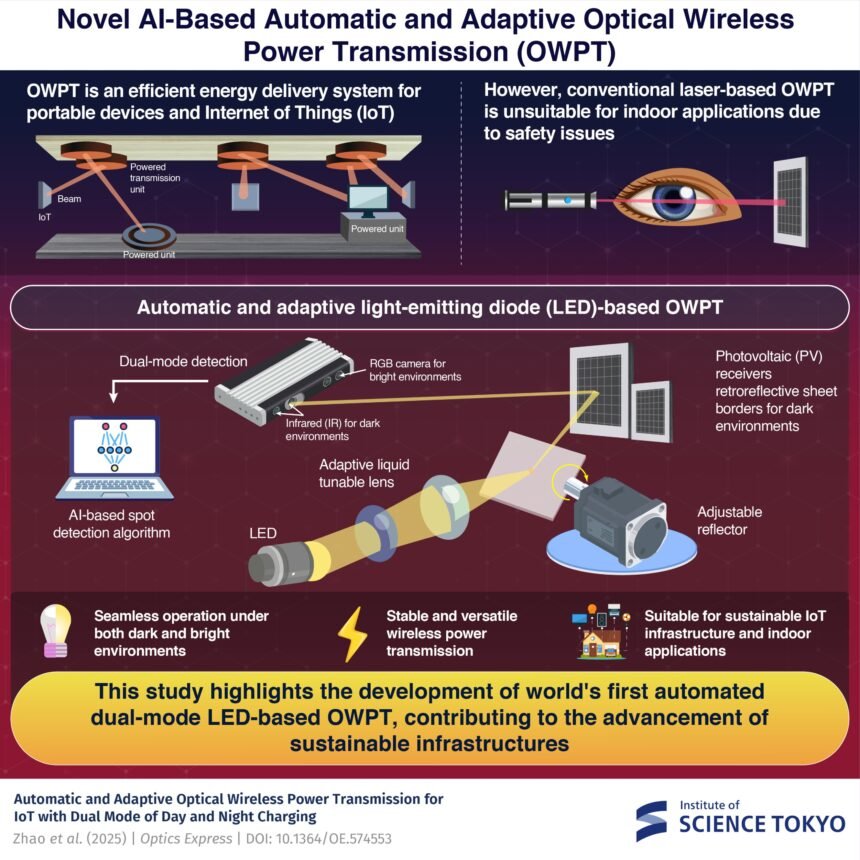
The world’s first automatic and adaptive, dual-mode light-emitting diode (LED)-based optical wireless power transmission system, that operates seamlessly under both dark and bright lighting conditions, has been developed by scientists at Science Tokyo. The system, along with artificial intelligence-powered image recognition, can efficiently power multiple devices in order without interruption. Because it is LED-based, it offers a low-cost and safe solution ideal for building sustainable indoor Internet of Things infrastructure.
With the rapid development of Internet of Things (IoT), the demand for efficient and flexible power solutions is also increasing. Traditional power delivery methods, such as batteries and cable connections, have many drawbacks. Batteries need frequent charging and replacement, while cables restrict device mobility.
Optical wireless power transmission (OWPT) is an emerging technology that can address these limitations. In OWPT, energy is transmitted through free space, without physical wires, by converting electricity to light, transmitting it, and then reconverting light back into electrical power using photovoltaic (PV) receivers.
Most current OWPT research has focused on laser-based systems. However, for indoor IoT scenarios, OWPT systems must comply with strict maximum permissible exposure regulations to prevent eye or skin hazards, making laser systems unsuitable without the development of special safety technologies.
In contrast, light-emitting diode (LED)-based OWPT systems are inherently safer, provide reliable power transmission, and are easier to control, cost-effective, and long-lived. Yet, these systems struggle with power loss over long distances and inconsistent performance under changing ambient lighting conditions.
To overcome these limitations, Professor Tomoyuki Miyamoto and doctoral researcher Mingzhi Zhao from the Laboratory for Future Interdisciplinary Research of Science and Technology at the Institute of Science Tokyo (Science Tokyo), Japan, have developed a groundbreaking LED-based OWPT system. “We have designed a dual-mode adaptive OWPT system that automatically adapts to both bright and dark indoor environments, while enabling safe and efficient power delivery to multiple IoT devices,” explains Miyamoto. Their study was published the journal Optics Express on October 24, 2025.
To overcome power loss during long-distance transmission, the proposed system utilizes an adaptive lens system with a double-layer lens configuration, consisting of a liquid lens with a tunable focal length and an imaging lens. This setup automatically adjusts the beam spot size, based on the receiver distance and size, ensuring optimal power transmission.
For accurate aiming of the light beam, the system utilizes an adjustable reflector that can be independently rotated in horizontal and vertical directions using two series-connected stepping motors. To ensure precise alignment towards the photovoltaic (PV) receivers, the researchers employed a depth camera, featuring both an RGB sensor and an infrared (IR) sensor. The RGB sensor detects the PV receiver position, while the IR sensor identifies the beam’s irradiation spot. This allows the control system to adjust the reflector’s orientation towards the target receiver.
To ensure continuous operation under both illuminated and dark conditions, the PV receivers are equipped with retroreflective (RF) sheets around their edges. These sheets reflect IR light emitted by the depth camera’s IR projector, creating a clear outline for each PV receiver. This allows the system to accurately detect receiver shapes and positions, isolate the target PV area, and minimize interference from the surrounding objects. To further enhance accuracy, the researchers integrated a convolutional neural network based on the Single Shot MultiBox Detector (SSD) algorithm.
With these innovations, the proposed auto-OWPT system can sequentially target multiple PV receivers of different sizes and at varying distances, rapidly switching between them and without interruption. In experiments, the system seamlessly operated under both lit and unlit environments and achieved efficient, stable power transmission up to a distance of five meters.
“Our auto-OWPT system offers a stable and versatile wireless power transmission solution,” notes Miyamoto. “It will play a key role in building sustainable IoT infrastructure, particularly in smart factories, homes, and indoor environments where safe, wireless, dynamic, and scalable power delivery is essential.”
More information:
Mingzhi Zhao et al, Automatic and adaptive optical wireless power transmission for IoT with dual mode of day and night charging, Optics Express (2025). DOI: 10.1364/oe.574553
Citation:
AI-powered LED system delivers stable wireless power for indoor IoT devices (2025, November 14)
retrieved 14 November 2025
from https://techxplore.com/news/2025-11-ai-powered-stable-wireless-power.html
This document is subject to copyright. Apart from any fair dealing for the purpose of private study or research, no
part may be reproduced without the written permission. The content is provided for information purposes only.