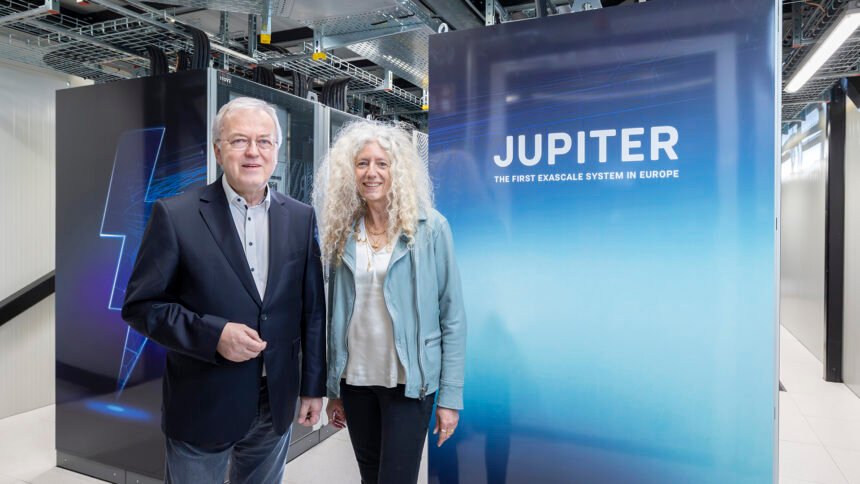
The Jülich Supercomputing Centre (JSC) is at the forefront of advancing high-performance computing in Europe by constantly innovating its systems like JUPITER and integrating cutting-edge AI and quantum technologies to address complex scientific, societal, and industrial challenges.
Located in Jülich, North Rhine-Westphalia, the Jülich Supercomputing Centre (JSC) is a pivotal player in Europe’s scientific computing landscape. From its origins as a national computational science hub in the 1980s, JSC has evolved into a global powerhouse of high-performance computing (HPC), artificial intelligence (AI), and emerging quantum technologies. With a strong focus on innovation, collaboration with academia and industry, and a dedication to advancing Europe’s digital sovereignty, JSC is driving the future of HPC-enabled scientific discovery.
Evolving Europe’s HPC Landscape
The journey of JSC began with early adoption of large-scale computing for scientific research, positioning Germany as a leader in computational science. Over the years, JSC has cultivated an ecosystem that combines national research priorities with European collaborations, academic partnerships, and industrial applications spanning various fields such as climate science, materials modeling, energy systems, and life sciences.
One of the key strengths of JSC is its ability to anticipate and adapt to major shifts in computational science. By designing systems for massive parallelism and cutting-edge hardware, JSC has paved the way for large-scale machine learning research and data-intensive simulations long before the rise of AI in the tech world.
JUWELS: Setting New Standards in Modular Supercomputing
An important milestone in JSC’s evolution was the development of the JUWELS supercomputer. As a modular HPC platform, JUWELS raised the bar for performance, flexibility, and efficiency, establishing itself as one of Europe’s top HPC systems. With its Booster module combining GPU accelerators and CPU resources, JUWELS enabled highly scalable simulations for a range of applications, including climate research, molecular dynamics, and particle physics. It was also one of the first systems in Europe to effectively support large-scale AI workflows, bridging the gap between traditional HPC and AI-driven computation.
JUPITER: Leading Europe into the Exascale Era
At the core of JSC’s current strategy is JUPITER, Europe’s first exascale supercomputer. Unveiled in 2024 and officially launched in 2025, JUPITER surpasses 1 ExaFLOP/s of sustained performance, making it not only the fastest supercomputer in Europe but also one of the most energy-efficient in its class. Featuring a heterogeneous architecture with superchips integrating CPU cores and GPU accelerators, JUPITER offers unparalleled versatility across a wide range of workloads, from traditional simulations to cutting-edge AI research.
According to Professor Thomas Lippert, one of the directors of JSC, “JUPITER represents a milestone in computing history, enabling a new era where HPC serves as a platform for innovation in science and AI, empowering researchers to tackle previously unattainable questions.” The power, scalability, and adaptability of JUPITER position it as a key driver for next-generation scientific advancements in fields like climate modeling, materials design, and biomedical research.
The JUPITER AI Factory: Democratizing Exascale Computing
A strategic initiative by JSC is the JUPITER AI Factory (JAIF), a platform leveraging the exascale capabilities of JUPITER to make them accessible to a wide range of users. JAIF provides universities, research institutions, start-ups, SMEs, and industry partners with a collaborative environment to develop, scale, and deploy AI applications. By facilitating experimentation with large AI models, data-intensive analytics, and integration of exascale computing into research and industrial workflows, JAIF fosters an ecosystem connecting scientific discovery with practical innovation, bolstering Europe’s competitiveness in AI and data-driven research.
Quantum Computing at JSC: Exploring Hybrid Approaches
While HPC remains at the core of JSC’s mission, the center is venturing into quantum technologies with initiatives like JUNIQ. JUNIQ is a multi-platform quantum computing infrastructure that provides diverse hardware and software tools, along with user support for scientific and industrial applications. The addition of a 100-qubit quantum computer named JADE in late 2024 marked a significant milestone for JUNIQ and hybrid classical quantum exploration, opening doors for accelerated scientific discovery in optimization and materials research.
Professor Dr. Kristel Michielsen, Director of JSC and Head of JUNIQ, emphasizes that quantum computing at JSC is not a separate track but an exploration of how it complements HPC. By experimenting with hybrid approaches that combine classical and quantum computing, JSC is paving the way for accelerated scientific breakthroughs and new computational pathways.
Collaboration and Milestones
Beyond its own systems, JSC plays a pivotal role in European and international consortia, including the European High-Performance Computing Joint Undertaking (EuroHPC JU). These collaborations ensure that German and European researchers have access to world-class resources while contributing expertise in scalable software frameworks, HPC architectures, and interdisciplinary research, shaping the future of computational science globally.
Integration of HPC, AI, and Quantum for Grand Challenges
As computational science advances, JSC remains committed to ambitious and future-oriented goals. By seamlessly integrating HPC, AI, and quantum technologies, JSC is not only pushing technological boundaries but also strategic ones. Through an ecosystem that addresses grand challenges like climate change, sustainable energy, advanced materials, and public health, JSC envisions a future where computational science drives innovation and discovery on a monumental scale.
This vision extends beyond individual systems to interconnected computational ecosystems, hybrid HPC-quantum workflows, collaborative platforms like the JUPITER AI Factory, and a cross-sector community that transcends boundaries and disciplines. With exascale computing at its core, exemplified by JUPITER, JSC is propelling science forward, accelerating innovation, and unlocking new frontiers in computational exploration. By bridging quantum resources with classical supercomputing, researchers can explore hybrid approaches to tackle complex problems, expanding the realm of computational science just as JSC set out to do from its inception.
Note: This article will also feature in our quarterly publication.