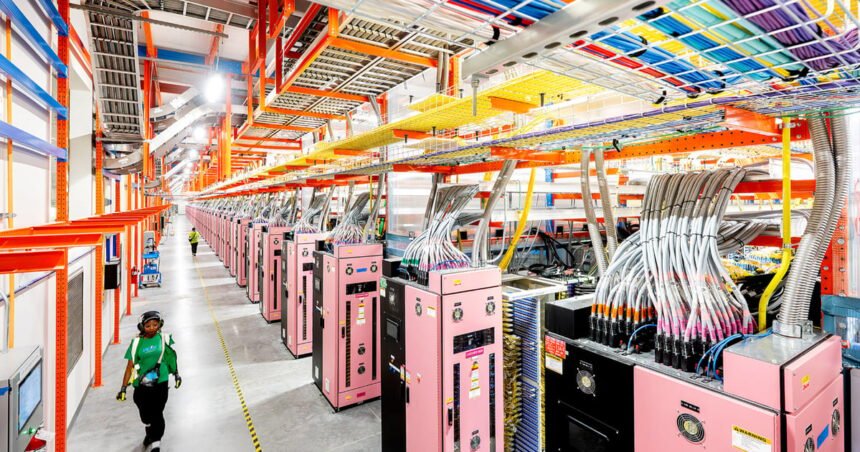
AWS, the industry giant in cloud services, is pushing the boundaries of networking infrastructure with a massive capital expenditure plan of $200 billion for the year 2026. The company’s strategic investment in AI infrastructure is reshaping the landscape of cloud computing, particularly in the realm of networking services. By leveraging cutting-edge technologies such as hollow-core fiber and custom hardware solutions, AWS is driving innovation in the field to ensure optimal performance and scalability for multi-cloud environments.
In a recent interview, Matt Rehder, the Vice President of AWS Network Engineering, shed light on the company’s forward-looking approach to networking. He emphasized the importance of meeting the ever-increasing bandwidth demands driven by generative AI and traditional cloud workloads. AWS’s unwavering commitment to scalability, reliability, and resiliency underscores its dedication to providing seamless networking solutions for customers across the globe.
The deployment of hollow-core fiber, a groundbreaking technology that enhances long-distance interconnectivity, represents a significant advancement in AWS’s networking infrastructure. While initially deemed impractical due to cost and supply concerns, hollow-core fiber has emerged as a viable solution for optimizing latency and expanding networking capabilities in metro areas. By leveraging this innovative technology, AWS aims to overcome geographic constraints and enhance connectivity in a cost-effective manner.
As AI workloads continue to reshape the data center landscape, AWS faces new challenges in addressing networking bottlenecks at scale. Control plane scalability and cabling complexities have emerged as key areas of focus for the company, prompting the development of advanced solutions to ensure seamless network operations. By investing in innovative control plane technologies and optimizing cabling designs, AWS is poised to deliver high-performance networking solutions that meet the demands of modern data centers.
One of the key differentiators for AWS lies in its vertical integration approach to networking hardware design. By developing proprietary networking devices and leveraging a consistent infrastructure across its network, AWS can enhance operational efficiency and streamline network management. This vertical integration enables AWS to implement unique capabilities, such as running control plane functions on networking devices, that would be challenging to achieve with off-the-shelf hardware solutions.
In conclusion, AWS’s relentless pursuit of innovation in networking technology is driving the evolution of cloud infrastructure and shaping the future of multi-cloud environments. By investing in cutting-edge technologies, optimizing energy efficiency, and focusing on scalability and performance, AWS is poised to deliver unparalleled networking solutions that empower customers to build and grow their digital ecosystems seamlessly.