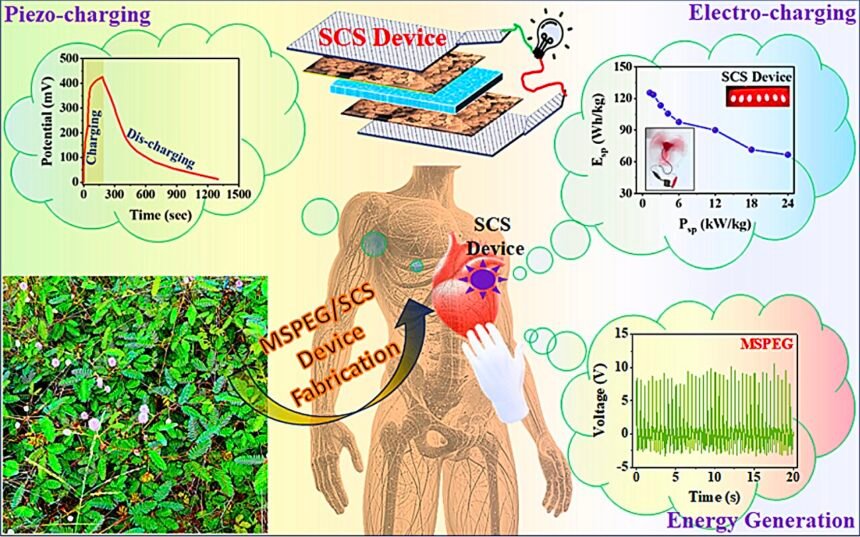
Researchers at the Materials Science Centre, Indian Institute of Technology Kharagpur have made a groundbreaking discovery in the field of energy generation. In a recent study published in the Chemical Engineering Journal, they introduced a new device based on seeds from the mimosa pudica plant. This device serves as both a bio-piezoelectric nanogenerator and a self-chargeable supercapacitor, offering remarkable efficiencies and a reduced environmental impact.
The motivation behind this study was the need for biocompatible, self-sustaining energy systems to power implantable medical devices and wearable electronics. Traditional energy generators rely on inorganic piezoelectric materials that can be toxic and harmful to the environment. The researchers sought to explore a natural, edible, and abundant resource as a green alternative, leading them to the mimosa pudica linn seeds.
The study had three main objectives. Firstly, the researchers aimed to develop a bio-piezoelectric nanogenerator using a hydrogel derived from the seeds to harvest mechanical energy. This energy could come from sources such as finger pressure, making the device versatile and practical for everyday use.
Additionally, the researchers designed a self-chargeable supercapacitor with electrodes based on RGO/NiZTO, using the same hydrogel from the seeds. This supercapacitor could efficiently store the energy harvested by the nanogenerator, providing a comprehensive energy solution.
The ultimate goal was to integrate these two capabilities into a single biocompatible device that could operate autonomously within various electronics, including medical implants and wearable technologies. By harnessing the cooperative effect of electroactivity and molecular transformations within the seed particles under mechanical stress, the researchers were able to characterize the nano energy generation mechanism of the device.
This innovative device represents a significant step forward in sustainable energy generation, offering a safe and efficient alternative to traditional inorganic materials. With further research and development, this technology has the potential to revolutionize the electronics industry, paving the way for a more environmentally friendly and biocompatible future.
Dr. Khatua and his team have developed a groundbreaking device utilizing MPL seed powder, which contains a unique combination of components such as tubulin, glycosylflavones, and glucuronoxylan polysaccharides. These components, rich in functional groups like -OH, enable the device to convert mechanical stress into electrical energy with high efficiency.
One of the key advantages of this device is its eco-friendliness, as it is based on edible MPL seeds and is less toxic to the environment compared to traditional energy harvesting solutions. Despite its biocompatibility, the device has shown impressive energy efficiency and conversion rates.
As a piezoelectric nano energy harvester, the device has achieved remarkable results, with an output of approximately 13.5 V and 2.98 μA, outperforming many bio-based competitors. The MPL seed bio-hydrogel used in the device exhibits a piezoelectric coefficient of 24 pC/N and an energy conversion efficiency of 40.2%.
Furthermore, when functioning as a supercapacitor, the device demonstrates excellent cycling stability, retaining 87.5% of its capacitance after 6,000 operation cycles. It boasts an energy density of 125.4 Wh/kg at 1200 W/kg power density and can generate and store voltage autonomously even under mechanical stress.
Dr. Khatua envisions a wide range of applications for this innovative device, including powering implants like pacemakers without the need for frequent battery replacements. It could also be utilized in flexible electronics for health monitoring and IoT sensors, contributing to the reduction of toxic materials and the advancement of circular energy systems.
Looking ahead, Dr. Khatua and his team plan to further enhance the device and explore its integration into various electronic devices. They aim to improve the piezoelectric response of the MPL seed-derived hydrogel by modifying its structure and scaling up cost-effective synthesis methods for the electroactive materials used in the device.
Their future research will focus on testing the device in practical medical and wearable prototypes, as well as exploring hybrid systems that combine piezoelectric, triboelectric, and solar energy harvesting technologies. The possibilities for this innovative technology are vast, and it holds great promise for the future of sustainable energy solutions.
Citation: Prem Pal Singh et al, Mimosa pudica linn seed derived natural piezoelectric nanogenerator and separator for RGO/NiZTO based high performance supercapacitor, Chemical Engineering Journal (2025).