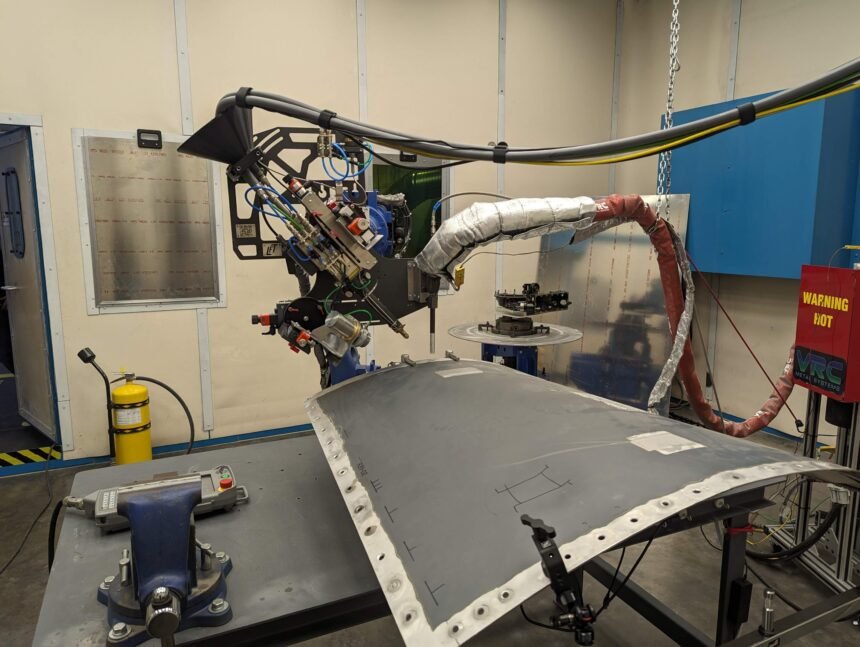
The innovative manufacturing technique known as laser-assisted cold spray (LACS) has been developed by the Center for Industrial Photonics (CIP) at the Institute for Manufacturing (IfM). This revolutionary process involves the localized heating of a supersonic powder stream with a laser to deposit metals and cermets, allowing for the building, coating, or repair of parts. Unlike traditional techniques such as thermal spraying, LACS overcomes high-temperature and material limitations, making it a game-changer in the industry.
The effectiveness of LACS has been demonstrated in aerospace applications, where precision and localized material deposition are crucial. This technique enables the on-demand fabrication of high-quality coatings and component repairs, ultimately extending the lifespan of aircraft. Moreover, LACS is environmentally friendly, reducing material waste and energy consumption compared to conventional methods, thus supporting the industry’s transition towards achieving net-zero emissions.
Additive manufacturing, also known as 3D printing, is a process that builds structures layer by layer, eliminating the need for subtractive methods that involve removing excess material. LACS can create parts from scratch or add coatings and features to existing components, making it ideal for industries such as aerospace, process, energy, and biomedical. This innovative manufacturing method offers numerous advantages, including rapid production of custom, complex parts with minimal material waste, integration of multiple materials for enhanced properties, and greater design flexibility and precision in production.
As of 2023, the United Kingdom holds a 7.6% share of the global additive manufacturing market, with an even smaller share in additive-based coating systems. The global additive manufacturing market is projected to experience significant growth, reaching between $70 billion and $88 billion by 2030. With its numerous benefits and potential for growth, laser-assisted cold spray technology is poised to revolutionize the manufacturing industry and pave the way for a more sustainable future. The anticipated growth in the manufacturing industry underscores substantial opportunities for innovation and development. One area of particular interest is laser-assisted cold spray technology, which is being pioneered by the Institute for Manufacturing (IfM) under the leadership of Professor Bill O’Neill and his team of experts.
Cold spray is a technique that involves fusing powdered metals, cermets, or polymers without melting them, allowing for the building, coating, or repairing of parts. Professor O’Neill and his team initially focused on using nitrogen as a carrier gas for the powder. However, when working with high-strength materials like titanium and aluminum alloys, they found that helium was essential for optimal deposition due to its ability to enable higher particle velocities and improve adhesion to the substrate.
The high cost of helium, at around £80 per minute of operation, posed a significant challenge. Even with state-of-the-art recycling efforts, only around 85% of the helium could be recovered. Additionally, the equipment required for recycling limited the size of parts that could be manufactured.
To overcome these challenges, the team developed a process known as “laser-assisted cold spray” (LACS). LACS involves using a laser to heat the deposition site locally, reducing the substrate yield stress and creating a stronger bond between materials without the need for melting. This innovation has several advantages over traditional cold spray methods.
Firstly, LACS enhances adhesion and deposition efficiency by softening the substrate and improving particle bonding. This results in stronger coatings, particularly for high-strength materials like titanium and refractory metals. Additionally, deposition at a lower particle velocity helps retain the powder’s structure in the coating, making it ideal for materials with specialized properties.
Furthermore, LACS allows for the deposition of harder and more challenging materials that typically have poor adhesion in standard cold spray. This includes cermets, refractory metals, and oxidation-resistant alloys. Lastly, LACS results in reduced residual stresses and porosity in the final product.
Overall, the development of laser-assisted cold spray technology represents a significant advancement in the manufacturing industry, offering new possibilities for innovation and growth. As the industry continues to expand, technologies like LACS will play a crucial role in driving progress and transforming the way we approach manufacturing processes. Laser-assisted cold spray (LACS) technology is revolutionizing the world of manufacturing by offering a range of benefits that traditional thermal spray methods cannot match. One of the key advantages of LACS is its ability to reduce residual stresses within coatings, leading to improved mechanical properties and enhanced structural integrity. Additionally, LACS minimizes porosity, further enhancing the durability of the deposited layer.
Unlike traditional thermal spray methods, LACS has minimal thermal impact on the substrate, keeping it below melting temperature to avoid phase transformations or distortion. This makes LACS ideal for heat-sensitive materials and applications where preserving the base material properties is crucial. The fast processing capabilities of LACS allow coatings to be added at rates of up to 10 kg per hour, making it a highly efficient manufacturing solution.
Furthermore, LACS operates at lower temperatures compared to other thermal spray methods, reducing power consumption and simplifying system design. By creating customized powders, LACS enables fine-tuning of coating properties, introducing specialized characteristics such as magnetism, solid-state lubrication, and enhanced wear resistance. This grading composition also provides local control of properties, reducing stresses at interfaces between dissimilar materials.
The versatility of LACS technology has significant implications for various industries, particularly aerospace. The ability to both build and repair custom parts using LACS offers a sustainable, cost-effective, and efficient solution for high-precision manufacturing requirements. Traditional repair techniques like welding are often unsuitable for high-performance applications, making LACS a game-changer in the aerospace sector.
Overall, LACS technology has the potential to transform manufacturing processes across industries, allowing for the creation of custom parts and efficient repair solutions with low-cost, low-energy consumption, and minimal material waste. With its innovative capabilities, LACS is paving the way for a new generation of advanced manufacturing technology that could significantly contribute to the transition to a more sustainable future.