Summary:
1. Many organizations in Southeast Asia are struggling with AI adoption because they view it as a set of tools rather than a fundamental shift in how business operates.
2. The region’s diverse cultures, income levels, and market sizes make AI implementation more challenging compared to more homogenous regions.
3. Bain & Company emphasizes the importance of focusing on how AI can reshape industries and revenue plans, rather than just seeking cost savings.
Article:
In a recent report by Bain & Company, it was highlighted that many businesses in Southeast Asia are facing obstacles in fully embracing AI technology. The main issue seems to be the mindset of viewing AI as merely a set of tools, rather than a transformative force that can revolutionize the way a business functions. The report, titled “The Southeast Asia CEO’s Guide to AI Transformation,” advises leaders to first consider how AI could reshape their industry and revenue strategies, and then allocate resources to areas where tangible and measurable results are expected.
One of the challenges unique to Southeast Asia is the diverse mix of cultures, income levels, and market sizes. This diversity makes AI adoption more complex compared to regions with more uniform conditions. The report points out that simple efficiency gains may not yield significant returns in this region. Instead, real benefits come from leveraging AI to rethink business operations, accelerate decision-making processes, or boost capacity without expanding the workforce.
Bain’s analysis also highlights that wages in Southeast Asia are approximately 7% of US levels, limiting the potential savings from labor cuts. Moreover, only 40% of the region’s market value is attributed to large firms, in contrast to 60% in India. With fewer major corporations capable of absorbing initial AI implementation costs, leaders are advised to prioritize speed, scalability, and process innovation over cost reduction alone.
Some organizations in the region are already experiencing positive outcomes by aligning their AI initiatives with specific business objectives. For instance, AI is being utilized to streamline product launches, enhance supply chain efficiency, and create new revenue opportunities. By leveraging predictive models to minimize machine downtime, a factory can increase output, while a financial institution can utilize AI for compliance tasks.
Bain’s senior partner, Aadarsh Baijal, emphasizes the importance of understanding how AI influences market dynamics. He believes that many leaders still view AI as a software deployment exercise, rather than a strategic redesign of competitive positioning. By recognizing how AI impacts demand, pricing, operations, and customer requirements, businesses can effectively prioritize their AI efforts.
The report also underscores the significance of addressing data quality, cultural factors, and talent development in AI transformation. While many organizations perceive scaling AI as a recruitment challenge, Bain argues that existing talent within the company can often fulfill AI roles. The key lies in fostering collaboration among teams and empowering staff to effectively utilize AI tools in their daily work.
Successful AI implementation involves two key groups – the “Lab” comprising technical teams responsible for process redesign and tool development, and the “Crowd” consisting of business employees who require AI proficiency for daily operations. For sustainable results, it is essential to integrate small expert groups with broader training initiatives, ensuring that new AI systems seamlessly integrate into existing workflows.
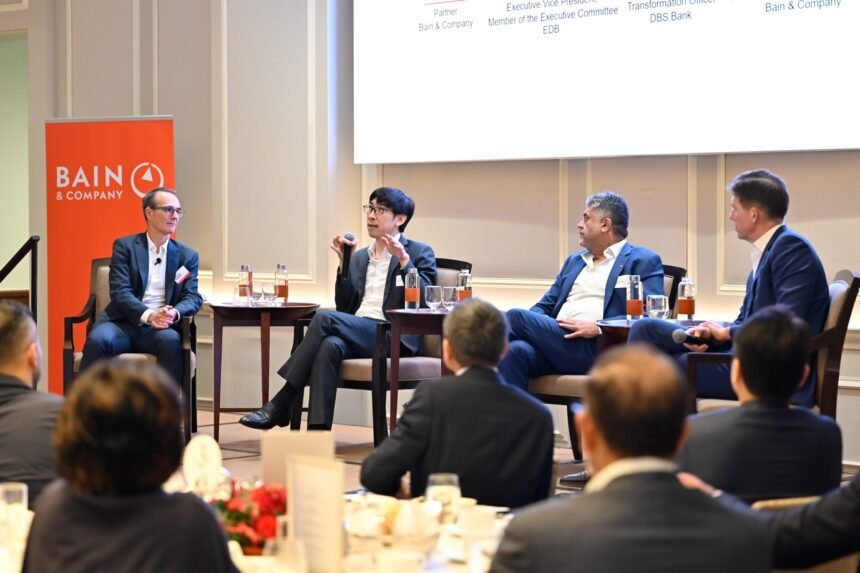
Furthermore, Bain is establishing an AI Innovation Hub in Singapore with support from the Singapore Economic Development Board (EDB). The hub aims to assist companies in transitioning from AI trials to scalable AI systems. It will focus on sectors such as advanced manufacturing, energy, financial services, healthcare, and consumer goods, offering solutions like predictive maintenance for factories, AI-driven regulatory compliance tools, and personalized retail experiences. By enabling firms to develop internal AI capabilities and engineering expertise, the hub seeks to empower businesses to independently manage AI initiatives.
In conclusion, as competition intensifies in Southeast Asia, organizations that view AI as a transformative shift in operational practices, as advocated in Bain’s AI guide, will be better positioned to translate pilot projects into sustainable, long-term outcomes.