

Friday, 8 May 2026
Subscribe
logo logo
  • Global
  • Technology
  • Business
  • AI
  • Cloud
  • Edge Computing
  • Security
  • Investment
  • More
    • Sustainability
    • Colocation
    • Quantum Computing
    • Regulation & Policy
    • Infrastructure
    • Power & Cooling
    • Design
    • Innovations
  • 🔥
  • data
  • revolutionizing
  • Stock
  • Investment
  • Future
  • Secures
  • Growth
  • Top
  • Funding
  • Power
  • Center
  • technology
Font ResizerAa
Silicon FlashSilicon Flash
Search
  • Global
  • Technology
  • Business
  • AI
  • Cloud
  • Edge Computing
  • Security
  • Investment
  • More
    • Sustainability
    • Colocation
    • Quantum Computing
    • Regulation & Policy
    • Infrastructure
    • Power & Cooling
    • Design
    • Innovations
Have an existing account? Sign In
Follow US
© 2022 Foxiz News Network. Ruby Design Company. All Rights Reserved.
Silicon Flash > Blog > Innovations > Customized 3D Printed Foods for Dysphagia Patients
Innovations

Customized 3D Printed Foods for Dysphagia Patients

Published August 22, 2025 By Juwan Chacko
Share
6 Min Read
Customized 3D Printed Foods for Dysphagia Patients
SHARE
In countries with aging populations like Japan, swallowing food can be a difficult task for many individuals. Dysphagia, a condition affecting millions worldwide, can significantly impact one’s quality of life. While texture-modified diets can aid in safe swallowing, customizing these diets to suit individual needs poses a challenge. This article explores a groundbreaking 3D bioprinting method developed by researchers from Kyushu University and Cardiff University to create personalized dysphagia-friendly diets using controlled radiofrequency and microwave energy.


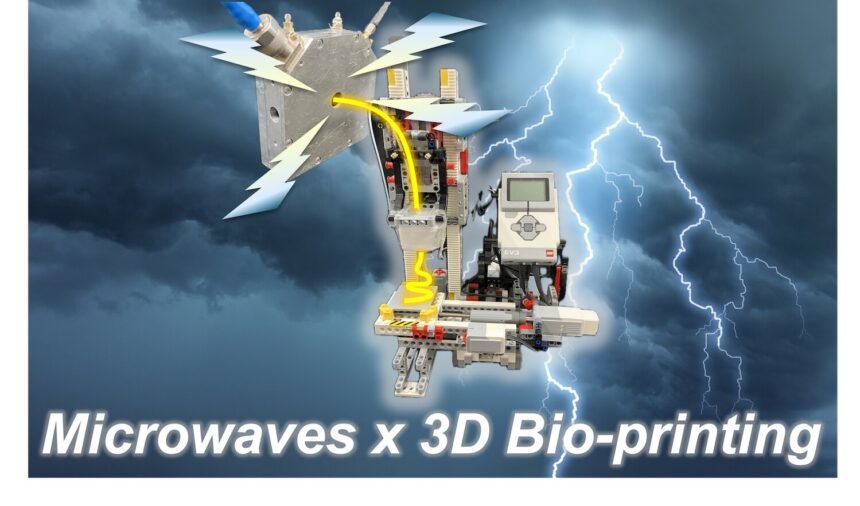
A graphic of the 3D bioprinter powered by Lego Mindstorms EV3 and radiofrequency microwave heating. Credit: Kyushu University/Shuntaro Tsubaki

In rapidly aging societies like Japan, the simple act of swallowing meals can be challenging for many. This condition, known as dysphagia, affects millions of people worldwide and can significantly deteriorate a person’s quality of life. While texture-modified foods like purĂ©es can make swallowing safer, it is difficult to tailor these foods to the wide spectrum of dysphagia, as some individuals can tolerate more solid meals while others require much softer textures.

Publishing in the journal Scientific Reports, research teams from Kyushu University and Cardiff University have developed a new 3D bioprinting method that can customize the texture, adhesiveness, and water retention of protein-based emulsion gels for dysphagia diets using controlled radiofrequency (RF) and microwave (MW) energy.

“For many people with dysphagia, meals are often limited to jelly-like materials, which can diminish the enjoyment of eating,” explains Shuntaro Tsubaki, first author and Associate Professor at Kyushu University’s Faculty of Agriculture. “Our goal is to create meals that are not only safe but also appealing.”

Tsubaki saw an opportunity to apply his expertise in microwave engineering to solve this challenge. “Conventional heating methods heat everything inside indiscriminately—both the parts you want to react and the parts you don’t,” he elaborates. “Microwaves are different. They can be controlled to heat only specific materials selectively. This precision is the key.”

See also  Waymo's Robotaxis Hit Atlanta Streets with Uber Partnership


A research team at Kyushu University, led by Shuntaro Tsubaki, has developed a 3D bioprinting system that creates food for people with swallowing difficulties or dysphagia. An emulsion gel ink made from egg white protein and canola oil is used. By adjusting the radiofrequency heating, the food can be fine-tuned to meet Japan’s standards for dysphagia-friendly diet. Music by: Bensound.com Artist: Benjamin Tissot License Code: F7ADC8QC2W6SRHMJ. Credit: Kyushu University/Javier Alfredo Jr. Morano

The team first developed a bioink that is composed of two main compounds: a stable oil-in-water emulsion and an aqueous solution containing egg white protein and stabilizers. These are then combined with a small amount of magnesium chloride, which acts as a microwave absorption aid, helping the bioink to heat efficiently and promoting the protein denaturation necessary for the liquid to solidify into a gel.

To print this bioink, the team constructed a custom 3D bioprinter using Lego Mindstorms EV3 inspired by previous research from their Cardiff University collaborators.

“After our initial tests proved we could control the gel’s texture with different energy frequencies, we then loaded the bioink into the 3D printer and extruded it through a thin applicator,” explains Tsubaki.

“As the bioink passes through the applicator, we apply a controlled burst of RF or MW energy to it, turning the bioink into a gel. That gel is deposited onto the printing dish layer by layer as the bioprinter nozzle moves across the dish.”

Crafting the future of dysphagia diets with 3D printing
The bioink is rapidly heated at different frequencies as it passes through the applicator. The thermal camera shows the quick rising temperature of the emulsion gel when microwaves are applied. Credit: Kyushu University/Shuntaro Tsubaki

The team’s experiments demonstrated that by simply changing the frequency of the energy applied, they could produce gels with a range of properties suitable for different dysphagia diet requirements.

When they used a lower frequency of 200 MHz, which falls in the radiofrequency range, the resulting gel was significantly harder and held its structure and water content more effectively. In contrast, using a higher frequency of 2.45 GHz, similar to that of a standard kitchen microwave, produced a gel that was much softer and more adhesive.

“The important thing is that we can control the texture by frequency, creating a customized texture for each person’s needs,” concludes Tsubaki.

See also  Revolutionizing 3D Printing: Enhancing Precision with Advanced Modeling Techniques

“Our new method holds potential beyond dysphagia diets—extending to artificial meat, functional nutrition, medical food, and even space rations. We are already working on other edible materials that can be 3D bioprinted. The ability to regulate protein aggregation and even trap flavors inside the oil phase could also lead to flavor-enhanced food-tech products.”

More information:
Shuntaro Tsubaki et al, Radiofrequency and microwave 3D bioprinting of emulsion gel for dysphagia diets, Scientific Reports (2025). DOI: 10.1038/s41598-025-06804-1

Provided by
Kyushu University


Citation:
3D printing method crafts customizable foods for people who have trouble swallowing (2025, August 22)
retrieved 22 August 2025
from https://techxplore.com/news/2025-08-3d-method-crafts-customizable-foods.html

This document is subject to copyright. Apart from any fair dealing for the purpose of private study or research, no
part may be reproduced without the written permission. The content is provided for information purposes only.


TAGGED: Customized, Dysphagia, Foods, Patients, Printed
Share This Article
Facebook LinkedIn Email Copy Link Print
Previous Article The Surge of Energy Fuel Stocks: What’s Driving the Momentum? The Surge of Energy Fuel Stocks: What’s Driving the Momentum?
Next Article Maximizing Cybersecurity with AI: A Guide for Businesses Maximizing Cybersecurity with AI: A Guide for Businesses
Leave a comment

Leave a Reply Cancel reply

Your email address will not be published. Required fields are marked *

Your Trusted Source for Accurate and Timely Updates!

Our commitment to accuracy, impartiality, and delivering breaking news as it happens has earned us the trust of a vast audience. Stay ahead with real-time updates on the latest events, trends.
FacebookLike
LinkedInFollow

Popular Posts

Malaysia Emerges as AI Investment Leader in Southeast Asia with 32% Funding Share

Malaysia has emerged as a dominant destination for AI investment in Southeast Asia, capturing 32%…

November 25, 2025

The Blueprint for Scaling Success: Insights from a Former Tesla President

Few companies have experienced the rapid growth that Tesla has, particularly surrounding the launch of…

July 21, 2025

Abacus Group Expands with Acquisition of Entara

Summary: Abacus Group, a NYC-based IT managed services provider, acquired Entara, a Chicago-based IT MSP…

June 20, 2025

Preventing Data Breaches: Proactive Measures for Security

Data loss prevention (DLP) encompasses both strategic and operational measures to prevent unauthorized data exfiltration,…

September 6, 2025

Biotech Investor Continues to Ride High on Celcuity Stock as it Reaches Record Levels

Summary: Tang Capital Management disclosed a new position in Celcuity Inc. valued at $56.8 million…

December 2, 2025

You Might Also Like

Empowering Innovation: The Role of Design Enablement Teams in the European Chips Act
Innovations

Empowering Innovation: The Role of Design Enablement Teams in the European Chips Act

Juwan Chacko
Secure Access: Biometric Passwordless Login and EU Digital Wallet Protection Platform
Innovations

Secure Access: Biometric Passwordless Login and EU Digital Wallet Protection Platform

Juwan Chacko
The Crucial Role of Intelligent Networks in Europe’s Digital Future
Innovations

The Crucial Role of Intelligent Networks in Europe’s Digital Future

Juwan Chacko
Innovating the Future: EPI’s Revolutionary Approach to High-Performance Computing
Innovations

Innovating the Future: EPI’s Revolutionary Approach to High-Performance Computing

Juwan Chacko
logo logo
Facebook Linkedin Rss

About US

Silicon Flash: Stay informed with the latest Tech News, Innovations, Gadgets, AI, Data Center, and Industry trends from around the world—all in one place.

Top Categories
  • Technology
  • Business
  • Innovations
  • Investments
Usefull Links
  • Home
  • Contact
  • Privacy Policy
  • Terms & Conditions

© 2025 – siliconflash.com – All rights reserved

Welcome Back!

Sign in to your account

Lost your password?