

Sunday, 9 Aug 2026
Subscribe
logo logo
  • Global
  • Technology
  • Business
  • AI
  • Cloud
  • Edge Computing
  • Security
  • Investment
  • More
    • Sustainability
    • Colocation
    • Quantum Computing
    • Regulation & Policy
    • Infrastructure
    • Power & Cooling
    • Design
    • Innovations
  • 🔥
  • data
  • revolutionizing
  • Stock
  • Investment
  • Future
  • Secures
  • Growth
  • Top
  • Funding
  • Power
  • Center
  • technology
Font ResizerAa
Silicon FlashSilicon Flash
Search
  • Global
  • Technology
  • Business
  • AI
  • Cloud
  • Edge Computing
  • Security
  • Investment
  • More
    • Sustainability
    • Colocation
    • Quantum Computing
    • Regulation & Policy
    • Infrastructure
    • Power & Cooling
    • Design
    • Innovations
Have an existing account? Sign In
Follow US
© 2022 Foxiz News Network. Ruby Design Company. All Rights Reserved.
Silicon Flash > Blog > Innovations > Enhancing Wearable Biosensors with Conductive Polymer Technology
Innovations

Enhancing Wearable Biosensors with Conductive Polymer Technology

Published July 7, 2025 By Juwan Chacko
Share
2 Min Read
Enhancing Wearable Biosensors with Conductive Polymer Technology
SHARE

Creating flexible, biocompatible, and electrically conductive materials for wearable biosensors is a challenging task. Researchers at the Max Planck Institute for Polymer Research have developed an innovative method to enhance the properties of the conductive polymer PEDOT:PSS, making it more stretchable and electrically conductive.


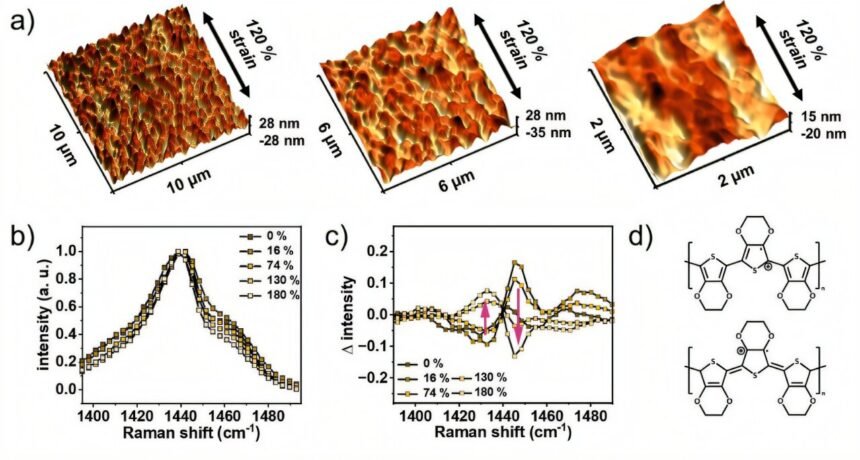
Properties of strained PEDOT:PSS thin films. Credit: Advanced Science (2025). DOI: 10.1002/advs.202502853

When aiming for stretchable, health-monitoring, skin-like sensor sheets, materials with demanding properties are required: they need to be flexible, biocompatible, and electrically conductive at the same time.

A research team at the Max Planck Institute for Polymer Research is tackling this complex task. In a recent study, the scientists present an innovative approach: using a transfer-printing process, the conductive polymer PEDOT:PSS is modified via plasticizers that diffuse from the substrate into the polymer film. This significantly improves both the electrical conductivity and the stretchability of the material.

The research results have been published in the journal Advanced Science.

A deformable patch that measures the heart rate or detects biomarkers in the sweat and feels as soft and flexible as one’s own skin—such visions demand new material developments.

To realize ideas like these, as well as wearable and skin-like electronics in general, materials that possess both high electrical conductivity and mechanical stretchability are required.

A team of scientists at the Max Planck Institute for Polymer Research led by Dr. Ulrike Kraft is currently working on this challenge. However, stretchability and electrical conductivity are often contradictory, which complicates the development of suitable materials, explains Ulrike Kraft, head of the Organic Bioelectronics Research Group.

See also  Enhancing AI Performance: KIOXIA AiSAQ's Latest Vector Search Library Update
TAGGED: Biosensors, Conductive, Enhancing, Polymer, technology, wearable
Share This Article
Facebook LinkedIn Email Copy Link Print
Previous Article Enhancing Edge Inference: Breaking AI’s Storage Barrier Enhancing Edge Inference: Breaking AI’s Storage Barrier
Next Article The Evolution of Data Center Capacity: A Focus on Hyperscalers The Evolution of Data Center Capacity: A Focus on Hyperscalers
Leave a comment

Leave a Reply Cancel reply

Your email address will not be published. Required fields are marked *

Your Trusted Source for Accurate and Timely Updates!

Our commitment to accuracy, impartiality, and delivering breaking news as it happens has earned us the trust of a vast audience. Stay ahead with real-time updates on the latest events, trends.
FacebookLike
LinkedInFollow

Popular Posts

Elon Musk to Establish xAI Innovation Hub in Seattle, Offering Lucrative Engineering Jobs Up to $440k

Exciting news for tech enthusiasts in Seattle as Elon Musk's groundbreaking AI startup is expanding…

September 7, 2025

SoftBank’s Massive $2B Investment in Intel: A Game-Changer for Tech Industry

SoftBank, a prominent Japanese conglomerate, has recently announced a significant $2 billion investment in Intel,…

August 19, 2025

FaZe Clan Faces Uncertainty as Influencers Depart

Six influential figures have recently made the decision to part ways with the renowned esports…

December 27, 2025

Yea or Nay: The Future of Nvidia H200 Chips in China

In a recent development, it has been noted that enterprise customers of Nvidia may not…

January 15, 2026

CasalĂş Secures Funding in Seed Round

Summary: CasalĂą, a Miami-based beverage startup, raised seed funding for its canned sparkling rum. The…

June 29, 2025

You Might Also Like

Empowering Innovation: The Role of Design Enablement Teams in the European Chips Act
Innovations

Empowering Innovation: The Role of Design Enablement Teams in the European Chips Act

Juwan Chacko
Secure Access: Biometric Passwordless Login and EU Digital Wallet Protection Platform
Innovations

Secure Access: Biometric Passwordless Login and EU Digital Wallet Protection Platform

Juwan Chacko
Revolutionizing Storage: IBM Unveils FlashSystem Enhanced with AI Technology
Infrastructure

Revolutionizing Storage: IBM Unveils FlashSystem Enhanced with AI Technology

Juwan Chacko
The Crucial Role of Intelligent Networks in Europe’s Digital Future
Innovations

The Crucial Role of Intelligent Networks in Europe’s Digital Future

Juwan Chacko
logo logo
Facebook Linkedin Rss

About US

Silicon Flash: Stay informed with the latest Tech News, Innovations, Gadgets, AI, Data Center, and Industry trends from around the world—all in one place.

Top Categories
  • Technology
  • Business
  • Innovations
  • Investments
Usefull Links
  • Home
  • Contact
  • Privacy Policy
  • Terms & Conditions

© 2025 – siliconflash.com – All rights reserved

Welcome Back!

Sign in to your account

Lost your password?