Scientists have been striving to enhance the performance of tactile sensors, focusing on sensing range and sensitivity improvements.
Mechanical metamaterials, particularly auxetic mechanical metamaterials (AMMs), are showing great promise. These materials, with a negative Poisson’s ratio, exhibit unique properties like inward contraction and localized strain concentration when compressed. These behaviors make them attractive for developing sensors and actuators with exceptional capabilities.
Despite their potential, current AMM technology faces challenges in fabrication and integration.
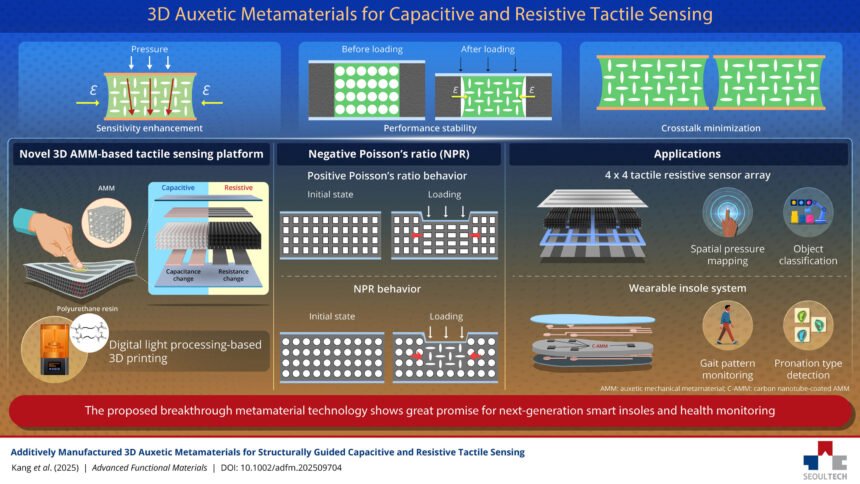
To address these challenges, a group of researchers from the Seoul National University of Science and Technology, led by Mr. Mingyu Kang and Dr. Soonjae Pyo, have introduced a novel 3D AMM-based tactile sensing platform. This platform involves a cubic lattice with spherical voids and is fabricated using digital light processing-based 3D printing.
Their study detailing these findings has been published in the journal Advanced Functional Materials.
The researchers explored the tactile sensing platform, utilizing 3D-printed auxetic metamaterials in capacitive and piezoresistive sensing modes. In the capacitive mode, the sensor responds to pressure through electrode spacing and dielectric distribution modulation, while in the piezoresistive mode, it leverages a network of carbon nanotubes that change resistance under load.
“The unique negative Poisson’s ratio behavior utilized by our technology induces inward contraction under compression, concentrating strain in the sensing region and enhancing sensitivity,” mentioned Mr. Kang.
“Our auxetic design enhances sensor performance through sensitivity improvement, stability in confined structures, and crosstalk minimization between sensing units,” he added.
The team demonstrated two proof-of-concept scenarios to showcase the innovative aspects of their work: a tactile array for spatial pressure mapping and object classification, and a wearable insole system for gait pattern monitoring and pronation type detection.
Dr. Pyo emphasized that “The proposed sensor platform can find applications in smart insoles for gait monitoring, robotic hands for precise object manipulation, and wearable health monitoring systems, offering comfortable sensing without disrupting daily activities.”
He further explained, “The auxetic structure maintains its sensitivity and stability even in rigid housings like insole layers, where conventional porous lattices tend to lose performance. Its scalability and compatibility with various transduction modes make it suitable for pressure mapping surfaces, rehabilitation devices, and human-robot interaction interfaces requiring high sensitivity and mechanical robustness.”
In the coming years, 3D-printed tactile sensors with auxetic structures could revolutionize wearable electronics, enabling continuous monitoring of human movement, posture, and health metrics with high accuracy. The adaptability and material independence of these sensors could lead to the development of custom-fit, application-specific sensors for personalized medicine, advanced prosthetics, and immersive haptic feedback systems.
As additive manufacturing becomes more accessible, mass-customized tactile interfaces with programmable performance may become standard in consumer products, healthcare, and robotics.
More information:
Mingyu Kang et al, Additively Manufactured 3D Auxetic Metamaterials for Structurally Guided Capacitive and Resistive Tactile Sensing, Advanced Functional Materials (2025). DOI: 10.1002/adfm.202509704
Citation:
3D-printed smart materials boost tactile sensor performance in wearable devices (2025, August 29)
retrieved 29 August 2025
from https://techxplore.com/news/2025-08-3d-smart-materials-boost-tactile.html
This document is subject to copyright. Apart from any fair dealing for the purpose of private study or research, no
part may be reproduced without the written permission. The content is provided for information purposes only.