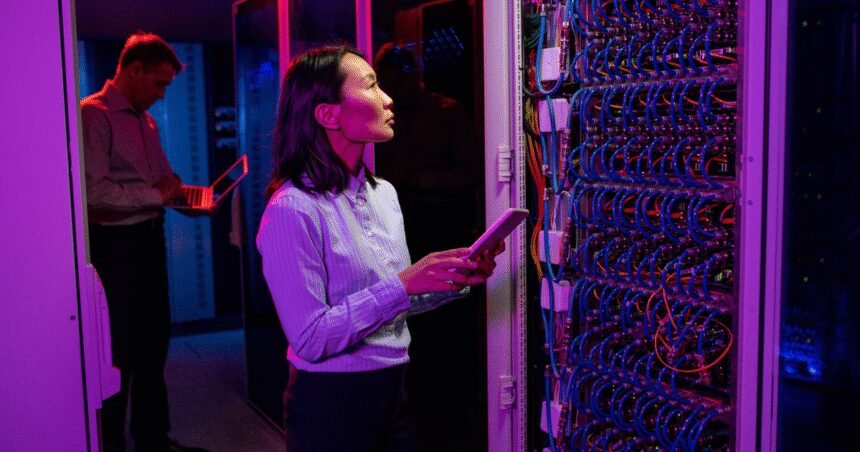
Data Center Technician: Hands-on Problem Solvers
A data center technician is primarily responsible for managing and supporting the physical infrastructure within a data center. Their duties include installing servers, storage, and network equipment, cabling, replacing faulty components, and assisting with equipment decommissioning. Technicians also play a crucial role in monitoring infrastructure health and conducting routine maintenance to ensure system availability and reliability. This role involves hands-on work, often requiring time on the data center floor while adhering to safety protocols.
Technicians typically work within established procedures and utilize tools such as ticketing systems and data center monitoring platforms. They collaborate with engineers during deployments and incident responses, offering initial on-site troubleshooting support.
Data Center Engineer: The Architects of Infrastructure
A data center engineer is primarily focused on designing, planning, and overseeing data center infrastructure. Engineers are responsible for making decisions regarding deployment, equipment layout for airflow and cooling, and system configurations to enhance performance and resilience.
Engineering roles typically fall into either IT engineering or facilities/MEP tracks, depending on the organization’s structure. IT engineering revolves around servers, virtualization, storage, networks, and reliability optimization through capacity modeling and configuration standards. On the other hand, facilities/MEP engineering deals with power distribution, cooling, and building infrastructure, collaborating closely with operations teams and vendors.
Technicians vs. Engineers: Key Similarities and Differences
Both technicians and engineers play vital roles in implementation, operations, capacity planning, and continuous efficiency improvements within a data center. While some organizations use these titles interchangeably, there are specific distinctions that set them apart:
1. Design Authority
Data center engineers are typically involved in planning and designing infrastructure, standards, and configurations, while technicians focus on implementing these designs by installing and configuring hardware according to established plans.
2. Monitoring and Maintenance
Technicians handle hands-on tasks at the component level, such as replacing faulty components or recovering crashed servers, whereas engineers focus on system-level activities like diagnosing complex failures and updating configurations to mitigate risks.
3. Education requirements
Engineering roles typically necessitate a bachelor’s degree or equivalent formal training, emphasizing design and analysis capabilities. In contrast, technician roles prioritize practical experience, precise execution, and comfort with physical tasks, often without specific educational prerequisites.
4. Compensation and Career Growth
Data center engineers typically receive higher compensation than technicians due to their design responsibilities, broader scope, and decision-making authority. Salaries for engineering roles often surpass $100,000 annually, while technician positions usually average around $46,500 per year. The exact figures vary based on location, company type, and experience levels.
Technician roles serve as a stepping stone for individuals aiming to transition into engineering careers. Many professionals start as technicians, gaining hands-on experience before progressing to junior engineering roles. This pathway can lead to senior engineering positions, reliability or architect roles, and leadership opportunities in operations or design.
Which Role Should You Choose?
If you prioritize compensation and system-level design tasks, pursuing a career as a data center engineer is likely the more appealing option. Candidates who enjoy strategic planning, solving complex problems, and developing standards may excel in engineering roles.
On the other hand, if you prefer hands-on work with a tangible impact on system uptime and reliability, technician roles offer a rewarding experience with a lower entry barrier. These roles provide a solid foundation for transitioning into engineering roles in the future.