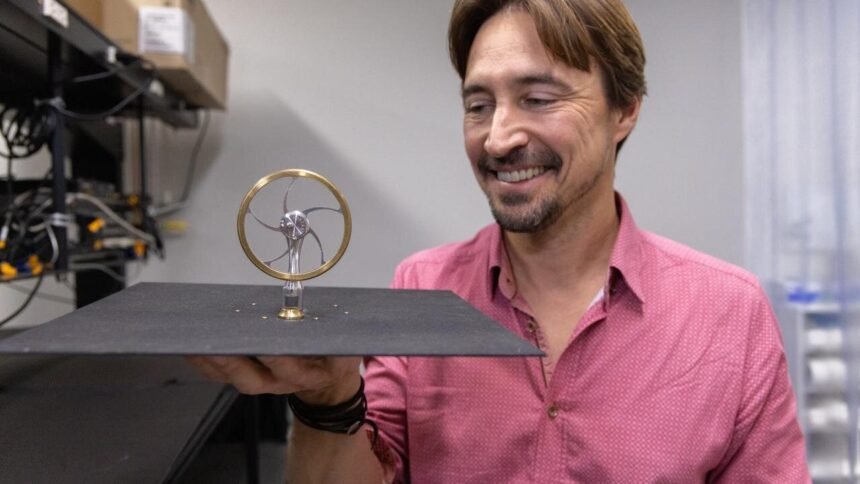
Engineers at the University of California, Davis, have developed a groundbreaking device that harnesses mechanical power at night by utilizing the natural warmth surrounding us and the cold expanse of space. This innovative invention has the potential to be utilized in various applications, such as ventilating greenhouses or other buildings. The research detailing this new device was published on November 12 in Science Advances.
The device in question is a Stirling engine, a type of machine that operates on a small temperature difference. Unlike traditional engines like internal combustion engines that require a significant heat gradient to generate power, the Stirling engine can efficiently work with minor temperature differentials. Professor Jeremy Munday, co-author of the research paper and an expert in electrical and computer engineering at UC Davis, explained that Stirling engines excel in scenarios where only slight temperature differences exist.
Typically, a Stirling engine is connected directly to a heat source on one side and a cooler environment on the other. However, Munday and graduate student researcher Tristan Deppe pondered a unique approach. Instead of heating up one side using conventional methods like burning fuel, they proposed connecting the cold side of the engine to deep space, which is extremely cold yet far away.
Munday elaborated on this concept, stating that the engine doesn’t need to physically touch space; it can interact with space radiatively. By tapping into the temperature differential between Earth’s warmth and the coldness of space, this experimental engine has the potential to revolutionize energy generation and utilization. The device could be a game-changer for sustainable energy solutions, offering a novel way to harness power during nighttime hours. Imagine standing outside on a cold, clear night, feeling the chill in the air as heat escapes from your body. Now, picture harnessing that heat loss to generate power. This concept may seem far-fetched, but researchers Deppe and Munday have found a way to do just that.
Their innovative idea involves using a simple Stirling engine, which consists of a piston driving a flywheel. By placing this engine on a panel that acts as a heat-radiating antenna and positioning it outdoors at night, they are able to utilize the ground as the warm side of the engine and channel the cold of space through the antenna.
After a year of nighttime experiments, the researchers discovered that their small device could generate at least 400 milliwatts of mechanical power per square meter. They successfully used the device to power a fan and even connected it to a small electrical motor to generate current.
The implications of this research are significant. It demonstrates the possibility of generating useful amounts of power from the night sky, particularly in areas with low humidity and clear night skies. This technology could be utilized to ventilate greenhouses or residential buildings, offering a sustainable and eco-friendly energy solution.
UC Davis has recognized the potential of this groundbreaking work and has filed a provisional patent related to it. The research, published in the journal Science Advances, opens up new possibilities for harnessing Earth’s ambient radiation to create power in innovative ways.