The tech giant has pledged to implement this framework in new and expanding markets across the US starting in the first half of 2026.
Power Pricing and Grid Upgrades
Electricity plays a central role in Microsoft’s plan, with a focus on ensuring that data center costs are not unfairly shifted onto residential customers. The company is committed to collaborating with utilities and state regulators to adopt rate structures that accurately reflect the costs associated with serving large data center loads. In regions like Wisconsin, Microsoft supports rate models that directly charge major customers for the necessary infrastructure. The recent implementation of a ratepayer protection plan in New York underscores the broader policy context surrounding this issue.
To meet the growing demand for AI services without overburdening local grids, Microsoft will engage in new generation contracts and fund grid upgrades in line with the expansion of its data center operations. In the Midwest, the company has already secured 7.9 GW of new generation capacity in the MISO wholesale market, doubling its current regional consumption. Additionally, Microsoft will continue to finance the essential transmission and substation upgrades needed to support its facilities, advocating for expedited permitting and interconnection processes for new power projects.
Taxes and Community Investment
Microsoft has made a firm commitment to paying full local property taxes on its data center developments, with the resulting revenue contributing to public services such as schools, hospitals, parks, and libraries. In Quincy, Washington, the company estimates that its data centers generate over $200 million in annual regional economic activity, bolstering tax revenues and supporting public infrastructure.
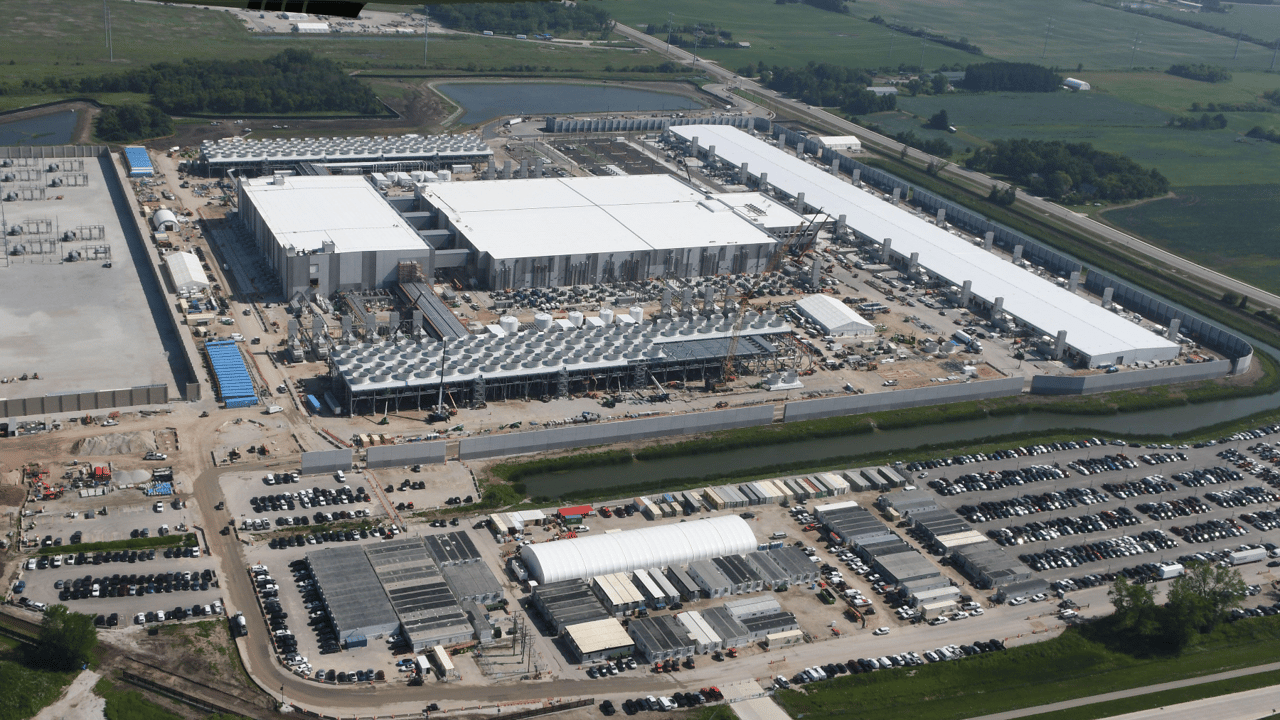
*A Microsoft data center in Quincy, Washington. (Credit: Microsoft)*
Water Use and Environmental Stewardship
Water conservation is a key pillar of Microsoft’s framework, with a focus on reducing water consumption across its data center fleet and replenishing more water than it withdraws from local water districts. The company has set a target to decrease data center water-use intensity by 40% by 2030, with newer facilities adopting closed-loop cooling systems to eliminate the use of potable water. In areas where local water infrastructure is limited, Microsoft will fund system upgrades rather than solely relying on existing municipal capacity. For instance, in Quincy, Washington, Microsoft collaborates with the Quincy Water Reuse Utility to treat and recirculate cooling water, reducing groundwater usage.
Workforce Development and AI Education
Microsoft acknowledges that the construction of new data centers creates numerous job opportunities during the buildout phase and sustains hundreds of permanent roles during operations. The company is committed to enhancing local participation through expanded partnerships, including a new agreement with North America’s Building Trades Unions to strengthen apprenticeship pipelines and the ongoing expansion of the Data Center Academy programs. These initiatives aim to train workers for various roles in operations and facilities management.
The framework also includes initiatives for community investment in AI literacy programs for K-12 schools, community colleges, and libraries, as well as small-business AI training through local chambers of commerce. Microsoft plans to increase nonprofit funding linked to employee volunteerism and donation matching efforts.
Scaling Facilities Within Local Limits
Microsoft’s strategy represents a practical application of mathematical optimization within data center operations and scaling, according to Jerry Yurchisin, a senior data science strategist at Gurobi. Yurchisin highlights the increasing demand for land associated with data centers and emphasizes the importance of considering how these facilities consume resources like energy and water. Large-scale data centers require significant amounts of these resources, underscoring the need for sustainable practices in their development and operation.
Local Decisions, Global Model
Brad Smith emphasizes that the Community-First Infrastructure framework will evolve based on community feedback and serve as a template for future international data center projects, tailored to local conditions. Smith stresses the significance of local decision-making in infrastructure expansion, acknowledging the substantial impact, both positive and negative, that such projects can have on communities. Microsoft is dedicated to embracing a long-term vision and recognizing its responsibility in addressing community challenges associated with infrastructure development.