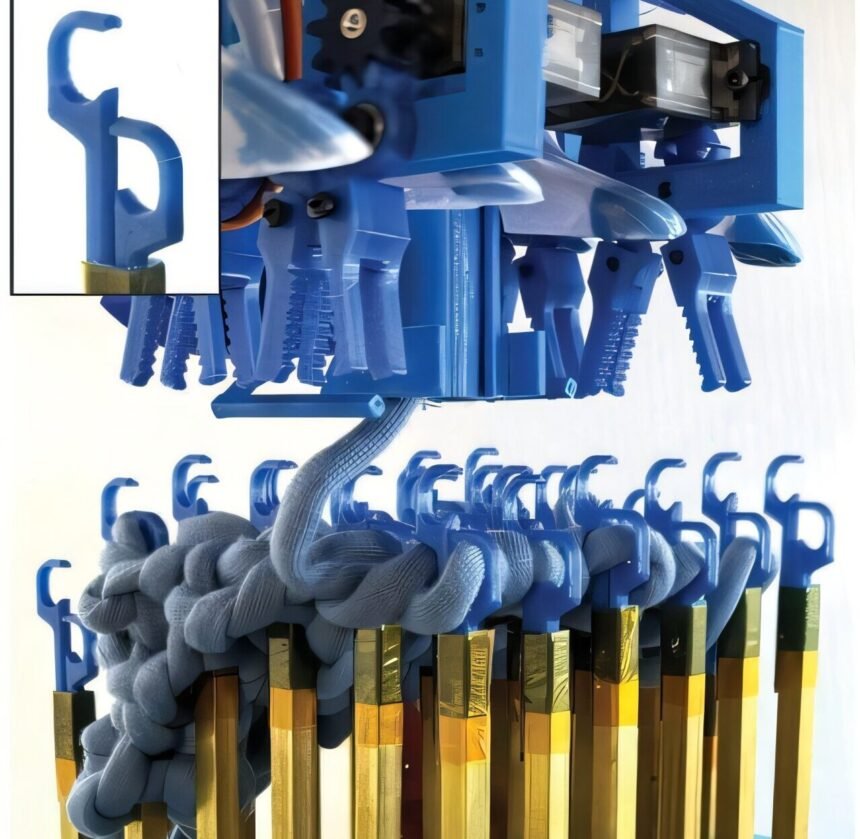
A new prototype of a knitting machine creates solid, knitted shapes, adding stitches in any direction—forward, backward and diagonal—so users can construct a wide variety of shapes and add stiffness to different parts of the object.
Unlike traditional knitting, which yields a 2D sheet of stitches, this proof-of-concept machine—developed by researchers at Cornell University and Carnegie Mellon University—functions more like a 3D printer, building up solid shapes with horizontal layers of stitches.
“We establish that not only can it be done, but because of the way we attach the stitch, it will give us access to a lot of flexibility about how we control the material,” said François Guimbretière, professor of information science at Cornell. “The expressiveness is very similar to a 3D printer.”
Guimbretière and co-author Victor Guimbretière, a student at Cornell Engineering, presented the work, “Using an Array of Needles to Create Solid Knitted Shapes,” at the ACM Symposium on User Interface Software and Technology in Busan, Korea on Sept. 30.
Guimbretière first became interested in solid knitting while tinkering with a knitting machine in the lab of co-author Scott Hudson, professor of human-computer interaction in the School of Computer Science at Carnegie Mellon University, in 2016. A few years later, Guimbretière built the prototype from scratch in his basement during the COVID-19 pandemic, using primarily 3D-printed components.