New resin enables reversible 3D printing
A groundbreaking study published in Advanced Materials Technologies showcases LLNL’s innovative hybrid additive and subtractive manufacturing system. The key component of this system is the patented resin that exhibits dual-wavelength behavior. Under blue light, the resin solidifies, while under ultraviolet light, it reverts back to a liquid state. This unique property allows for corrective manufacturing, enhanced print resolution, and the potential for upcycling and recycling of 3D printed parts.
The resin’s versatility opens up new possibilities for manufacturers, enabling them to modify and refine printed objects without the need for complete reprints. By simply shining a different wavelength on the object, defects can be corrected, making the process more efficient and sustainable.
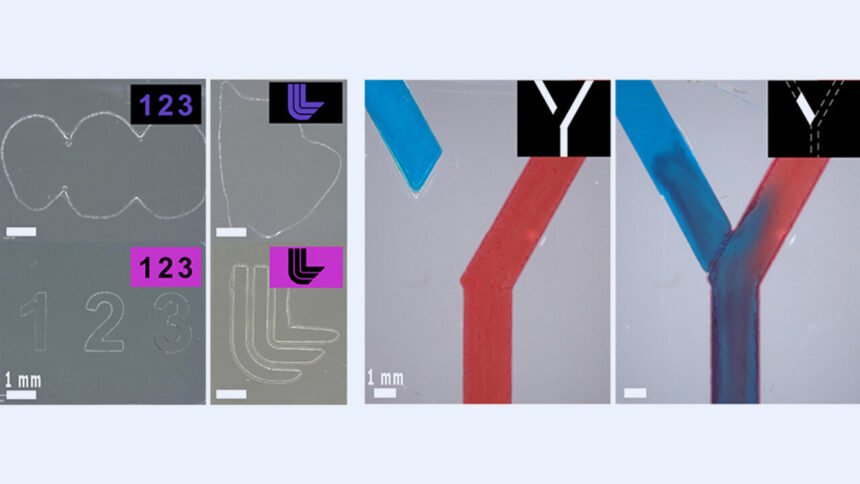
One remarkable demonstration of this technology involved the creation of a fluidic device with separate channels that were later connected using the degradation response of the resin. This ability to make post-printing modifications highlights the transformative nature of this resin in the 3D printing industry.
Commercialization and technical details of the resin
The resin technology developed by LLNL is now available for commercialization through their Innovation and Partnerships Office (IPO). This cutting-edge resin enhances the capabilities of light-based printing systems, allowing for the creation of intricate, detailed parts with higher resolution. Additionally, the resin can smooth surfaces, correct errors, and add or remove temporary support structures, making it a valuable tool for advanced manufacturing companies.
By optimizing the chemistry of the resin, the researchers achieved a delicate balance between stability and degradability. The resin hardens and degrades quickly, providing manufacturers with the flexibility to make changes to printed objects as needed. This technology has the potential to save time and materials costs by enabling editable and recyclable 3D prints.
Looking ahead, the team at LLNL is exploring ways to further enhance this hybrid manufacturing system by integrating on-machine metrology and feedback control. This advancement would enable automatic corrections of print errors in real-time, paving the way for true adaptive manufacturing.
Future directions for adaptive manufacturing
The future of additive manufacturing looks promising with the continued development of this innovative resin technology. By incorporating on-machine metrology and feedback control, the researchers aim to create a seamless and adaptive manufacturing process that can correct errors on-the-fly. This approach not only enhances the efficiency of 3D printing but also opens up new avenues for volumetric additive and subtractive manufacturing techniques.
The team behind this project, led by LLNL scientist Liliana Dongping Terrel-Perez, envisions a future where 3D printing is not only precise and efficient but also highly adaptable to changing design requirements. With a focus on sustainability and innovation, LLNL is at the forefront of revolutionizing the additive manufacturing industry.