

Saturday, 2 May 2026
Subscribe
logo logo
  • Global
  • Technology
  • Business
  • AI
  • Cloud
  • Edge Computing
  • Security
  • Investment
  • More
    • Sustainability
    • Colocation
    • Quantum Computing
    • Regulation & Policy
    • Infrastructure
    • Power & Cooling
    • Design
    • Innovations
  • 🔥
  • data
  • revolutionizing
  • Stock
  • Investment
  • Future
  • Secures
  • Growth
  • Top
  • Funding
  • Power
  • Center
  • technology
Font ResizerAa
Silicon FlashSilicon Flash
Search
  • Global
  • Technology
  • Business
  • AI
  • Cloud
  • Edge Computing
  • Security
  • Investment
  • More
    • Sustainability
    • Colocation
    • Quantum Computing
    • Regulation & Policy
    • Infrastructure
    • Power & Cooling
    • Design
    • Innovations
Have an existing account? Sign In
Follow US
© 2022 Foxiz News Network. Ruby Design Company. All Rights Reserved.
Silicon Flash > Blog > Innovations > Revolutionizing Computing: The Breakthrough of the World’s First 2D Non-Silicon Computer
Innovations

Revolutionizing Computing: The Breakthrough of the World’s First 2D Non-Silicon Computer

Published June 16, 2025 By Juwan Chacko
Share
2 Min Read
Revolutionizing Computing: The Breakthrough of the World’s First 2D Non-Silicon Computer
SHARE
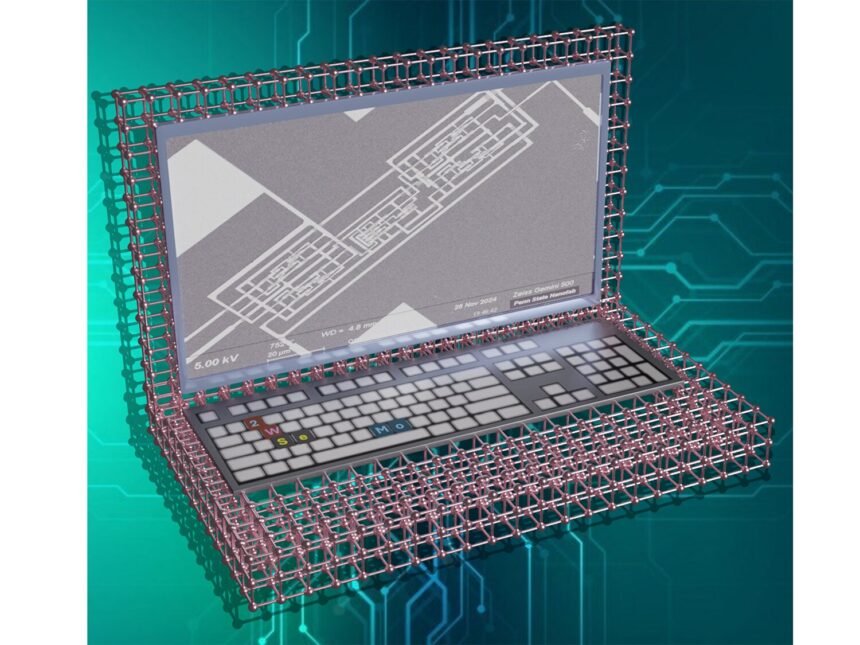
Silicon has long been the go-to material for semiconductor technology, but a groundbreaking development by researchers at Penn State suggests its reign may be challenged. In a pioneering feat, they have utilized ultra-thin two-dimensional (2D) materials to create a computer capable of basic operations, marking a significant advancement in the quest for sleeker, faster, and more energy-efficient electronics.

In a world first, they used two-dimensional (2D) materials, which are only an atom thick and retain their properties at that scale, unlike silicon, to develop a computer capable of simple operations.

The development, published in Nature, represents a major leap toward the realization of thinner, faster and more energy-efficient electronics, the researchers said.

They created a complementary metal-oxide semiconductor (CMOS) computer—technology at the heart of nearly every modern electronic device—without relying on silicon.

Instead, they used two different 2D materials to develop both types of transistors needed to control the electric current flow in CMOS computers: molybdenum disulfide for n-type transistors and tungsten diselenide for p-type transistors.

“Silicon has driven remarkable advances in electronics for decades by enabling continuous miniaturization of field-effect transistors (FETs),” said Saptarshi Das, the Ackley Professor of Engineering and professor of engineering science and mechanics at Penn State, who led the research. FETs control current flow using an electric field, which is produced when a voltage is applied.


See also  Edge Computing Revolution: Efficient Computer and BrightAI Pave the Way for Energy-Efficient AI Processing
TAGGED: breakthrough, Computer, computing, NonSilicon, revolutionizing, worlds
Share This Article
Facebook LinkedIn Email Copy Link Print
Previous Article Meter Secures 0M in Latest Investment Round Meter Secures $170M in Latest Investment Round
Next Article GeekWire’s Top Stories: June 8-14, 2025 GeekWire’s Top Stories: June 8-14, 2025
Leave a comment

Leave a Reply Cancel reply

Your email address will not be published. Required fields are marked *

Your Trusted Source for Accurate and Timely Updates!

Our commitment to accuracy, impartiality, and delivering breaking news as it happens has earned us the trust of a vast audience. Stay ahead with real-time updates on the latest events, trends.
FacebookLike
LinkedInFollow

Popular Posts

Cracking the Code: Unveiling the Hidden Layers of Enterprise AI Orchestration

Summary: 1. Andrej Karpathy created a project called LLM Council where AI models debate and…

November 26, 2025

AI Startup Funding: Bay Area Reigns Supreme with Seattle in Top 5

Seattle has emerged as a top player in the AI startup scene, ranking fourth in…

September 17, 2025

Reunited with Google Pixel 10 Pro XL

Returning to the Pixel 10 Pro XL after a three-month hiatus has left me with…

February 8, 2026

Reviving Investor Confidence: Lululemon’s Founder Sets Sights on Renewed Trust with New CEO Appointment

Lululemon founder and major shareholder Chip Wilson aims to bolster investor confidence in the yoga…

December 29, 2025

Delinea Launches Cloud-Native Security to Support AI

Delinea Enhances Machine and AI Security Capabilities on Cloud-Native Identity Platform In a bid to…

April 26, 2025

You Might Also Like

Revolutionizing Entertainment: OpenAI and Reliance Collaborate to Enhance JioHotstar with AI-Powered Search
Business

Revolutionizing Entertainment: OpenAI and Reliance Collaborate to Enhance JioHotstar with AI-Powered Search

Juwan Chacko
Empowering Innovation: The Role of Design Enablement Teams in the European Chips Act
Innovations

Empowering Innovation: The Role of Design Enablement Teams in the European Chips Act

Juwan Chacko
Revolutionizing Enterprise Treasury Management with AI Advancements
AI

Revolutionizing Enterprise Treasury Management with AI Advancements

Juwan Chacko
Revolutionizing Network Testing with Spirent Luma’s Agentic AI: A Game-Changer in Triage Time Reduction
Global Market

Revolutionizing Network Testing with Spirent Luma’s Agentic AI: A Game-Changer in Triage Time Reduction

Juwan Chacko
logo logo
Facebook Linkedin Rss

About US

Silicon Flash: Stay informed with the latest Tech News, Innovations, Gadgets, AI, Data Center, and Industry trends from around the world—all in one place.

Top Categories
  • Technology
  • Business
  • Innovations
  • Investments
Usefull Links
  • Home
  • Contact
  • Privacy Policy
  • Terms & Conditions

© 2025 – siliconflash.com – All rights reserved

Welcome Back!

Sign in to your account

Lost your password?