Summary:
- Direct-to-chip (DTC) single-phase cooling is currently the dominant direct liquid cooling (DLC) technique due to its ease of use and familiarity in data centers.
- However, immersion cooling, although technically superior with higher heat removal capacity, is still not widely adopted in the market due to high costs, infrastructure requirements, and training challenges.
- As power densities increase and environmental concerns grow, immersion cooling may become the future standard for data center cooling, offering unmatched thermal performance, extreme density potential, energy efficiency, sustainability benefits, and hardware longevity.
Article:
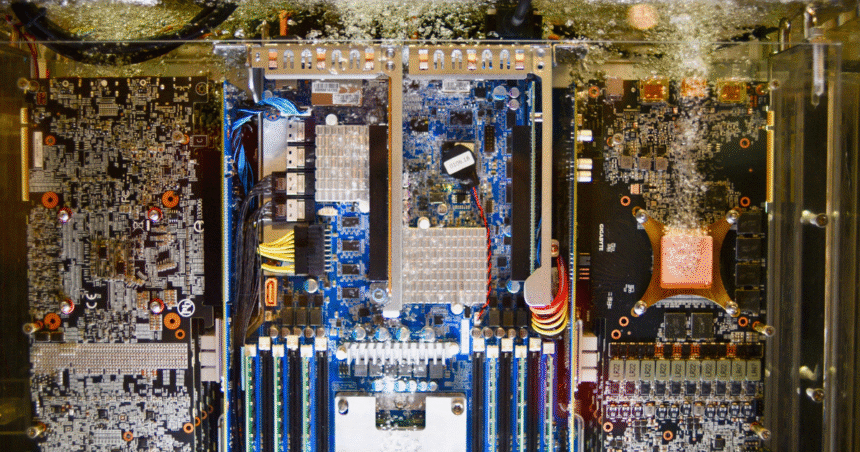
In the realm of data center cooling, the prevailing choice has long been direct-to-chip (DTC) single-phase cooling. This method has gained popularity for its reliability, simplicity, and seamless integration into existing data center infrastructure. It serves as a dependable solution for facilities concerned about operational disruptions and retrofitting issues, making it the preferred choice in the current market landscape.While DTC remains the go-to option for many data centers today, the spotlight is shifting towards immersion cooling as the superior solution for the future. Immersion cooling stands out for its ability to support denser racks, offering higher heat removal capacity by fully submerging servers in dielectric fluids. Although currently more prevalent in specific applications like cryptocurrency mining and high-performance computing, immersion cooling has yet to gain significant traction in mainstream data center setups due to its high initial costs, specialized infrastructure demands, and the need for specialized training.
The future potential of immersion cooling lies in its unmatched thermal performance, extreme density potential, energy efficiency, sustainability benefits, and impact on hardware longevity. By eliminating the need for airflow and enabling higher compute density per square foot, immersion cooling presents a compelling case for revolutionizing data center cooling practices. While both air and immersion cooling are expected to coexist in the industry for the foreseeable future, the trajectory points towards immersion becoming the primary choice as data centers adapt to evolving workload trends, power densities, and sustainability requirements.
As data centers face increasing power costs, rising compute power demands, and environmental challenges, the shift towards immersion cooling may become inevitable. The tipping point for immersion’s widespread adoption will not hinge on sudden appeal but rather on necessity driven by escalating power densities. Operators who embrace immersion early on stand to gain a competitive edge in preparing for the future of data center cooling, where immersion will not only enhance thermal efficiency but also reshape data center architecture and enable the next generation of computational infrastructure.
In conclusion, the future of data center cooling belongs to those willing to embrace immersion before it becomes a necessity. As high-density workloads push the boundaries of existing cooling solutions, early adopters of immersion cooling will be well-positioned to lead the way in developing expertise and leveraging the benefits of this advanced cooling technology. Embracing immersion cooling before reaching the tipping point is not just a bold move; it’s a strategic investment in the future sustainability and efficiency of data center operations.